


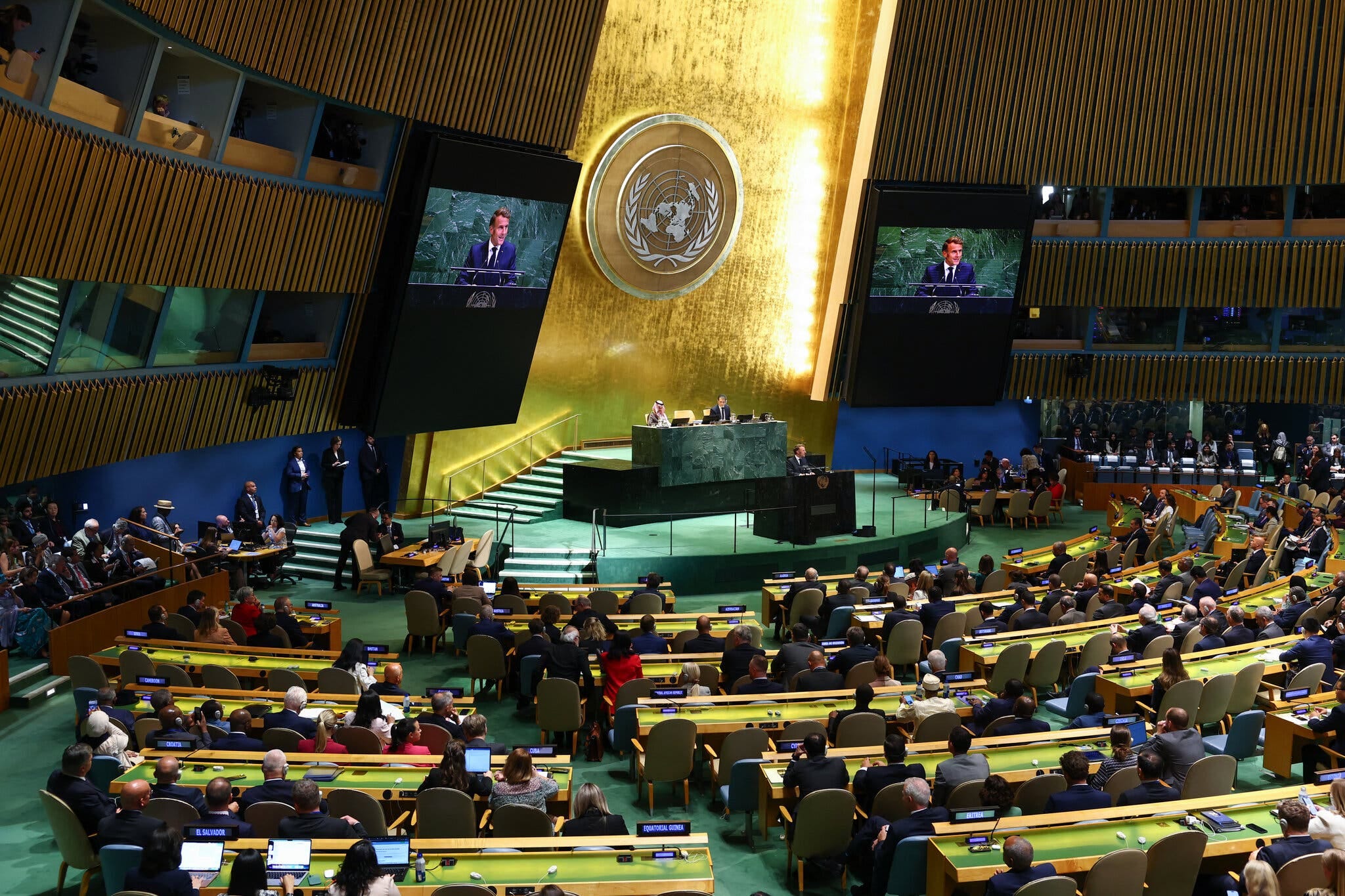
This year, unlike almost any other, has been marked by anniversaries around the globe. Yet the one commemoration that has truly circled the world is the end of the Second World War and the birth of the international system founded on the UN Charter. We have already seen the military parades and the tallying of victims—an encounter with the past and the price of postwar peace. Now, as the UN General Assembly meets and the Day of the Charter (24 October) approaches, the time is less about memory and more about reflection on the present and the future. But how can one celebrate in the midst of horrors that in moments overshadow even Auschwitz or Jasenovac? How can one look forward amid a genocide that, for Israel, has continued for two years with impunity? For countless Palestinian children—killed while waiting for food or while asleep—the future has already been stolen. Palestine will remain an open wound for all of us who still have a conscience.
Debates on the UN often fall into two intellectually lazy extremes: either the UN is dismissed as ineffective, impotent, even obsolete, or it is clung to like a drowning man to a straw. In moments of despair, it is not surprising that anger produces calls for radical “solutions,” such as dismantling what is seen as a decayed mechanism of agencies, institutions, and networks. And yet, alongside failures, the UN has also had achievements. Tearing something down is easy; building something new is incomparably harder—especially in a historical moment like ours. Let us not forget: the UN was founded in the aftermath of a global war, when the longing for peace was nearly universal. Today, as some argue that the world stands on the brink of a new global war, the question is all the more urgent: are there any adults in the room? Is there anyone with reason, wisdom, patience, and vision to launch an initiative for revitalizing the world organization? Ultimately, the UN is not an entity unto itself; it is only what the member states make of it, especially those with disproportionate power in its decision-making bodies. Every success and every failure of the UN reflects, in one way or another, the behavior of its members.
Those who carefully reread the Charter are right to call it the most “Gandhian” document ever written, the most peace-oriented blueprint for world order. Alongside it stand other foundational texts—the Covenants on Civil and Political Rights and on Economic, Social, and Cultural Rights, as well as the many conventions, including the one on genocide. Beneath our very feet lies a trampled vision of peaceful humanity. Like many national constitutions, these texts are beautiful words on paper whose force is barely felt in practice. In an era of empty rhetoric and conceptual distortions, it is crucial to value initiatives that seek to renew global order on the foundations of the Charter.
Here I must briefly turn to the political leadership of my country. President Siljanovska Davkova delivered a pre-recorded video address, in English, before departing for New York—pointlessly, since most of the population would not understand a word. The real aim, however, was transparent: to declare loyalty to Western centers of power. You may say my judgment is harsh, since she spoke of peace, development, human rights, even a social contract with nature. But these were empty phrases at a time when the fate of the world hangs in the balance. The key message was her insistence that the so-called “rules-based order” is under threat. And from what? From the rise of a multipolar system. Strange indeed that a professor of law would deploy political clichés masking the imperial and hegemonic narrative of the West. The “rules-based order” is nothing but a distorted version of international law—one of the constitutional foundations of our own legal system. By using this invented and dangerous term, our president legitimizes the replacement of the Charter with realpolitik and raw power—military power above all. The West and its allies do not seek peace; they despise diplomacy, dismiss negotiations, and close their eyes to breaches of the Genocide Convention (it is ironic that the Houthis, of all actors, seem to apply it most consistently). In short, in Macedonia, nothing new: the sun still rises in the West.
On the other hand, the East offers a profoundly different perspective—modern, yet rooted in fidelity to the principles of the Charter. At the recent Shanghai Cooperation Organization summit, President Xi Jinping once again elaborated his Global Governance Initiative. Its brilliance lies in its careful balance: respect for the foundations of the current order, combined with an insistence on adapting it to changed historical circumstances and to lessons learned over the past 80 years. As Einar Tangen aptly put it, this initiative is the antidote to the failed era of unipolar arrogance. Even the most patient observers now see that enough is enough: concessions to aggressors only lead the world deeper into the abyss. China’s style of communication is unlike the West’s; it is not brutal, but refined, yet clear enough to make evident who is undermining the Charter-based order (as opposed to the “rules-based” order, a distinction of enormous consequence).
At its core, Xi’s vision diagnoses the world order as afflicted by three crises: a crisis of legitimacy (it no longer reflects today’s global distribution of power and actors), a crisis of effectiveness (institutions are paralyzed), and a crisis of vision (a choice between hegemony and catastrophe). Against this, Xi argues that there is a real, viable, and just alternative: cooperative and orderly multipolarity. This model rejects the logic of “winners and losers” and instead embraces “win-win cooperation” and “a community with a shared future.” Justice, he insists, is not rhetorical—it is measurable. Tangen underscores the key metrics: sovereign equality grounded in broad consultation rather than imposition by the strong; revitalized multilateralism through reform rather than abandonment of institutions like the UN; and, most importantly, people-centered outcomes—justice measured through improved lives. China itself has provided proof through poverty elimination, human development, and collective emancipation.
Skeptics may dismiss such proposals as impossible. We know well who will try to block any change to the status quo through military interventions, economic warfare, or engineered political upheavals. But the world can no longer afford the luxury of “business as usual.” Those who oppose a just world must be confronted openly. The Global Majority—seeking a wise and gentle exit from crisis—must act upon its numerical strength. And we, as active citizens, cannot leave states and institutions to act alone. We must push from below. We must act as midwives to a new world order; or else we may not live to see one at all.
