


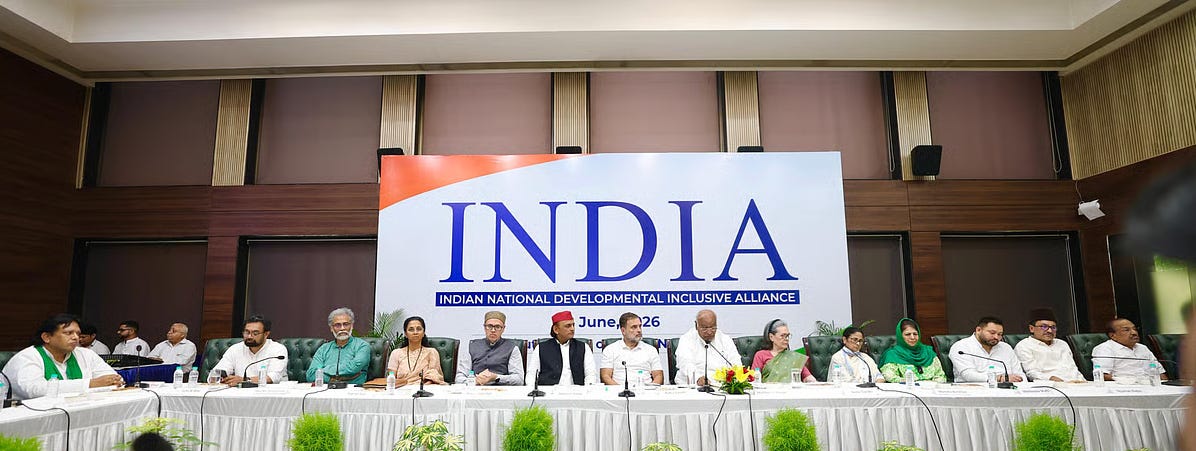
It is a good augury for the Republic that the INDIA opposition bloc, with as many as 23 parties in attendance, has regrouped and agreed on a five-point agenda of action to begin with.
Among the notable absentees have been the Dravida Munnetra Kazhagam (DMK) and the Aam Aadmi Party (AAP).
One dares speculate that the DMK, which is currently in a lover’s quarrel with the Congress for the latter having deserted it to go over to the new successful kid on the block, will think many times before ever aligning with the right-wing, Brahminical Bharatiya Janata Party (BJP) if the union government should ever confront such a choice.
As to the AAP, its political ambitions clearly stretch beyond any state-level successes, and thus, viewing the Congress as its natural adversary, it is unlikely to change its mind.
Then there is the ultra-new Cockroach Janata Party (CJP), around which speculations are rife – a dime a dozen.
And not without cause: how is it, it is asked, that permission to demonstrate in large numbers for a whole day at Jantar Mantar was granted to it when hardly any oppressed group of citizens, be they farmers or any others, are almost never so allowed to gather there? Or why, while demonstrations mounted by the Indian Youth Congress and the National Students’ Union of India in city after city are routinely lathicharged and water-cannoned, etc., did the CJP event face no such strong-arm measures?
Be that as it may, a reliable read of this new breathtaking occurrence may for now come directly from the founder of the CJP as recorded in an elaborate conversation with Frontline, rather than from the many secondary interpretations that now populate social media, etc.
Abhijeet Dipke comes across as a truthful and earnest young political aspirant who seeks to lead the millions who have suddenly jumped on to his call to forge a new governance model that caters conscientiously to the problems of India’s Generation Z.
In the cited interaction, he speaks of the “big lies” of the BJP (to note, the BJP party president has openly castigated the CJP as a fifth column charged with causing mayhem in the country) and mentions Gandhi, Ambedkar and Nehru as his guides to collective political action – Gandhi for having been the “greatest freedom fighter”; Ambedkar for having made it possible for the likes of him to go to Boston and his father to be an engineer; and most instructively, Nehru for having resisted the impulse to become an autocratic ruler of what could have been an authoritarian state and for having furnished the intellectual and institutional wherewithal of a secular, democratic state.
He describes his ideology as ‘socialist’ and also says that the CJP will not be amenable to any existing political outfits to align with it.
Dipke has issued a call to the Modi government to ask the education minister to resign within a week from June 6, failing which a call will go up from him for an all-India protest.
It might suffice for now to say that fingers should be crossed for the outcome of the course that the CJP founder has set out before making any very definitive prognostications about the fortunes of the new youth movement and about its equation with the INDIA bloc or not.
Any thought of aligning with the BJP may not but make nonsense of what we hear Dipke say in the above interview, although what shenanigans the ruling BJP might employ to co-opt or crush the CJP must remain a live curiosity.
It is encouraging that the INDIA bloc has decided to meet and confer every two months.
The all-important conundrum that will confront its confabulations will inevitably be this: what should be the modus vivendi between state-level parties and the Congress?
This conundrum may have been somewhat simplified by the losses suffered by the DMK, the RJD and the TMC in their respective spheres of clout. explaining why Mamata Banerjee not only attended the conclave but also seemed suddenly to be one of its most zealous advocates.
Has it been understood that the politics of the bloc at the level of the union government must now anchor itself around the Congress, with Rahul Gandhi as the accepted leader?
If that be so, a merger of factions that once were part of the Congress back into the parent party may seem a desirable move, strengthening the grand old party in its onwards struggles to dislodge the ruling BJP.
If, however, no such clarity still obtains within the INDIA bloc, a self-defeating internecine contention among aspirants may indeed ensue and kill the prospect of alternative politics at the Union level.
As to the forthcoming state elections, two courses offer themselves: one, that secular/democratic forces coalesce to ensure that the BJP is defeated; or two, that local strong satraps desire to achieve exclusive sway, risking the loss of power yet again in state assemblies.
These parties would have noted that in the new electoral climate of the republic, a win or a loss tends to happen in short measures, and any substantial divisions of votes cannot help but make the losses more probable.
The time for dubiously articulated half-measures of compromised ideologies is quite past.
As to what the Bloc may now do vis-à-vis recapturing power at the Union level, the time for dubiously articulated half-measures of compromised ideologies is quite past.
That Rahul Gandhi has been articulating this reality in recent months may inspire others to join forces so that a convincing assault is mounted on culturally revanchist, economically brutal and administratively corrupted ways of governing the nation.
Most crucially, the INDIA bloc may, much sooner than later, begin to hit the streets, not once or twice but regularly, to carry its analyses and convictions to the masses of citizens and thereby also test what sort of resolve or modus operandi the Modi government adopts to meet the democratic challenge.
Many have commented that with the CJP, especially now on the streets, a redux of the 1974 popular movement that brought the present dispensation to the possibility of power may indeed be in the offing.
As to the agenda, millions of voters now seem willing to go over to the old practice of voting by ballot – one that scores of developed countries in the West did after their unhappy trek with the notorious EVM.
Should this not be a prime demand of the INDIA bloc as it sets out in the coming months to expand and consolidate its charter, both for the powers that be and for “we, the people”?
This much may safely be said – it may not be so smooth a proposition for the current dispensation to carry on with business as usual.
