


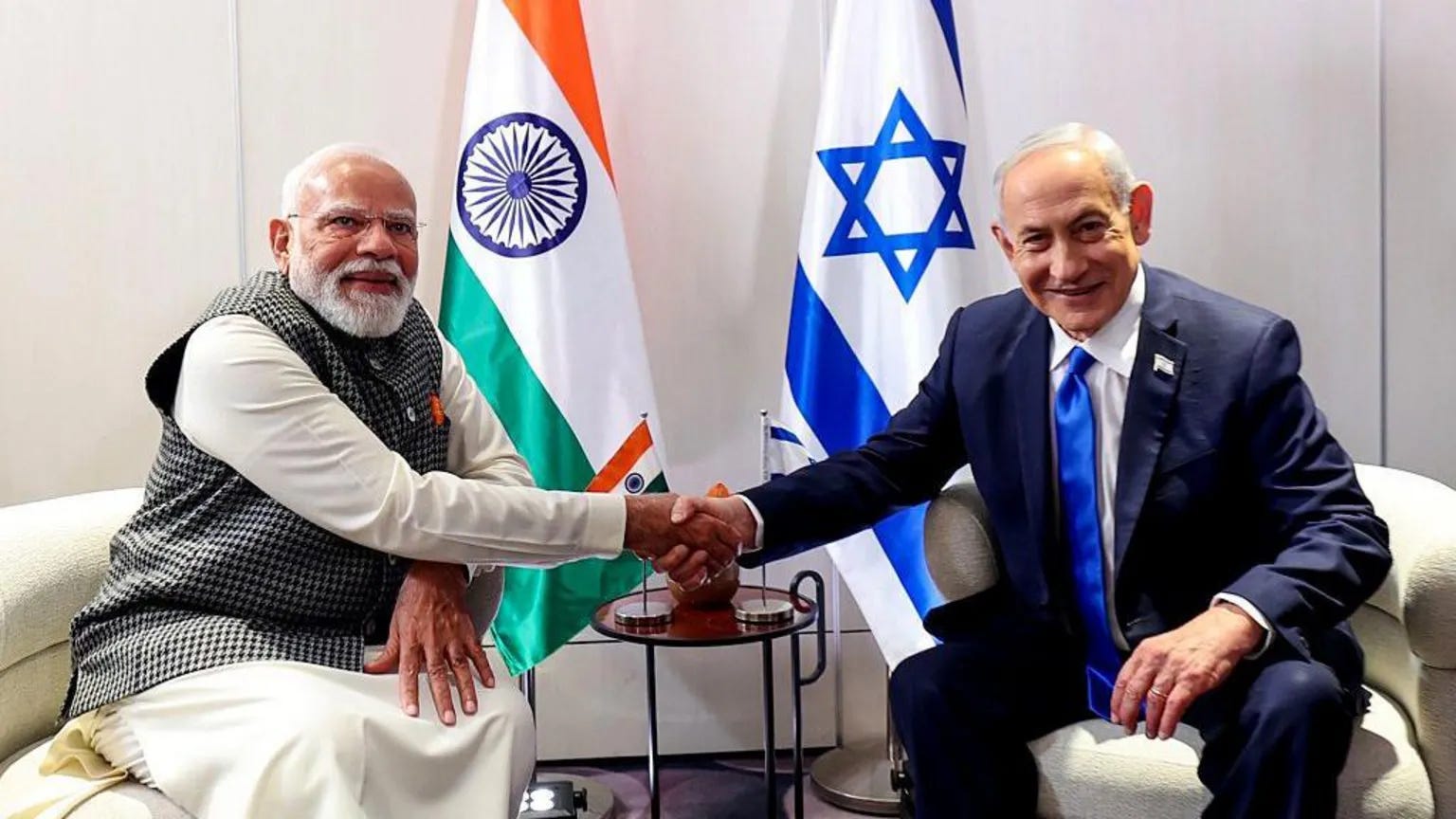
Modi’s visit to Israel distilled India’s new posture into a single tableau: a warm embrace of Prime Minister Benjamin Netanyahu, a deliberate silence on Gaza’s devastation, and a slate of defence-focused engagements that underscored how sharply New Delhi’s strategic compass has turned. As reported by Al Jazeera, the trip marked a consolidation of India–Israel military cooperation at the very moment Gaza’s humanitarian collapse is testing the moral and geopolitical foundations of India’s global partnerships.
In the long, anguished months of war in Gaza, the world has watched a strip of land barely 365 square kilometres in size reduced to ruins. Entire neighbourhoods have been flattened. By mid-2025, United Nations agencies estimated that more than 71,000 Palestinians had been killed, the majority women and children, and over 60 per cent of homes damaged or destroyed. Hospitals have collapsed under bombardment and blockade. Famine warnings have echoed through Security Council chambers.
The UN Commission of Inquiry concluded that Israel’s conduct amounted to acts consistent with genocide under international law, citing patterns of mass civilian death, starvation and the systematic destruction of life-sustaining infrastructure. The language is legal. The suffering is human.
Against this devastation, a striking geopolitical realignment has taken shape. India—once a standard-bearer of the Non-Aligned Movement and an early champion of Palestinian statehood—has drawn closer than ever to Israel. The transformation has been swift and unapologetic. New Delhi abstained on United Nations resolutions calling for an immediate humanitarian truce in Gaza, a move widely interpreted as shielding Israel from diplomatic isolation. For many in the Global South, the abstention signalled not neutrality but a recalibration of moral priorities.
The numbers tell part of the story. According to data cited by SIPRI and Indian media, India accounted for 34 per cent of Israel’s arms exports between 2020 and 2024, making it Israel’s largest defence customer. Israel supplied 13 per cent of India’s total arms imports during the same period. Multi-billion-dollar missile defence systems, surveillance platforms and drone technologies have woven the two militaries into an intricate partnership. Investigations by Al Jazeera and The Wire have reported Indian companies exporting rocket propellants and components during the Gaza war. Even as images of pulverised apartment blocks circled the globe, the machinery of defence commerce continued to hum.
This is not merely a transactional alignment. It is animated by a deeper ideological resonance. Hindu nationalism and Zionism, though born of distinct histories, share a vocabulary of civilisational resurgence and existential threat. Analysts observed that both governments frame their policies as necessary correctives to historical humiliation. Security is invoked not simply as policy but as identity. The state becomes custodian of a majority faith, and dissent is often recast as disloyalty.
In India, the revocation of Article 370 in August 2019 stripped Jammu and Kashmir of its constitutional autonomy, placing nearly eight million residents under prolonged lockdown and communications blackout. The Harvard Law Review has argued that subsequent domicile changes enabling non-residents to purchase land risk altering the region’s demographic character.
Human Rights Watch has documented communal violence and property demolitions affecting Muslim communities, particularly following the inauguration of the Ram Temple in Ayodhya in January 2024—an event laden with symbolism three decades after the Babri Mosque’s destruction triggered riots that killed more than 2,000 people. For critics, the parallels with Israeli policies in the occupied Palestinian territories are unsettlingly direct.
Yet Gaza is not an abstraction for ideological comparison. It is a humanitarian emergency that has shaken the credibility of the international system. More than 150 countries have supported calls for a ceasefire and unimpeded humanitarian access. The International Court of Justice has ordered provisional measures aimed at protecting civilians and preventing further harm. Aid agencies warn that reconstruction costs could reach tens of billions of dollars, even as basic water and electricity networks lie in shards.
The Middle East’s economic integration—from proposed trade corridors linking India to Europe via the Gulf to energy cooperation schemes—risks becoming collateral damage in a region destabilised by perpetual war.
India’s repositioning reverberates far beyond West Asia, sending quiet shockwaves through the Asia-Pacific—from ASEAN capitals to Canberra’s strategic corridors. As a pivotal force in the Indo-Pacific architecture and a member of the Quad, India has become central to the region’s security imagination: a democratic heavyweight, a maritime partner, a counterbalance in unsettled waters. Across Southeast Asia and Australia alike, trade volumes are rising, joint naval exercises multiplying, supply chains intertwining through critical minerals, digital economies and clean energy transitions. Yet strategy without principle is a fragile edifice.
For ASEAN—founded on stability, sovereignty and regional equilibrium—and for Australia, which has long championed a rules-based order and the authority of international law, values cannot be ornamental flourishes appended to communiqués. They are the steel within the structure. Pluralism at home and adherence to humanitarian norms abroad cannot be selectively invoked when convenient and quietly shelved when uncomfortable. The Indo-Pacific’s credibility as a region committed to law over force, dialogue over domination, depends on moral coherence.
If the Asia-Pacific seeks to shape a century defined by resilience rather than rupture, it must ensure that its strategic partnerships are anchored not only in shared interests but in shared conscience.
The dilemma is delicate. A strategic partnership with India is vital. Yet silence in the face of alleged atrocity corrodes moral authority. The Australian Parliament’s research service has underscored the importance of integrating democratic principles into bilateral engagement. Mechanisms such as Magnitsky-style sanctions legislation, strengthened export controls, and transparent human rights dialogues exist not to punish partners reflexively, but to ensure consistency between rhetoric and reality.
For global policymakers, the deeper question is what kind of international order is being built. If the devastation of Gaza becomes normalised—if collective punishment and demographic engineering are treated as regrettable but tolerable tools of statecraft—the precedent will echo far beyond the Mediterranean. Fragile societies from Lebanon to the Red Sea littoral have already felt the tremors. Shipping routes have been disrupted, regional militias emboldened, and sectarian tensions inflamed. Humiliation is a potent accelerant.
There remains, however, a possibility of recalibration. India’s historical legacy as a bridge between worlds need not be eclipsed by majoritarian politics. Israel’s own democratic institutions, however strained, retain voices calling for accountability and negotiated peace. The Arab states, many of which have pursued cautious normalisation with Israel, recognise that economic modernisation cannot coexist indefinitely with images of mass civilian suffering. A durable ceasefire, meaningful humanitarian access and a credible pathway to Palestinian statehood—alongside ironclad security guarantees for Israel—are not utopian aspirations. They are strategic necessities.
Across the Asia-Pacific and among principled nations that still speak the language of a rules-based order, there exists both the capacity and the responsibility to act with quiet resolve. Strategic engagement with India can deepen across trade corridors, digital innovation, climate transitions and maritime security in the Indo-Pacific, yet such engagement must be anchored in an unambiguous affirmation that international humanitarian law is universal, not selective.
Dialogue with Israel can recognise legitimate security anxieties born of history and geography, while holding firm to the simple moral truth that the protection of civilians is not a diplomatic accessory but a legal and ethical obligation. Economic visions linking the Middle East to South and Southeast Asia—from energy grids to shipping lanes and technology corridors—can be reshaped to privilege reconstruction, schools, hospitals, water systems and renewable infrastructure over the relentless circulation of missiles and munitions.
The Asia-Pacific, home to more than half the world’s population and the engine room of global growth, cannot afford a Middle East locked in perpetual conflagration; nor can it accept a precedent in which devastation is normalised and accountability deferred. A steadier chorus of nations—from Tokyo to Jakarta, from Seoul to Wellington, from Brussels to Pretoria—can insist that prosperity without justice is brittle, and that security without humanity is unsustainable. In this fragile century, moral consistency is not naïveté; it is strategic foresight.
The grief of Gaza has unsettled consciences across continents. Children pulled from concrete dust, doctors operating without anaesthetic, families queuing for water—these are not statistics but indictments of a system that too often confuses power with principle. The future of the Middle East will not be secured through arms transfers or abstentions in distant chambers. It will be forged through dignity, reconstruction and political courage.
History is not static. Nations choose their trajectories. The question facing India, Israel and their partners is whether alignment will be defined by shared democratic ideals or by shared impunity. For a region weary of funerals and fractured promises, the choice carries generational weight. A better future for Gaza—and for the Middle East at large—depends on rediscovering the conviction that security and justice are not rivals but twins.
Without both, peace is a mirage shimmering above the rubble. As India and Israel draw closer in the shadow of Gaza’s ruins, the world is left to decide whether this alignment will be remembered as a stand for shared security or a surrender to shared impunity.
