


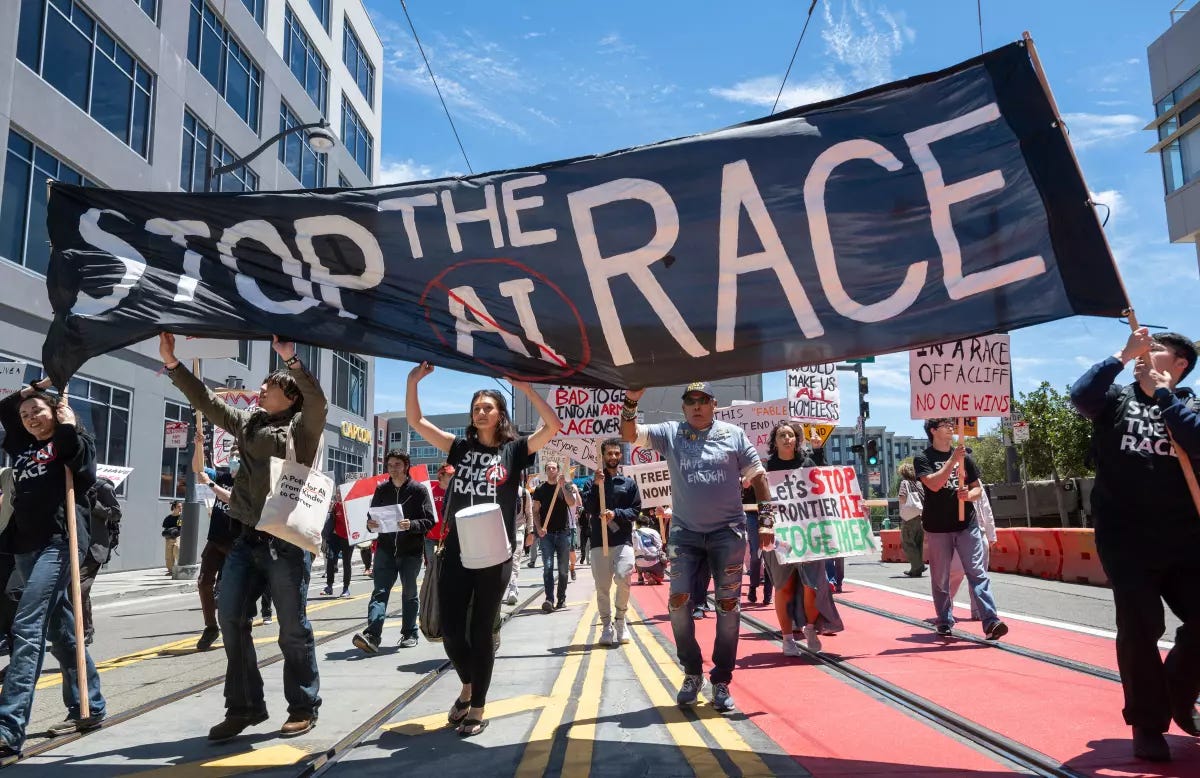
Let’s start from an uncomfortable premise: AI is going to happen. Not because it is good, or wanted, or well governed, but because there is currently no credible resistance to the capital building it. Governments are competing to host it and pension funds are invested in it. The opposition is real, but it is small, scattered and mostly aesthetic. Whatever you think of the technology, betting on it being stopped is not a strategy.
If that is the starting point, the interesting question is not whether AI arrives: it is who ends up owning what it produces (assuming, of course, that it does indeed produce what is promised).
The mood turns
The public is not enthusiastic and is becoming less so. The 2026 Bentley-Gallup research found that 39% of Americans now think AI does more harm than good, up from 31% a year earlier, against a threadbare 9% who think the reverse. Nearly eight in ten expect it to reduce the number of jobs over the next decade. Among 18 to 29 year olds, the share with no trust at all in businesses to use AI responsibly has risen from 29% to 41%.
That is not a technology problem. It is a legitimacy problem, and legitimacy problems are political.
The corporate story changes
The industry has noticed. Barely a year ago its leaders were briefing the apocalypse. In May 2025 Dario Amodei warned that AI could wipe out half of all entry-level white-collar jobs and push unemployment to 10 to 20%, and that everyone else was sugar-coating it. It was framed as honesty.
Now the same voices have done an about-face. In May 2026, Amodei, sharing a stage with Jamie Dimon, reached instead for the Jevons paradox, the comforting idea that automating most of a job simply expands what is left of it. Sam Altman has declared that the purpose of AI is not to take people’s jobs and called AI chief executives tone-deaf for saying otherwise. This has been described as the “jobocalypse messaging swerve.” The new line, more or less and suspiciously in unison, is that you are not being replaced, you are being augmented: in other words, “nothing to see here!.”
The data did not change. One study shows that US employers alone cut 101,743 jobs in the first half of 2026, directly citing AI as the reason (approximately 23% of all cuts): the number could be much higher when AI is hidden among other explanations. What changed is that the polling got ugly. Read the reassurance as Big Tech anxiety, not confidence.
Two outcomes emerge
There are really only two ways this ends.
The first is the one anti-AI activists fear, and they are not wrong to fear it. Ownership of the technology, the compute and the data consolidates in very few hands, the state becomes a customer rather than a regulator, and ordinary people absorb disruption without historical precedent. That road leads somewhere authoritarian and produces a bloody resistance to match.
The second is barely discussed, because it sounds hopelessly naive. What if everyone actually got a share of all that newly accrued value?
The meaning of shared value
Notice that the elites have started saying this themselves. In May 2026 Gavin Newsom signed an executive order directing California to explore severance standards, worker ownership models and what he calls universal basic capital, on the logic that people do not need charity, they need ownership. Bernie Sanders has proposed an AI tax and a requirement that businesses give workers a real stake. Interest has been reported in variants of the idea from figures as unalike as Sanders, Newsom, Steve Bannon, Sam Altman and Donald Trump.
The words are shared, the meaning is not. At one end of the spectrum, sharing value means a productivity bonus in the December payslip and a press release. At the other, it means transferring the returns on automated labour to the people whose labour it replaced, held as assets rather than handouts: in short, genuine wealth redistribution.
The second version is worth taking seriously, because it describes something that has repeatedly eluded reformers. Every previous attempt at redistribution had to argue for taking something from someone. This one arrives with a surplus attached and a plausible claim that the surplus was built on all of us, our work, our writing, our data. If AI delivers the value its backers promise, it is the most credible vehicle for economic justice to appear in decades, if not centuries.
Power must be taken
None of this happens on its own. There is no government on Earth currently willing to face down the AI barons and compel the entire downstream economy to do the right thing, and there is no reason to expect any existing administration to volunteer any time soon. The existing political class—whether left or right—is bought and paid for.
The political vehicle for a redemptive AI transition does not exist yet. It will not be centrist, because the centre is invested. It will not be recognisably left or right, because that binary is already dissolving on this issue, which is precisely why Bannon and Sanders can arrive at the same policy from opposite directions. It will be built by whoever is willing to go and win power on the promise that the gains get shared, and then actually do it with a merciless message to AI barons of FAFO: it will be won by AI populism.
Unlikely, obviously. But it is the only version of this story in which ordinary people come out ahead.
