


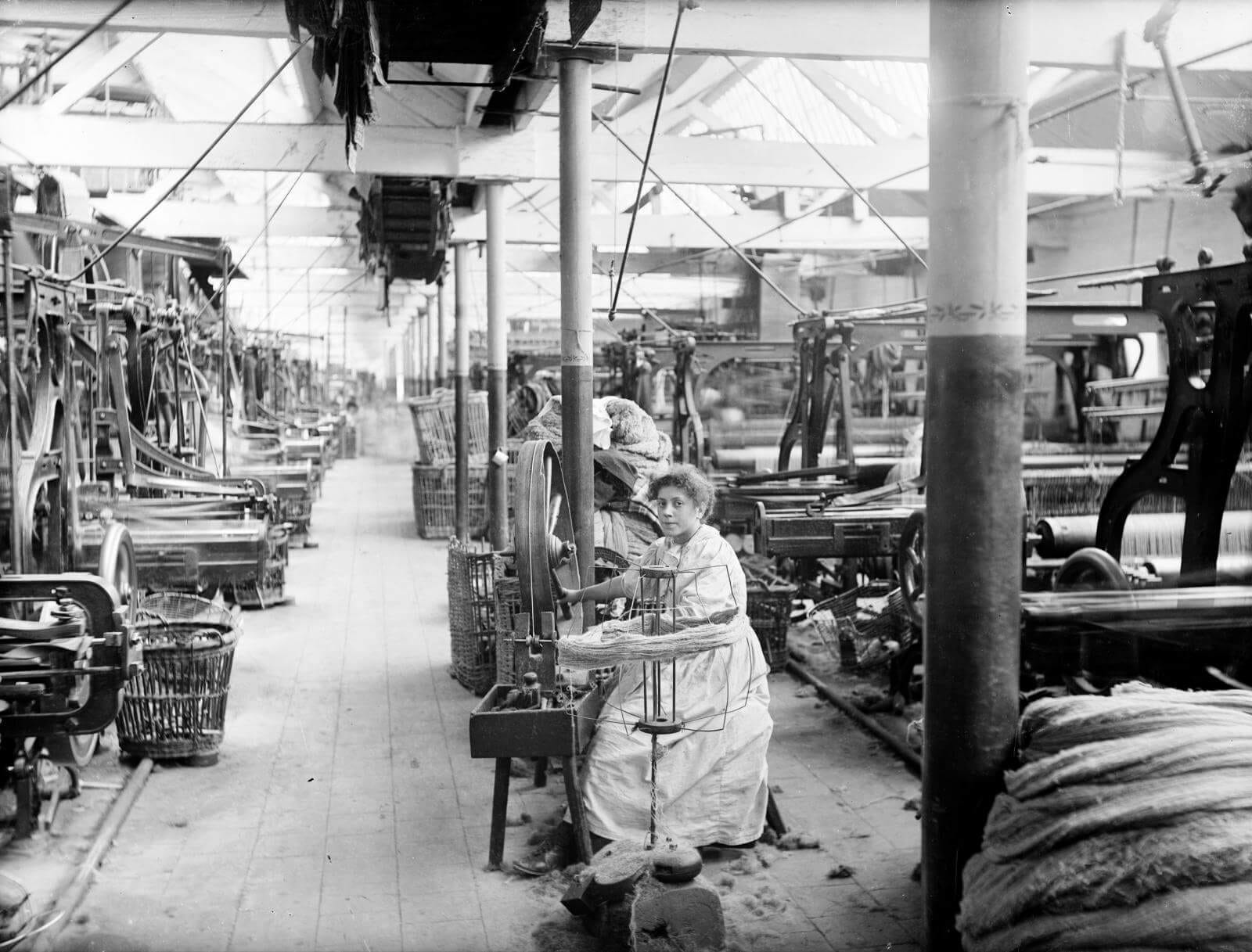
In the 1892 preface to The Condition of the Working Class in England, Friedrich Engels argued that, as industry developed, some exploitative practices ceased to benefit the largest manufacturers. Firms that observed decent standards could be undercut by competitors using longer hours, truck payments or harsher exploitation. Uniform regulation could therefore protect large or compliant firms against “low-road” competition. He wrote that the Ten Hours Act and related reforms ran “much against the spirit of Free Trade and unbridled competition, but quite as much in favour of the giant-capitalist” against smaller competitors. He added that the Factory Acts, originally “the bugbear of all manufacturers,” eventually came to be willingly accepted and their extension tolerated. Larger employers also found that continual conflict with a large workforce was costly, giving them an interest in more orderly industrial relations.
A clearer formulation about employers actively seeking regulation can be found in Marx’s Capital in chapters 10 and 15. Marx noted that some factory owners complying with the 1833 Act petitioned Parliament against the “immoral competition” of rivals who evaded it. Then in 1863, 26 Staffordshire pottery firms sought legislation because competition made voluntary restrictions on child labour impossible. Their memorial concluded that “some legislative enactment is wanted.” More generally, Marx noted that capitalists began calling for “equality in the conditions of competition” meaning that restraints on exploitation should bind all competitors alike.
From this we can derive a general principle that competition could compel even an employer who recognised the harms of excessive hours to continue them, because unilateral restraint meant being undercut. A general law could solve that collective-action problem by imposing the same minimum conditions on everyone.
That said, Engels did not regard enlightened factory owners as the principal originators of the Factory Acts. In his account, the early legislation was wrung from generally resistant manufacturers through workers’ agitation, trade-union pressure, humanitarian campaigning and political conflict. Robert Owen and Sir Robert Peel were exceptional manufacturer-reformers. Only later did substantial sections of capital, especially large firms, accept or support regulation when it served their interests. Thus, a sharper historical proposition would be that the Factory Acts arose principally from struggle against capital, but their consolidation and extension became possible partly because some capitalists discovered that uniform regulation protected them from destructive competition, reduced industrial conflict and disproportionately burdened smaller exploitative rivals.
Both Engels and Marx therefore saw regulation as simultaneously protective of workers, a restraint on competitive exploitation, and, rather less benignly, a mechanism assisting the concentration of capital.
These observations of the English industrial revolution are quaint, but they are resurrected in the face of a new type of industrial revolution, that in a best case scenario, increasingly seems to be based on the control of the means of computational capital through the extraction and profiting from data.
It is suggested that the central parallel is the collective-action problem. An AI company may recognise that extensive testing, slower deployment, security controls or restrictions on dangerous capabilities are desirable. But if competitors can release faster, spend less on safety and capture the market, restraint carries a competitive penalty. Like the nineteenth-century manufacturer who could not voluntarily reduce working hours while rivals continued exploiting children, even a comparatively responsible AI company can be driven by competition towards conduct it regards as collectively dangerous. The UK’s recent frontier-AI assessment expressly identifies the possibility of a competitive “race to the bottom” in which developers build and release rapidly while underinvesting in safety.
A historical parallel / common regulatory approach in the face of market dynamics therefore seems to be requiring every significant developer to incur certain safety costs; preventing companies from gaining advantage simply by externalising risks; making caution commercially sustainable rather than commercially self-defeating; converting voluntary standards into inspectable and enforceable obligations.
Importantly, the EU AI Act exemplifies this logic through common requirements concerning model evaluation, adversarial testing, systemic-risk mitigation, incident reporting and cybersecurity for general-purpose models presenting systemic risk. There may also be a parallel in the changing position of some of the largest AI firms. Leading AI companies increasingly advocate some form of mandatory regulation. OpenAI has proposed a federal frontier-safety framework, while Anthropic has proposed mandatory independent testing and governmental powers to prevent or recall dangerously deployed systems. This may be laudable, but that does not necessarily mean their concerns are insincere. Nevertheless, as Engels and Marx appeared to emphasise, regulation can be both genuinely protective and advantageous to incumbents. Large firms are better able to absorb compliance costs, employ regulatory specialists, undertake expensive evaluations and influence technical standards. Regulation may eliminate irresponsible rivals while simultaneously making market entry harder.
Therefore, in a present day context, the issue may not merely be about regulatory capture by monopolies, but that the same regulatory framework can perform several functions at once including protecting workers, users and society; restraining genuinely dangerous competitive pressures; stabilising the industry and increasing public confidence; protecting large incumbents against less regulated competitors; accelerating concentration by imposing costs smaller firms cannot bear.
Perhaps this historical analogy should not be overstated. Factory legislation dealt with relatively observable working hours, injuries, child exploitation, and employment relationships. AI risks are more dispersed, uncertain and transnational; affected persons may include workers, users, creators, democratic institutions and people who never directly use the system. The creation of technology that has powers of creativity, analysis and authorship also risks rendering human labour superfluous and creating what Marx might have described as proportionally the largest surplus labour populations within the history of industrial capitalism. Nevertheless, the core principle is that emerging AI regulation can be understood as a legally enforced common floor that prevents competitive pressure from rewarding firms which externalise the costs of unsafe development, while potentially strengthening the largest firms capable of bearing and shaping that regulation.
Even this may be the optimistic conclusion. Factory legislation presupposed a continuing relationship of dependence in that capital still required workers, and the law sought to regulate the conditions under which their labour could be used. Advanced AI raises a more disturbing possibility. Just as rulers sustained by natural-resource rents may become less dependent upon, and therefore less responsive to, their citizens, those controlling computational capital may become progressively less dependent on human labour, professional expertise and the social cooperation from which political bargaining power has historically arisen. The tendency may therefore be not towards market equilibrium, but towards the concentration of power, the displacement of labour and the erosion of reciprocal social relations. The spectre haunting AI regulation is not merely that workers will be exploited by the machine, but that those who own the means of computational capital may come to regard workers, and the social compact built around their indispensability, as superfluous.
This possibility has recently been described as the “intelligence curse.” Rentier-state scholarship has long suggested that governments deriving revenue from natural resources rather than broad taxation may become less dependent on their citizens, weakening incentives for investment, representation and accountability. Labour-replacing AI could reproduce this structure at a still deeper level, i.e. control over computational capital might reduce not only fiscal dependence on citizens but economic dependence on human labour itself. The analogy is not deterministic, institutions can convert resource wealth into shared prosperity, but it identifies the political stakes of who owns AI and upon whom its owners continue to depend.
