


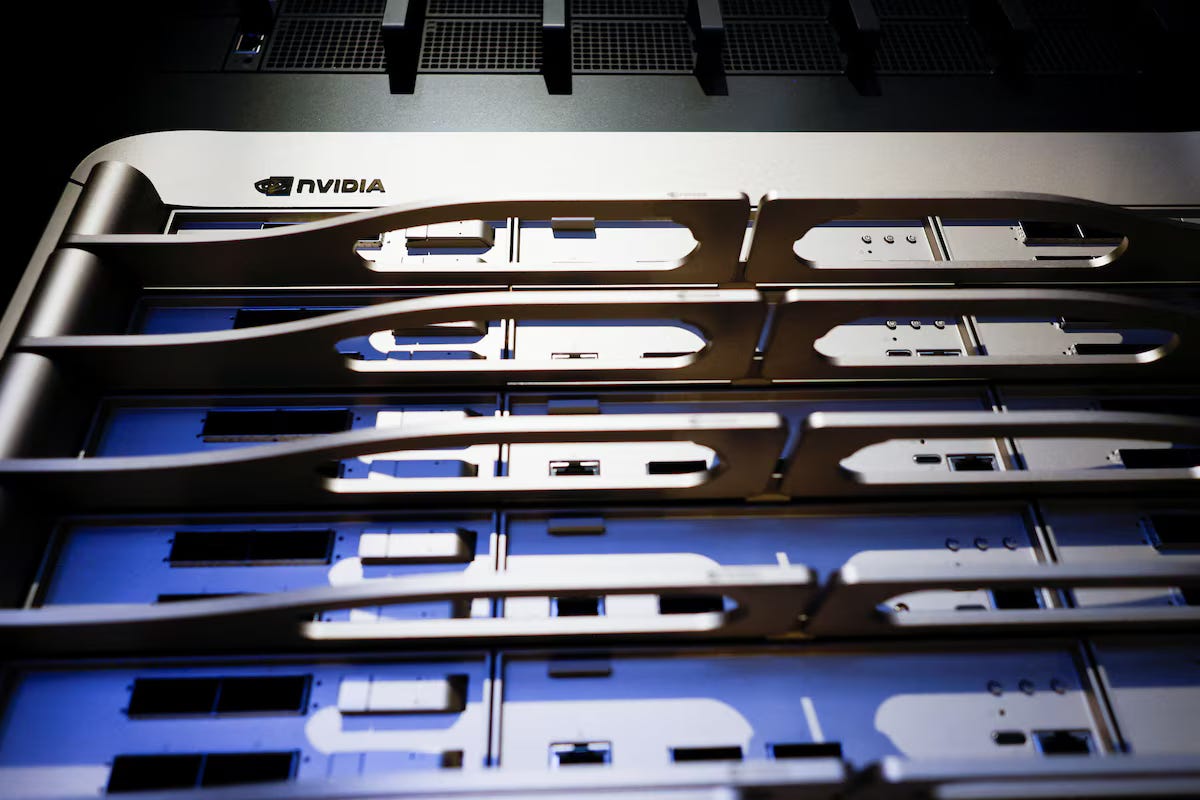
Watching Wall Street erupt in euphoria over Jensen Huang’s theatrical return to Nvidia—a 31% single-day surge conjured out of thin air after Trump told CNBC he had “convinced them” and Nvidia’s board cited “input from senior levels of the United States government”—felt very much like a desperate piece of kabuki theatre. For eleven days, the sudden absence of AI’s leather-jacketed high priest had wiped a trillion dollars off Nvidia’s market cap and exposed the fragility of the entire “neocloud” debt pyramid. Yet the moment Washington stepped onto the stage to wave away national security scandals and bless Huang’s second coming, the algorithms dutifully brought the Nasdaq back to life. This is the system confirming, in case a confirmation is still needed, that market price discovery is dead and buried. It is also the system buying time (and cashing in) by doubling down on a narrative that has already exhausted its material premise. An Evercore note circulated on Monday couldn’t help giving the game away, calling it “AI’s first bailout” and admitting that the U.S. government has officially become the “implicit backstop of the AI industrial complex.”
Behind this pantomime lies a financial architecture that is as fragile as it is delusional, in a way that overlaps with criminal. Just days before the White House stepped in to rescue the narrative, the Federal Reserve’s own November Financial Stability Report—and Governor Michael Barr, presenting it at Bocconi University in Milan—put a number on the delusion: more than $3 trillion in off-balance-sheet AI buildout commitments across the seven largest tech firms, comprising over $1 trillion in signed-but-unstarted leases and over $2 trillion in take-or-pay contracts and guarantees, piled atop corporate debt expected to exceed $800 billion before year’s end, with the largest U.S. banks holding close to $1 trillion of exposure to the data centre complex, its special purpose vehicles, and the private credit feeding it. Yes, the Fed notes that these figures represent the gross contractual ceiling (the largest possible amount, counted at face value), not directly comparable with debt. This, however, is precisely the scandal, since the headline number understates the exposure by excluding private credit, which the Fed itself admits is “harder to measure.”
In more explicit terms, what we’re looking at is a closed-loop hallucination in which chipmakers, hyperscalers, and debt-soaked neoclouds pass the same promissory notes around in a circle to simulate demand that does not exist in the real economy. For those who remember it, this is Lucent Technologies’ vendor financing ($7.2 billion of on-balance-sheet exposure to customer financing at its March 2000 peak, followed in 2001 by the WinStar bankruptcy) at more than 400 times the scale and with the entire built environment of American computation as the counterparty, rather than a single doomed telecom startup. And nobody in the market can claim ignorance: 87% of the Fed’s surveyed market contacts now name AI as a salient risk, up from 50% in the spring. So, Washington’s underwriting of this Ponzi scheme by fiat can only be seen as an act of pure desperation; a state-sanctioned racket designed to socialise a multi-trillion-dollar hole before the public realises that the emperor has no clothes, no revenue, and no future. Whatever happens next, this, at a minimum, will be the monstrous bill passed on to future generations.
Meanwhile, the sheer brazenness of the insider windfalls harvested off this state-engineered whiplash (with well-connected speculators and, reportedly, Trump’s own orbit front-running the market swing) lays bare the deeper truth: capital is fundamentally asocial and misanthropic. What we nostalgically mistake for “society” was always a temporary byproduct of capital’s need for living labour. And now that automation has rendered that need largely redundant, the system sheds even the pretence of socialisation, degenerating into naked looting by a kleptocratic ruling clique sitting atop mountains of fictional capital. Monday’s bounce, already fading in the cold light of Tuesday’s and Wednesday’s trading, is not a recovery; it’s the classic dead cat bounce, a defibrillator jolt applied to an empty story, proving once again that when real accumulation stalls, all that remains is an updated version of Hobbes’ Leviathan: a sovereign power staging miracles and insider trades to keep the casino open one more day.
The spectacle we’ve just witnessed is the unmistakable death rattle of a system running on pure simulation. The key point is capitalism’s terminal paradox: it needs living human labour to generate real surplus value and profits, yet its own technological imperative relentlessly eliminates that labour, forcing the entire economy to survive on enormous amounts of debt-driven fictitious capital. Today’s AI buildout is the ultimate monument to that contradiction: trillions of dollars in circular vendor financing, unstarted data-centre leases, sovereign debt chasing a productivity mirage that will simply not materialise. When the story begins to crack, the capitalist state has no choice but to step in. The goal is not to save the balance sheet but to prop up the hallucination itself. This is crisis capitalism’s broken record—recruiting the state as an emergency manager of simulation.
The only remaining question is how long the zombie regime can refuse to admit it has already run out of road and how much social and geopolitical destruction it will unleash before the reckoning hits. Because this bloated apparatus cannot wind down gracefully. Every time it threatens to dissolve, the fusion of state power and corporate finance—Benito Mussolini’s only slightly updated definition of fascism—must escalate the madness by stoking imperial conflict in the global peripheries while gutting public budgets, just to feed the next round of stimulus and liquidity. The bottom line is that the oligarchy can stage a hundred more boardroom resurrections and print another ten trillion in phantom guarantees, but no executive order can conjure surplus value out of thin air. When the bill for this chimaera finally comes due, it will stop looking like a routine market correction. It will be the violent collision of an exhausted civilisation with the reality that it spent decades trying to outrun.
The trajectory is brutally simple: crisis capitalism cannot afford a “return to normal.” You cannot rescue a system drowning in unpayable IOUs through endless money printing unless you simultaneously crush money velocity in the real economy—otherwise, all that newly minted liquidity spills into consumer prices and triggers runaway inflation. That is why a permanent state of emergency (or, in Carl Schmitt’s well-known term, “state of exception”) does more than just distract us; it functions as a cynical tool of macroeconomic management. COVID lockdowns and the following war in Ukraine normalised monetary debasement alongside the narratives of “necessary sacrifice,” rationing, and austerity. Today, the escalation of conflict and the re-armament drive serve a dual purpose: they channel state printing directly into corporate balance sheets while using wartime austerity to further depress working-class consumption, wipe out middle-class status, and keep inflation at least partially bottled up. Unless, of course, the system is prepared to accept the “radical” alternative: unleashing hyperinflation to inflate away the mountain of debt it holds, a gamble that, however, can only succeed with an iron apparatus of social control already locked in place. Either way, when the AI hallucination finally breaks, war mobilisation and authoritarian emergency rule remain the simplest functional alibis left for a bankrupt system now firmly on that collision course.