


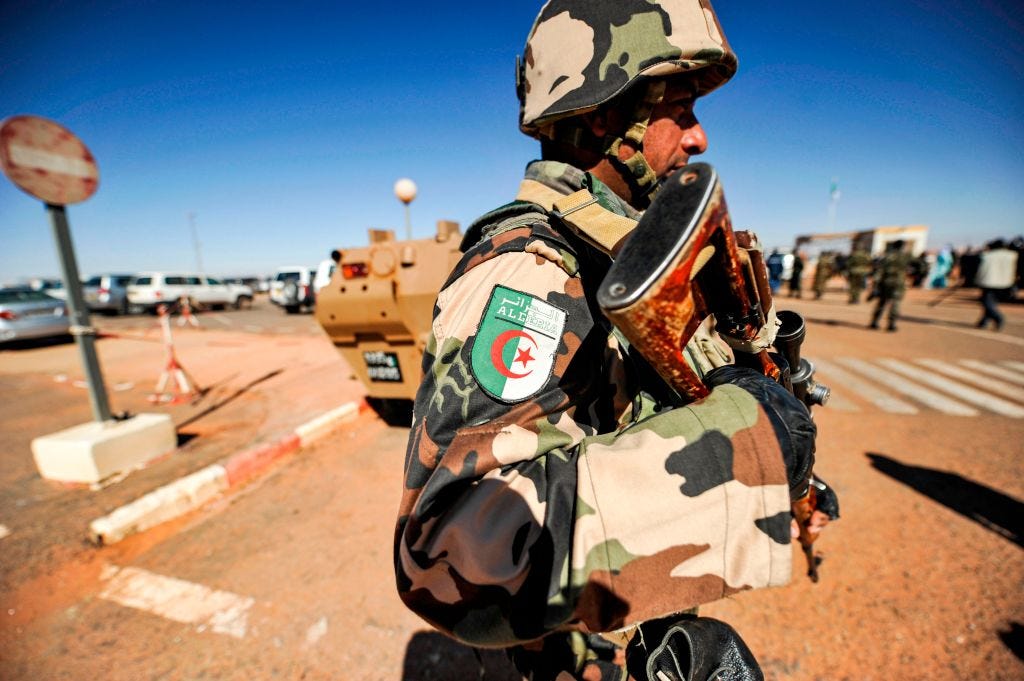
On 30 October, the first convoy of Algerian troops arrived in its southern neighbour Niger as security ties continue to deepen between the two countries. It is Algeria’s first foreign deployment since it sent troops to Egypt during the 1973 Arab-Israeli war. The deployment was approved by both houses of the parliament on 25 October.
“Niger’s security is part of Algeria’s security,” said Foreign Minister Ahmed Attaf, who tabled the proposal before legislators. Algeria shares a 951 km-long border with Niger in the Sahara Desert, which became a hotbed for terror groups after the destruction of Libya by NATO powers in 2011.
Groups affiliated with Al-Qaeda and the Islamic State have carried out multiple attacks in recent times in Niger, where Algeria has strategic energy projects.
Strategic infrastructure
In August, Algeria and Niger jointly laid the foundation stone for a project to explore four wells in the Kafra oil field in Niger’s northern Agadez region, about 85 km south of the Algerian border.
The Algerian state oil company Sonatrach, whose subsidiary ENAFOR is drilling, holds a 50% stake in the project. Its Nigerien counterpart, Sonidep, holds the other half. Niger’s petroleum ministry estimates the potential at 2.5 billion barrels.
A subsidiary of Algeria’s state-owned electricity and gas utility group Sonelgaz built the 40-Megawatt Algerian–Nigerien Solidarity Power Plant in Niger’s capital, Niamey, earlier in June.
That month Algeria also started constructing its section of the Trans-Saharan Gas Pipeline (TSGP) to transport 30 billion cubic metres of natural gas from Nigeria to Algeria’s Hassi R’Mel hub, from where it is to be exported to Europe through the Trans-Mediterranean Pipeline.
At a total length of 4,128 km, the TSGP is to span three countries. 2,310 km of this pipeline will be laid in Algeria, which owns a 45% stake in the project through Sonatrach. 1,039 km will be in the origin country, Nigeria, whose state-owned petroleum company owns another 45%. The 841 km in the middle will run through Niger, which owns the remaining 10% through Sonidep.
It is to protect such critical infrastructure that the Algerian deployment is to be made, at the request of Niger, Attaf told the legislators. “We are not sending our soldiers to wage war in Niger, but for a mission to secure economic infrastructure,” added Senator Belkacem Boulghiti, addressing the media after the parliament voted to approve the deployment.
A deepening military cooperation
While the deployment itself may have this limited mission of guarding infrastructure, a much deeper military cooperation is developing between the two countries. Earlier, on 21 October, Niger’s Minister of National Defence, General Salifou Modi, visited Algeria.
He met the Algerian army’s chief of staff, General Saïd Chanegriha, who expressed “Algeria’s readiness to consider any proposal from Niger that could strengthen military and security cooperation, serving the best interests of both brotherly countries.”
In that meeting, they signed a memorandum of understanding for “cooperation and exchange of experiences in the field of the fight against terrorism, as well as responding to any project requested by the Nigerien authorities aimed at strengthening the operational capabilities of the Nigerien army.”
Four days later, parliament approved troop deployment. The troops will be stationed at Madama, a military base strategically located in Niger’s north, near the Libyan border. “This site occupies a strategic position for monitoring the Sahel region and cross-border routes,” said former Algerian diplomat Amar Belani, recalling that it was “a former French support point developed as part of Operation Barkhane,” which started in 2014.
However, this French operation, meant to suppress the terror groups it helped spawn across the Sahel by participating in the destruction of Libya in 2011, was a failure as armed violence only rose alongside increasing French troops.
Barkhane unravelled eight years later amid a wave of anti-France protests leading to popularly supported coups that ousted the France-backed governments in its former colonies, bringing in military governments that went on to expel the French troops: Mali in 2022, Burkina Faso in early 2023, and Niger later that year.
Diplomatic rift and revival
Algeria joined the chorus condemning the coups in all three countries, which went on to form the Alliance of Sahel States (AES) in late 2023. This had already caused a strain on the diplomatic relations between Algeria and the AES countries when, in April 2025, Algeria shot down a Malian drone that was targeting terror groups in its border region of Kidal.
Algeria claimed that the drone had crossed into its airspace. Mali refuted the claim. All three AES members, including Niger, withdrew their ambassadors from Algeria. Algeria reciprocated.
Over the next months, attacks by Al-Qaeda and IS-affiliated groups intensified in all the AES states, which have long been accusing France of backing these groups to destabilise their countries for asserting sovereignty and breaking free from French neocolonial rule.
Algeria had not only fought the French for its independence but also the Islamist extremist groups within a bitter civil war in the 90s. Al-Qaeda and IS growing in Mali and Niger is perceived as a threat to Algeria, which shares a total of over 2,310 km of land border with the two Sahelian neighbours.
In February 2026, Algerian president Abdelmadjid Tebboune invited his Nigerien counterpart Abdourahamane Tchiani to Algeria for a meeting, where they agreed to restore diplomatic relations at the highest level.
“In the face of ongoing terrorist threats and the ongoing organised border crime, the leaders of the two countries expressed their concern for each other’s security and said that the security of one is inseparable from the security of the other,” read a statement by the Algerian presidency.
“With this spirit of effective solidarity, they agreed to immediately activate the Algerian-Nigerian mechanisms concerned to intensify coordination in border surveillance and coordinate strategies for combating terrorism.” They also agreed to develop closer cooperation in the field of agriculture, healthcare, and infrastructure.
“We will protect Niger no matter what.”
In August, Algeria donated two Mi-24V helicopters, two Mi-171 helicopters, and associated military equipment. Later that month, following a failed mutiny on 29 August, Algeria deployed more aircraft, including four Sukhoi Su-30 fighter jets and an aerial refuelling aircraft to Air Base 101 in Niger’s capital, Niamey.
“There are countries, which I will not name, that have conspired against (Niger). We stand by its side,” Tebboune said in a televised address on 3 October. Niger itself has named France and France-backed governments in the neighbourhood—including Chad, Benin, and Côte d’Ivoire—and Ukraine as assisting terror groups to destabilise the country after it expelled French troops.
“Today, we have interests. We have reached agreements (with Niger) in the oil, mining and other sectors, and some are seeking to destroy all of this overnight,” added Tebboune, declaring, “We will protect Niger no matter what.”
Algeria has the second-most powerful military in Africa. While AES countries had developed a security partnership with Russia to help combat terror groups after expelling French troops, the entry of Algeria as a security partner advances the principle of “African solutions to African problems,” adopted by the African Union (AU) as an official position in Agenda 2063.
Meanwhile, Algeria and Mali also mutually reinstated their ambassadors in July. On the sidelines of the 81st session of the UN General Assembly in September, Algeria’s foreign minister Attaf also met his Burkinabe counterpart, Karamoko Traoré. The ministers not only discussed how to revive bilateral relations and strengthen ties but also “the main security and development challenges facing the region.”