


Algeria has made substantial investments in water infrastructure over recent decades. Dams, groundwater abstraction, inter-basin transfers, desalination plants and drinking-water networks have helped expand access to water and strengthen the country’s capacity to respond to growing demand.
These investments are essential. But water security is not only a question of infrastructure, technology or the volume of water that can be mobilised. It is also shaped by the relationship between water, landscapes and the communities that inhabit them.
Across Algeria, and particularly in its Saharan regions, this relationship has a long history. Oases, traditional irrigation systems, seasonal waterways and settlement patterns reflect generations of adaptation to an environment characterised by irregular rainfall and considerable climatic variability.
This accumulated knowledge offers valuable perspectives for thinking about the future of water management.
Water security begins with the territory
In arid and semi-arid regions, rainfall is often irregular and concentrated in short, sometimes intense episodes. Depending on soil conditions, vegetation cover and topography, rainfall may infiltrate the ground, replenish soil moisture and contribute to groundwater recharge, or rapidly flow through wadis and drainage channels.
The way a territory receives and retains rainfall is therefore as important as the infrastructure used to store and distribute water.
Soil degradation, vegetation loss and erosion can reduce the capacity of landscapes to absorb and retain water. Conversely, restoring vegetation cover, protecting natural drainage pathways, improving soil permeability and developing appropriate water-retention structures can help strengthen local hydrological functions.
These measures complement major water infrastructure. They also reconnect water management with the everyday organisation of settlements, agricultural land and ecosystems.
The knowledge embedded in Saharan landscapes
Southern Algeria provides an important illustration of how water management is connected to culture and social organisation.
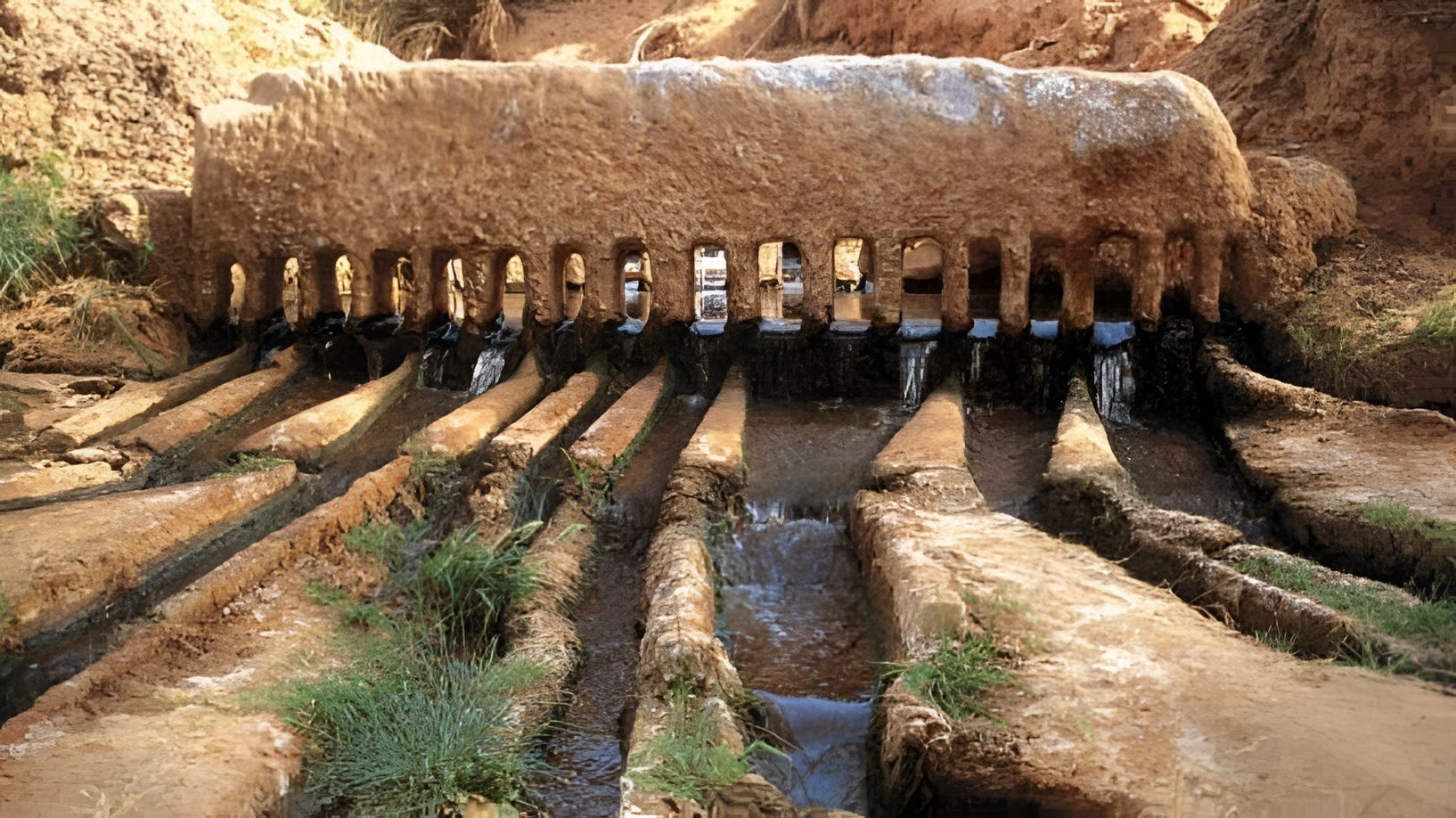
Traditional systems such as foggaras, oasis gardens and local floodwater-harvesting practices were developed through close observation of the environment. Their operation involved not only technical knowledge of groundwater, soils and topography, but also collective rules for water distribution, maintenance and use.
The oasis itself can be understood as an integrated living system. Its agricultural organisation, vegetation, irrigation channels, architecture and settlement patterns evolved in response to the availability and movement of water.
This heritage should not be considered simply as a record of the past. It contains practical knowledge that can inform contemporary approaches to water conservation, soil restoration and adaptation to climate variability.
Combining this knowledge with modern hydrology, engineering and ecological science offers an opportunity to develop solutions that are both technically appropriate and rooted in the characteristics of local territories.
The strategic importance of Saharan basins
The Guir and Zousfana river systems, which contribute to the Saoura basin, illustrate the importance of understanding water beyond administrative and settlement boundaries.
These systems connect mountain environments, desert landscapes, oases and human settlements. Their hydrological dynamics are influenced by rainfall variability, upstream conditions, sediment transport and the capacity of soils and landscapes to retain water.
Understanding these relationships requires long-term monitoring, accessible hydrological information and scientific cooperation across geographical boundaries.
It also requires attention to the ways in which communities experience and interpret water: the memory of exceptional floods, the location of former agricultural areas, the condition of traditional channels and the changing behaviour of intermittent rivers.
Such observations can complement scientific measurements and contribute to a more complete understanding of the territory.
Restoring the small water cycle
An additional dimension of water security concerns the local circulation of water between soil, vegetation and the atmosphere.
Healthy soils and vegetation contribute to infiltration, evapotranspiration, soil moisture and the regulation of surface temperatures. Their condition influences the capacity of landscapes to withstand drought and recover after rainfall.
This perspective is central to what I call Fertile Hydrology: an integrated territorial approach based on three complementary principles—slow water, infiltrate it and support vegetation.
The approach brings together established ecological and hydrological practices while recognising the value of traditional knowledge developed in drylands.
Foggaras, oasis gardens, traditional floodwater harvesting and local systems of water distribution offer valuable lessons. Their principles can be considered alongside contemporary techniques such as rainwater harvesting, small retention structures, soil restoration and the rehabilitation of natural drainage systems.
The objective is not to reproduce historical systems unchanged, but to understand what they can teach us and how their principles can be adapted to present conditions.
Towards a shared approach to water security
Algeria can strengthen its water strategy by connecting major infrastructure with action at the local and catchment scales.
This could include:
• systematic rainwater harvesting in urban and rural settlements;
• restoration of degraded soils and vegetation cover;
• improved management of intermittent rivers and floodplains;
• protection and rehabilitation of oasis water systems;
• treatment and reuse of wastewater;
• monitoring of groundwater resources and agricultural water productivity.
Such initiatives would benefit from cooperation between public institutions, researchers, engineers, local practitioners and communities.
Pilot territories could provide opportunities to document local knowledge, test appropriate techniques and measure their hydrological and ecological results.
Water security is therefore not only about the quantity of water available. It also concerns the relationships that allow water to remain part of a living landscape.
For Algeria, combining water mobilisation with territorial restoration offers an opportunity to strengthen long-term resilience, protect cultural and natural heritage, and consolidate the foundations of water and food sovereignty.
The future of water management may depend as much on what societies build as on what they learn to preserve, reconnect and transmit.