


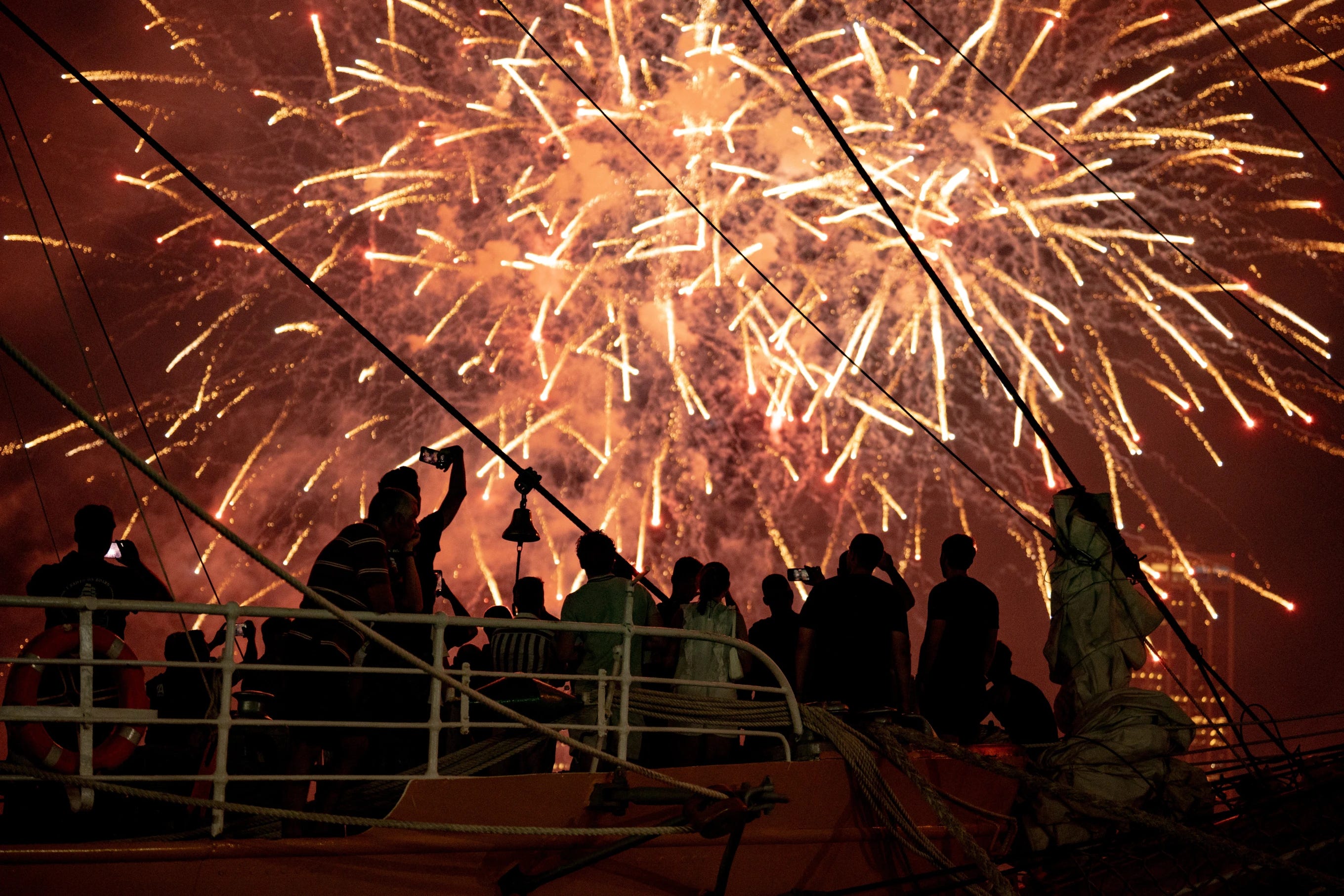
Four hundred thousand tonnes of fireworks will light up the American sky on this Fourth of July, the nation’s 250th birthday. The spectacle is magnificent. But so was the Titanic—right up until the iceberg.
Beneath the cascade of red, white and blue, beneath the campaign-style rhetoric from a President who proclaims this “the most extraordinary republic ever,” a far more troubling picture is emerging. This is not a nation celebrating enduring democratic vitality. This is a superpower confronting the accumulated wreckage of its own contradictions—a republic whose internal fractures now threaten to undermine the very global order it constructed.
The irony is as breathtaking as it is brutal. The United States marks its semiquincentennial not as the beacon of democratic aspiration but as a cautionary tale of institutional decay. Freedom House, the Washington-based watchdog, has awarded the United States its lowest-ever score on political freedom and civil liberties, ranking it 61st globally—alongside Mongolia, Panama and Romania. The reasons cited are damning: escalating executive dominance, legislative dysfunction, growing pressure on free expression, and systematic efforts to undermine anti-corruption safeguards.
For the first time in its history, the world’s oldest continuous democracy now carries the label of a “flawed democracy.” The V-Dem Institute goes further, describing the United States as a “conspicuous, exceptional new autocratizer”—a description it calls “unprecedented” for a wealthy Western nation.
The man at the centre of this transformation used the anniversary podium not to unify but to divide. President Trump’s 4 July address on the National Mall repeated familiar calls for new voting restrictions, warned that “communists” could gain ground, and cycled through a litany of self-congratulatory achievements. A speech that could have summoned the nation’s better angels instead doubled down on polarisation. “We salute the American giants,” he declared at Mount Rushmore. But what of the American present—fractured, exhausted, increasingly unrecognisable to itself?
The numbers tell a story the fireworks cannot drown out. A new Pew survey of 42,151 people across 36 countries finds that only 35 per cent of respondents worldwide believe the United States contributes to peace and stability. In Canada, the share of those who view America as a reliable partner plummeted from 83 per cent in 2022 to just 35 per cent in 2026. In Australia, that figure fell from 57 per cent to 33 per cent. Across Germany, the proportion who believe Washington takes other nations' interests into account dropped from 60 per cent to 23 per cent in just three years.
Meanwhile, 57 per cent of global respondents now hold an unfavourable view of the United States. This is not a superpower projecting strength. This is a superpower alienating its own coalition.
And yet, this diplomatic erosion is merely the surface symptom of a deeper malady—one rooted in the very machinery of American power. The intelligence apparatus that was supposed to protect the republic has, for generations, functioned as an engine of imperial overreach. The historical record is unforgiving: Operation Ajax in Iran (1953), Operation PBSuccess in Guatemala (1954), Project FUBELT in Chile (1973), Operation Cyclone in Afghanistan, the catastrophic WMD intelligence failure that justified the 2003 invasion of Iraq—a cascade of covert interventions that systematically dismantled democratic institutions abroad while claiming to defend them.
The Iraq War alone cost an estimated $2 trillion and claimed 4,500 American lives, alongside some 300,000 Iraqi civilians. More devastating still was the blowback: the rise of ISIS, the empowerment of radical factions, the systematic unravelling of regional stability. These were not intelligence failures. They were the intended outcomes of a foreign policy that placed geopolitical alignment above democratic principle—a policy whose consequences now recoil upon the metropole.
Consider the theological architecture beneath these operations. The CIA’s worldview has long assumed that sovereignty is legitimate only when aligned with American interests—a metaphysical claim that positions Washington as the arbiter of political existence itself. “Plausible deniability” was not merely an operational doctrine; it was a theological assertion of sovereign exception, a claim that the United States could act invisibly, beyond the reach of international law, while reserving the right to judge the legitimacy of every other nation’s government.
This is not realism. This is a form of imperial theology—a faith that sanctifies American order as universal truth, that treats democracy as instrumental rather than intrinsic, and that mistakes the projection of power for the defence of liberty.
The tragedy is that this architecture is now consuming itself. The same apparatus that destabilised democracies abroad has, through the erosion of institutional norms and the concentration of executive power, begun to destabilise democracy at home. The Freedom House report documenting executive dominance is not an external critique; it is the domestic mirror of the very pathologies the CIA exported for decades. The empire has turned its instruments inward.
And what of America’s allies—Australia included? The Lowy Institute’s polling on global trust is not an abstraction. When reliability ratings collapse from 57 per cent to 33 per cent in just five years, when a generation of Australian policymakers must recalibrate assumptions that have held since the ANZUS treaty, the consequences are profound. The United States is no longer the reliable partner it once was—not because its material power has diminished, but because its political credibility has evaporated. Trust, once lost, is not easily regained.
The 250th anniversary should have been a moment for reckoning—for confronting the gap between founding ideals and present reality, for acknowledging that a republic that cannot govern itself cannot lead the world. Instead, it has become a spectacle of self-congratulation, a celebration of the myth while the machinery of democracy groans under the weight of its own contradictions.
Nearly half of Americans—46 per cent—do not even know what the 250th anniversary commemorates. How can a nation defend democratic values abroad when its own citizens have forgotten what they are?
This is not a counsel of despair. It is a summons to clarity. The United States remains capable of renewal—but only if it abandons the comfortable fiction that all is well. The fireworks will fade. The speeches will be forgotten. What will remain is the question that 250 years of American history has placed before us: Can a republic founded on the consent of the governed survive the governance of the unaccountable? The answer, on this 250th birthday, remains terrifyingly uncertain.
