


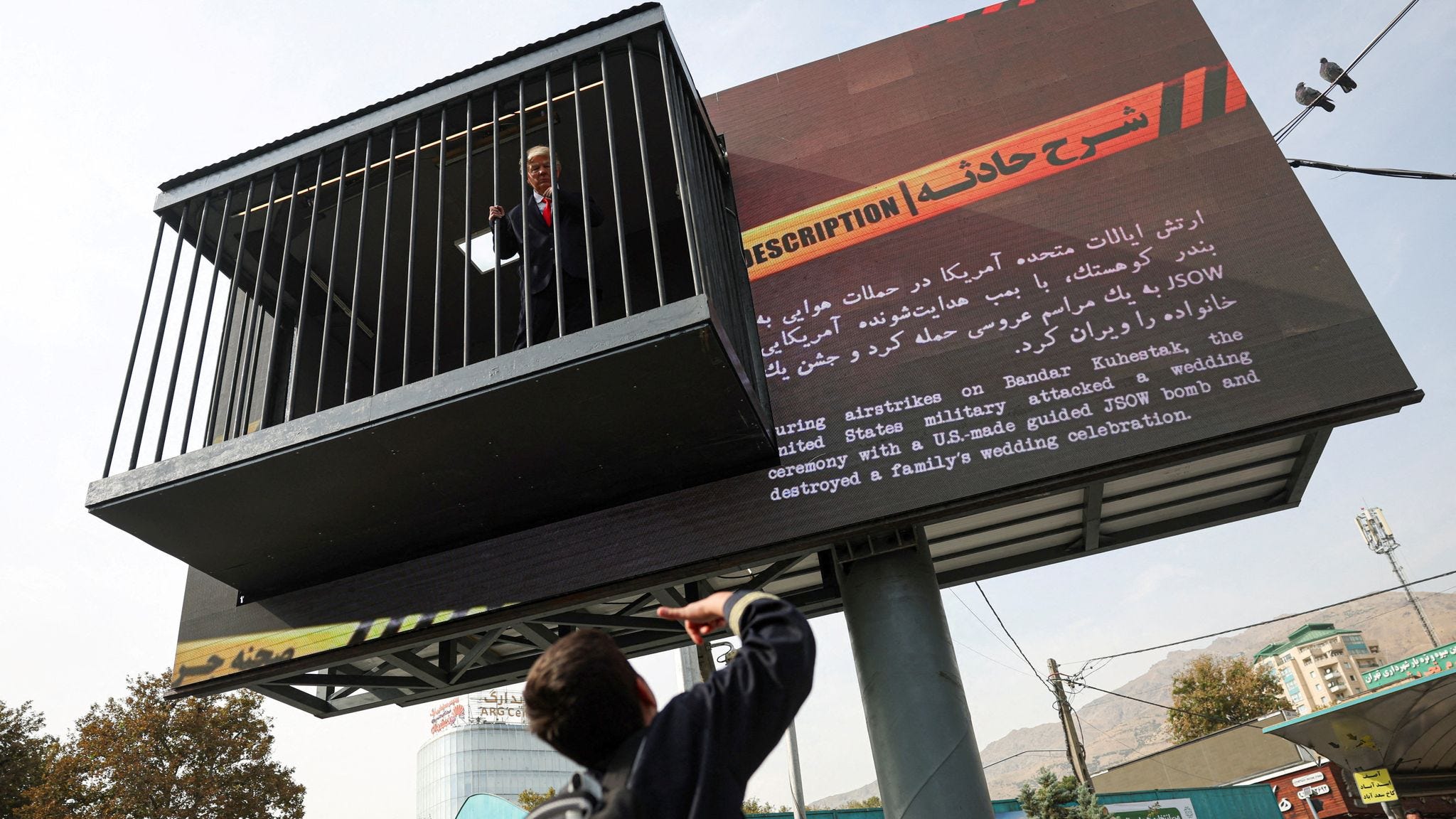
In Tehran, Donald Trump has already been put behind bars. Not by a court, but in a public display that turned the American president into a prisoner of his own war. The image was intended as political mockery. Yet after the US midterm elections, it carries a more serious question: who, exactly, is trapped by this conflict?
Trump entered the White House promising to keep America out of new wars. Eight months after launching one against Iran, he has lost both houses of Congress. His vice president, JD Vance, acknowledged the connection more plainly than the president himself. “The reason we lost is the war,” Vance wrote after the vote. Trump conceded that the conflict had played a part.
Neither admission means American voters rejected every aspect of Washington’s policy towards Iran. Inflation, tariffs and broader dissatisfaction with the administration also shaped the result. But the war made those grievances harder to separate. A conflict fought thousands of miles from American homes began appearing in petrol prices, household budgets and the cost of running a farm.
The Republicans have paid an electoral price. Whether that changes American policy is another matter.
Trump’s predicament exposes a contradiction within the coalition that brought him back to power. His promise to avoid new wars appealed to Americans exhausted by decades of military intervention. Yet another part of the Republican establishment remains committed to the belief that American military superiority should be used to impose political outcomes abroad.
These positions could coexist while war remained hypothetical. Iran made the contradiction impossible to ignore.
For the interventionists, ending the conflict without forcing Tehran into major concessions risks looking like defeat. For voters who supported Trump precisely because he promised to avoid another Middle Eastern war, continuing it represents a betrayal. The president now faces the prospect of disappointing one constituency by escalating and another by negotiating.
That might appear to give Democrats a straightforward opportunity. They have gained control of Congress while Republicans are struggling to explain the costs of a war they initiated. But opposition to Trump is not necessarily opposition to the assumptions behind his foreign policy.
Democrats have criticised the administration’s conduct of the war, its economic consequences and its handling of Congress. Those criticisms matter. They do not, however, establish that the party is prepared to abandon the sanctions, military commitments and regional security arrangements that have defined Washington’s approach to Iran across successive administrations.
Under Joe Biden, sanctions remained in place, the United States did not return to the nuclear agreement, and American support for Israel continued. Trump has taken confrontation much further, but the underlying relationship did not begin with him.
There are meaningful differences between the parties, particularly over diplomacy, executive authority and the acceptable costs of military action. Pretending otherwise would obscure the choices facing Washington. Yet there is also considerable continuity in the belief that Iran must be compelled to change its behaviour before the United States substantially changes its own.
The question for the incoming Democratic Congress is therefore not simply whether it opposes Trump’s war. It is whether it will use its authority over funding, oversight and war powers to constrain him. Winning an election does not, by itself, amount to a different foreign policy.
For Iran, the distinction is crucial.
Tehran has never needed to believe that Democrats are its friends to recognise the significance of their victory. The more important development is that American military power has failed to insulate the American political system from the consequences of using it.
Iran cannot match the United States aircraft for aircraft, nor can it absorb physical destruction at the same cost. American strikes damage infrastructure that Iran must rebuild under sanctions and severe financial pressure. But Tehran has another means of imposing costs: the Strait of Hormuz.
By disrupting shipping through one of the world’s most important energy corridors, Iran has helped move the consequences of war into economies far beyond the battlefield. Higher energy prices affect transport, manufacturing, agriculture and household spending. The political consequences are not confined to countries within missile range.
This does not mean Iran single-handedly determined the American election. It means Washington has discovered that military superiority does not guarantee control over a war’s economic consequences.
The same problem is confronting Europe. European governments have supported different aspects of Washington’s regional policy while confronting the rising energy costs and commercial uncertainty associated with the conflict. Some have begun questioning whether continued escalation serves their interests.
Iran’s leverage, however, should not be confused with immunity. The country has suffered extensive destruction, economic disruption and civilian losses. The ability to impose costs on an adversary does not erase the suffering at home.
That distinction matters when discussing how ordinary Iranians view the war.
From outside Iran, it is tempting to divide the population into supporters of the government and opponents of it, then assume those categories determine attitudes towards American military action. Iranian society is considerably more complicated.
A person can resent the economic policies of the Iranian government and still reject foreign bombardment. Someone who wants negotiations may also believe that reopening Hormuz without enforceable concessions would leave Iran vulnerable to another attack. Opposition to Washington does not necessarily imply satisfaction with Tehran.
For people trying to earn a living, these questions are not abstract. War affects prices, transport, employment and the ability to plan beyond the next few weeks. A shopkeeper does not need to understand the intricacies of American congressional politics to know that another round of strikes could disrupt business. A university graduate considering a future abroad may fear both continued isolation and a new military escalation.
These are different experiences, and neither can be reduced to a single national mood. Nor should the opinions of a few individuals be presented as a representative survey of Iranian society.
What the war has done is force questions of national security into everyday decisions. The possibility of another attack is no longer something discussed only by military officials or political commentators. It is part of the uncertainty surrounding ordinary life.
That is why the assumption that Iran will interpret Trump’s electoral defeat as an invitation to compromise is questionable.
Tehran’s leadership has repeatedly argued that American assurances are worthless without changes in conduct. Mohsen Rezaei, secretary of Iran’s Supreme National Security Council, has tied the reopening of Hormuz to implementation of Iran’s conditions, rather than another round of promises.
Others within Iran favour a more flexible diplomatic approach, warning that insisting on the other side’s complete capitulation could prolong the conflict. The disagreement is real. Both positions, however, start from the recognition that an agreement must address the conditions that produced the present confrontation.
Trump’s political weakness could create an opportunity for negotiations. It could also make the coming weeks more dangerous.
Before the new Congress takes office in January, the president may conclude that a limited military operation offers a way to recover the initiative. A strike presented as decisive, followed by a declaration of victory, might appear attractive to an administration facing domestic criticism.
But wars do not end simply because the side launching an attack declares its objectives achieved. Iran could respond in ways that prolong the confrontation, while Israel has its own calculations about whether another round of fighting should remain limited.
An operation intended to rescue Trump’s political position could leave him with a larger war and fewer ways to end it.
This is the uncomfortable reality behind the midterm results. American voters have demonstrated that a distant war can carry a domestic political price. They have not yet demonstrated that elections can prevent Washington from continuing it.
For Iran, that creates both leverage and danger. For Americans, it raises a question that extends well beyond Trump: if voters can punish a president for starting a war but cannot reliably prevent the next escalation, how much control do they really exercise over the decisions made in their name?
Trump may be behind bars only in a Tehran display. The harder problem is the political system that made his war possible and whether an electoral defeat will be enough to change its course.
Amerikans did not vote against war. They don't give a fuck about dead Iranian schoolgirls or leaders of foreign nations assassinated by the United States of Israel, or uncounted dead in Gaza or Ukraine. Or the destruction of Europes' economy or the collapse of our global life support system.
All they care about is the cost of petrol or diesel needed to drive their monster trucks around town.
As Scott Ritter said they have no moral compass.