


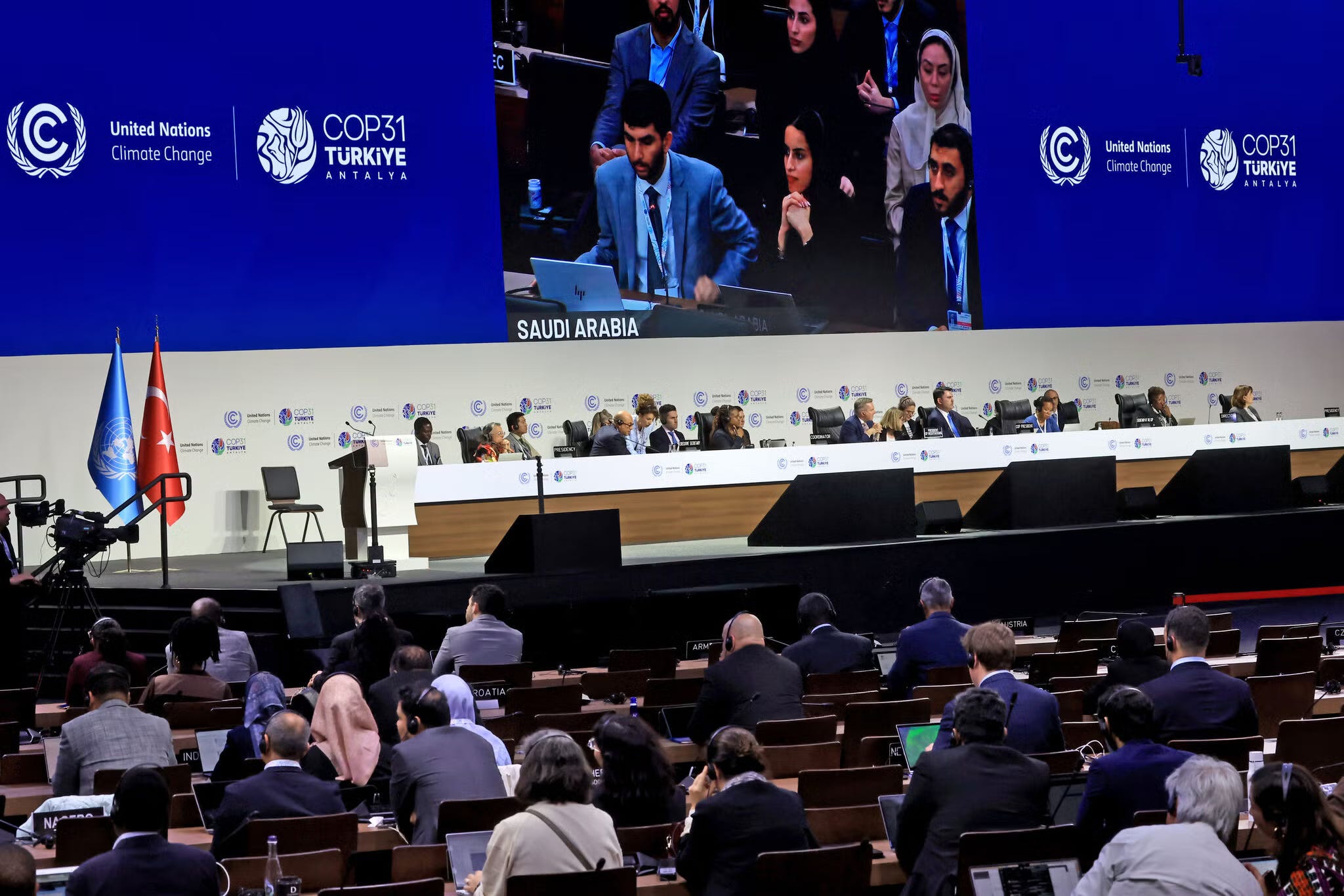
These climate change conferences are becoming rather trying. They resemble the very problem they claim to resolve, adding the poison of cynicism to policy killing, stone dead, possible reform and viable initiatives. Be that as it may, it was hardly a shock that COP31, known in its longer form as the Conference of the Parties, ended without resolution, despite being the longest running climate talks in history.
From the outset, things were bound to go oddly, given the co-hosting arrangements. While the event took place in Antalya, Turkey, the chair of the event was Australia’s Climate Change and Energy Minister Chris Bowen. Australia remains a fossil fuel power reluctant to relinquish such a status, coming in as the world’s third largest exporter of commodities. During the course of stalling negotiations, the Climate Action Network International thought it befitting that Australia receive the award of “Fossil of the Day.” As the environment group stated, “Moving speeches about the Pacific, no new climate finance, a Prime Minister [Australia’s Anthony Albanese] who couldn’t bring himself to say ‘fossil fuels,’ and a Presidency struggling to lead the negotiations” unfolded even as coal and gas expansion continued. This was “a masterclass in climate hypocrisy: performative empathy combined with a remarkable lack of leadership, both in Antalya and at home.”
Albanese’s tawdry reference to the story of a 13-year-old girl from Tuvalu at the Leaders’ Summit was particularly galling in that regard, avoiding any reference to fossil fuels. This was telling, given the continued Australian practice of heavily subsiding the fossil fuel industry from the pocket of the taxpayer. In 2025-26, $AU16.3 billion was provided, in sharp contrast to $AU1.36 billion in global climate finance in 2024-25. Canberra, while failing to contribute new funding to the Pacific Resilience Facility (PRF), remains a keen promoter for others to front up the funds. Some 38 coal and gas projects have also been approved since the Albanese government took office in 2022.
This remained the theme and fractious point through the negotiations. The final draft cover text released by the Turkish and Australian conveners on 22 November was filled with much praise, noting “that significant collective progress towards the Paris Agreement temperature goal has been made, from an expected global temperature increase of more than 4ºC according to some projections prior to the adoption of the Agreement to an increase of around 2.6ºC based on the full implementation of the current national climate plans.” The text, somewhat later, noted “deep concern that peak global warming is expected to exceed 1.5ºC above pre-industrial levels in the next few years.” Yet, phasing out fossil fuels, let alone an acknowledgement of their role in climate change, was conspicuously absent. Reference to “clean” electricity was also nowhere to be found, and the initial US$120 billion adaptation finance target was dropped in favour of a carbon capture target of 500 million tonnes per annum by 2035.
As with previous climate change negotiations, notably at COP30 in Brazil, the fossil fuel lobby proved mighty, prompting an accusation by European Union representative Darragh O’Brien that the talks had been “hijacked by some oil states.” Its strength was evident in a joint statement issued from the Shenzhen trilateral summit held by Presidents Donald Trump of the United States, Xi Jinping of China and Vladimir Putin of Russia. “The three countries plan to increase the production and supply of refined petroleum products for the benefits of all nations. They reaffirmed the importance of stable energy flows.”
This very fact led the EU to lead a revolt in rejecting the draft cover decision. Joining them was the AILAC group of Latin American states and the group of Least Developed Countries (LDCs). The absence of any reference to fossil fuels was in contrast to the COP28 meeting that was held in Dubai. The decision text in that instance noted that there would be a “transitioning away from fossil fuels,” though made no mention of phasing out oil, coal and gas. This drew a rebuke from UN Secretary General António Guterres: “To those who opposed a clear reference to a phaseout of fossil fuels in the COP28 text, I want to say that fossil fuel phase-out is inevitable whether they like it or not. Let’s hope it doesn’t come too late.”
Bowen did his best to gild the stained affair and his stewardship at the talks by suggesting that the failure to make mention of the patently obvious was an adequate outcome. “What we’re doing is providing the most ambitious outcome that consensus will allow.” He also chose to see the Shenzhen summit declaration on increased oil production with suitably thick and gaudy spectacles. “China is here engaging constructively with us, very actively,” he insisted. “They’re coming at this conversation in the spirit of helping us make it work.” His spectacles were evidently so thick as to avoid mentioning the US, which sent no official delegation to Antalya, nor Russia.
The Russian delegate, Sergei Kononuchenko, also lost patience with the righteousness of the EU case, arguing that their provision of climate finance through loans to developing states was inappropriate. “This is an old colonial distribution of labour under a new banner.”
Climate change boffins suggest that the failure of the COP negotiations to reach a decision does not spell an end to the process. “What it may mean,” say the pollyannish Jacqueline Peel and Kathryn Bowen in The Conversation, “is that international climate cooperation will look different from this point onwards.” That’s some wonderful jabberwocky suggesting that change will be slow, staggered and uneven. Brussels and the Pacific island states remain more isolated than ever, while multilateralism shows few signs of gaining momentum.