


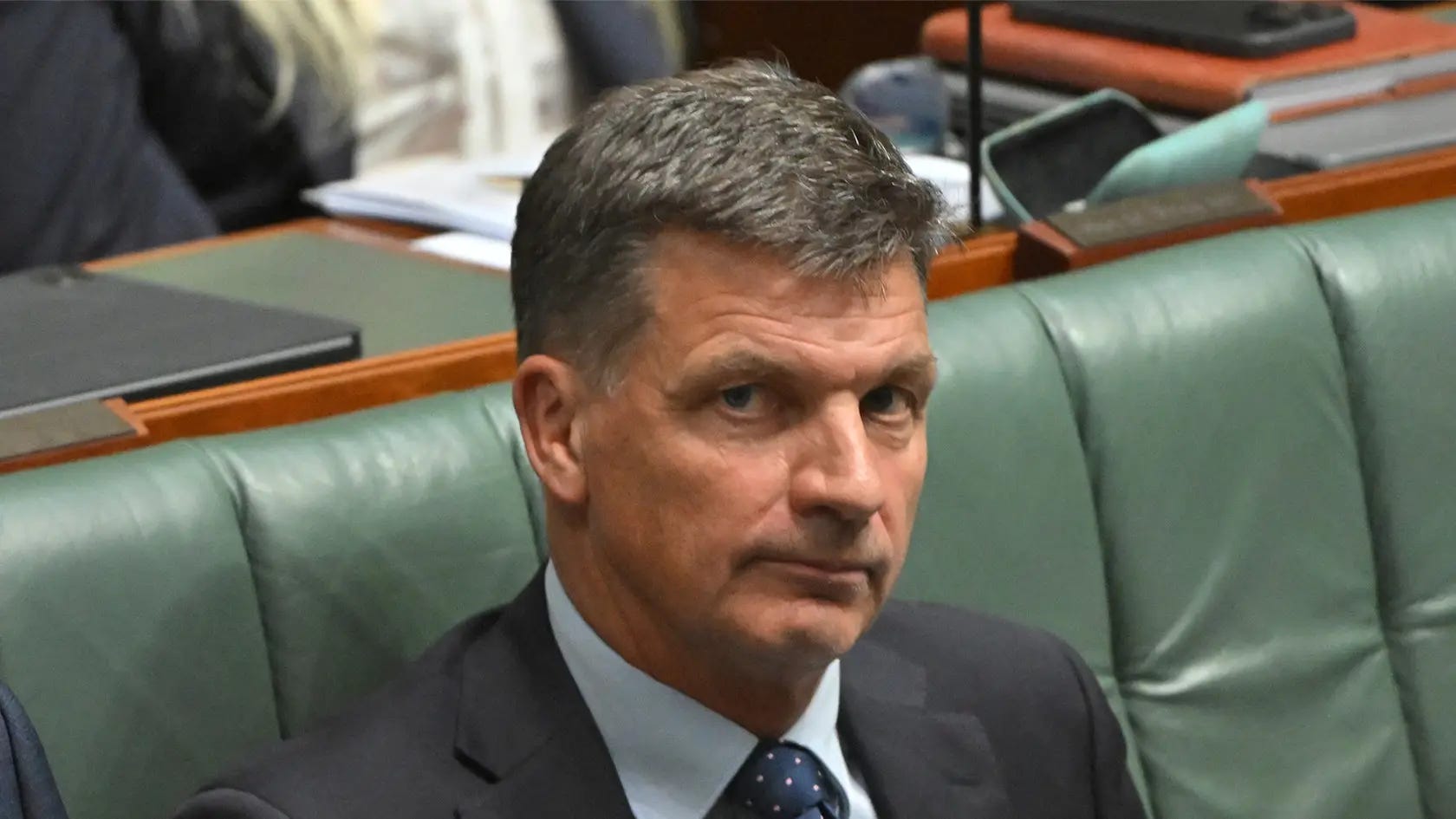
The announcement by Opposition Leader Angus Taylor to slash temporary visas by 650,000 over four years, halve the humanitarian intake to 10,000, and drive net overseas migration down to just 100,000 is not a policy. It is a surrender note, written in the language of electoral panic and addressed directly to the voters of Pauline Hanson’s One Nation. With this single, breathtaking capitulation, the Liberal Party of Australia the party of Menzies, of Howard, of the open economy and the immigration nation, has formally conceded that it no longer sets the terms of the national conversation. One Nation does.
The numbers are staggering, even by the standards of a political system that has spent a decade treating human beings as budget line items. Net overseas migration, currently running at 292,100, would be cut to a level not seen outside the pandemic since 2004. Bridging visas would be reduced from 414,000 to 20,000, forcing hundreds of thousands of people to physically leave the country simply to reapply for the right to remain.
Temporary graduate visas would be scrapped entirely except for a narrow, instrumentalised category of PhD, health, and education graduates from regional universities a hierarchy of human worth that would make Mae Ngai’s “impossible subjects” look almost generous. AUKUS and Five Eyes nations would receive a privileged visa pathway, doubling the talent allocation to 7,000. This is not border control. This is a geopolitical caste system dressed in the language of skills and sovereignty.
The philosophical betrayal is complete. Under John Howard, immigration was an economic lever, a tool to expand the tax base, fill labour shortages, and fuel GDP. The migrant was a utility-maximising subject, welcomed because they enhanced the aggregate welfare of citizens. Taylor’s policy inverts this entirely. The migrant is now a structural liability: a competitor for housing, a burden on infrastructure, a cultural stranger.
The slogan “Australia should be a home, not a hotel” is telling. A home implies bounded intimacy, exclusive membership, and the right to exclude. A hotel implies temporary, transactional hospitality. This is a return to a pre-Kantian conception of hospitality as conditional, bounded by sovereignty, and revocable at will. The non-citizen is no longer a guest but a potential intruder.
What makes this moment so profoundly troubling is not merely the content of the policy but the absence of any serious attempt to justify it. The Coalition has not released economic modelling. It has promised costings “closer to the 2028 federal election.” This is not a neutral omission. It is an epistemological abdication, a deliberate refusal to subject a radical restructuring of the Australian economy to the scrutiny of economists, demographers, and public servants.
The Business Council of Australia has warned that the significant reduction in net overseas migration to 100,000 will “very likely risk Australia’s economic growth and stop businesses across the economy accessing the workers they need.” The Australian Chamber of Commerce and Industry has rejected the “false binary that Australia must choose either fewer migrants with higher skills or more migrants with lower skills.”
The Grattan Institute has calculated that cutting permanent migration to 160,000 annually would lower rents by just 2.5 per cent over ten years, a modest effect that would be more than offset by the economic damage of a smaller, older, less dynamic workforce. And yet the Coalition ploughs ahead, substituting intuition for evidence and grievance for governance.
The housing crisis is real. The strain on infrastructure is real. But migration is not the cause. Australia’s housing shortage is the result of decades of underinvestment, speculative capital, tax concessions, and urban planning failures. Migration becomes the visible, racialised proxy for deeper anxieties about demographic and cultural transformation.
This is a classic populist displacement: economic suffering is attributed to the outsider rather than to structural failures. The migrant is scapegoated for a crisis that predates the post-COVID migration surge and will outlast any visa cut. In the process, Australia loses the very people who could help build the homes, staff the hospitals, and fill the skills gaps that the Coalition claims to care about.
The political calculation behind this manoeuvre is transparent, and it is a calculation of despair. One Nation’s support has surged from 6.5 to 28 per cent in the thirteen months since Labor’s May 2025 election victory. The Coalition has lost thirty-two seats over the past two elections, bleeding to teal in inner-city seats like Kooyong and Wentworth and to Labor in the suburbs.
Taylor’s response is to chase the One Nation flank, abandoning the urban moderates and migrant diaspora communities that once formed the backbone of the Liberal Party’s electoral coalition.
The member for Kooyong does not matter. The Chinese-Australian voters of Bennelong do not matter. What matters is the anxious, outer-suburban voter who feels that the country is changing too fast and that no one is listening. Taylor has decided that the path back to power lies not in the affluent, multicultural suburbs of Sydney and Melbourne, but in the anxious, regional heartlands where One Nation thrives.
And Labor? Just as terrified. Albanese has already slashed migration, targeted students, and let Tony Burke dress demagogy as economic management. This is a reverse auction: lowest number wins. One Nation sets the floor. Labor bids highest. Australia is not immune; the nationalist right may not hold office, but it dictates policy. One Nation has already won.
This is a race to the bottom, and it cannot be won. By adopting One Nation’s agenda, the Coalition legitimises the very forces threatening to replace it. Voters may reasonably ask: “Why vote for the copy when you can vote for the original?” The One Nation party has already claimed credit for dragging the Coalition into its policy space, with Pauline Hanson declaring that the Liberal and Labor parties have been “dragged” to follow her agenda.
This is a Gramscian nightmare: the far right has exercised hegemony by shaping the terms of debate, shifting the Overton Window so that anti-immigration positions are now mainstream, and the mainstream has responded not by challenging that hegemony but by surrendering to it.
The international implications are equally serious. Australia’s reputation as a multicultural, open, and welcoming nation is one of its most valuable strategic assets. It underpins relationships across the Indo-Pacific, sustains the international education sector that generates $53.6 billion in export income, and supports the research collaborations and diaspora networks that give Australia influence far beyond its size.
The Lowy Institute’s 2026 poll found that 55 per cent of Australians believe the number of migrants coming to Australia each year is too high a record high, and a signal that the politics of migration have shifted. But political sentiment is not a policy blueprint. The task of leadership is to shape public opinion, not merely to follow it. Taylor has chosen to follow, and in doing so he has diminished his party, his country, and the liberal tradition he claims to represent.
The philosopher Giorgio Agamben wrote of the “state of exception” in which certain populations are included in the political order only through their exclusion. The Coalition’s policy creates precisely this condition. Temporary migrants are necessary for labour, consumption, and cultural diversity, yet they are denied the full rights of membership. They become homo sacer figures who can be abandoned without legal consequence. The halving of the humanitarian intake, coupled with a thirty-day limit for onshore asylum claims, forecloses the space in which the stateless might appear as claimants rather than mere biological entities. Hannah Arendt’s “right to have rights” is quietly extinguished.
What is being proposed is not a migration policy. It is a moral statement about who belongs and who does not, wrapped in the bureaucratic language of visas and net overseas migration targets. It is a policy that will make Australia poorer, older, and more insular. It will damage the economy, strain international relationships, and entrench a politics of resentment that cannot solve the underlying crises of housing, productivity, and inequality.
Angus Taylor has gambled his party’s future on the politics of grievance. The tragedy is that in doing so, he may have gambled away something far more valuable: Australia’s sense of itself as a nation that looks outward, not inward; that welcomes, not excludes; that builds, not divides.
The international community is watching. Global strategists and policymakers should understand this moment for what it is: a warning. The migration debate in Australia is not merely a domestic political contest. It is a test of whether liberal democracies can resist the politics of fear and grievance or whether they will surrender to it, one visa at a time. The answer, for now, is uncertain. But the stakes could not be higher.
