


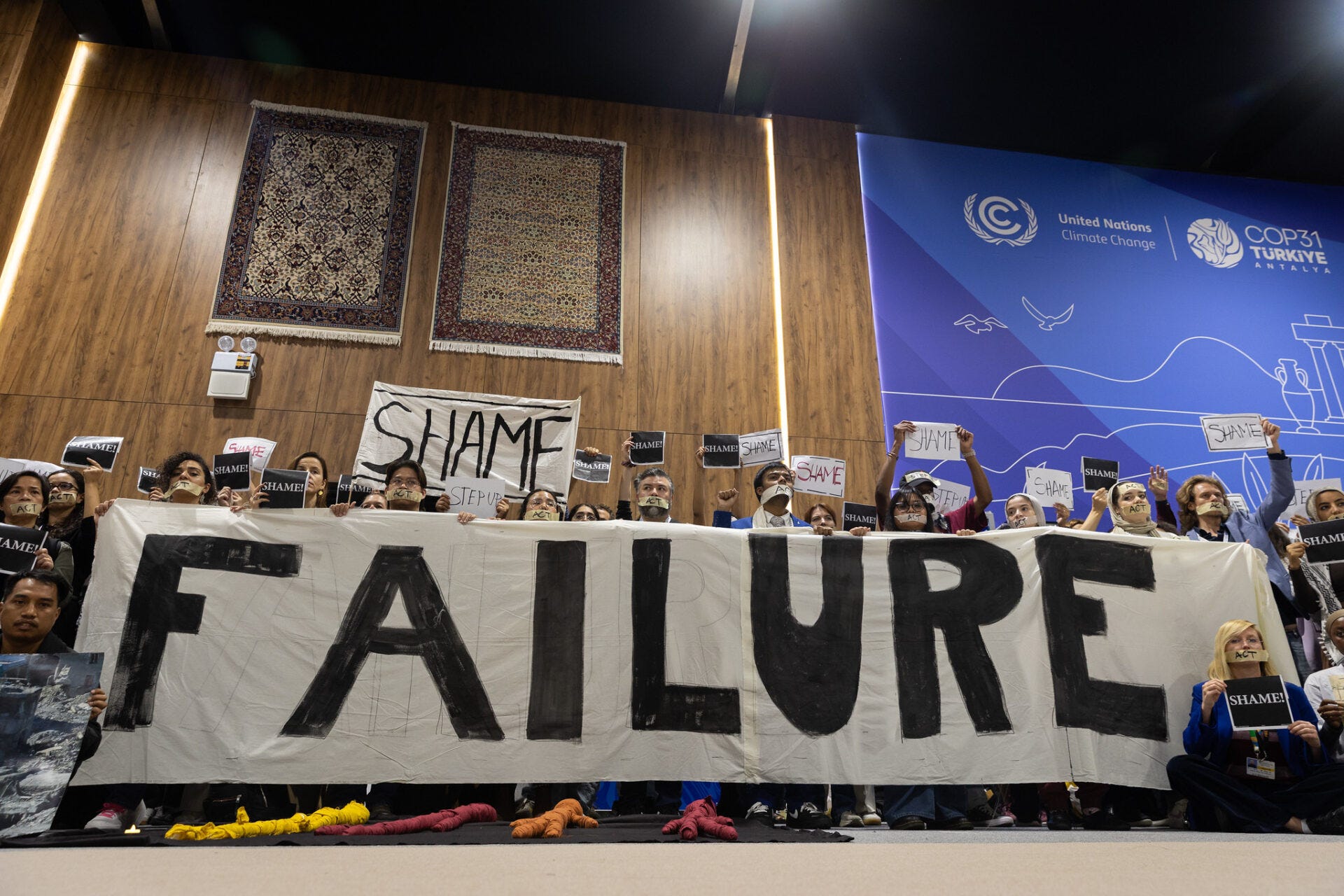
The lights in Antalya did not go out with a bang. They went out with a procedural shrug. COP31 ran forty-nine hours past its deadline and then died on a single missing phrase: fossil fuels. It was the first total collapse of a UN climate conference since Copenhagen in 2009, and the immediate post-mortem was brutally candid.
The European Union’s climate minister said the talks had been “hijacked by some oil states.” More than 130 countries had backed a demand that the final text retain a reference to transitioning away from fossil fuels; the Türkiye–Australia presidency did not restore it. The cover decision—the Antalya Pact—was never adopted.
In the same fortnight, the Global Carbon Project delivered a number that should haunt every strategist who still believes the multilateral system is adequate for the century. Global fossil-fuel emissions were projected to fall by 0.4 per cent in 2026, to roughly 42.2 billion tonnes. Oil emissions dropped by nearly 2 per cent; coal crept up; and total CO₂, once deforestation and peat fires were counted, actually rose by about 1 per cent.
The dip was not the work of the Antalya Pact, which did not exist. It was the work of the Iran war, which shut the Strait of Hormuz, sent fuel prices beyond reach, and forced economies to burn less oil because they could not afford to burn more. Glen Peters of Norway’s CICERO institute called it “a little bit of good news, but for the wrong reasons.”
This is the defining paradox of the post-Antalya moment: diplomacy failed to name the problem, and war solved it by accident, at a price paid overwhelmingly by those who had no say in either the war or the summit.
The environmental ledger from the conflict is already obscene. Iran’s president told COP31 that US and Israeli strikes on fuel facilities at Asaluyeh and near Tehran released 1.5 million tonnes of carbon dioxide. The Conflict and Environment Observatory counted more than 300 environmental incidents in the first ten days of the war—toxic clouds, black rain over Tehran, oil slicks drifting across a shallow Gulf that holds some 700 fish species and the world’s second-largest dugong population.
Carnegie Endowment analysts put the daily cost of the war to the United States alone at $2 billion, while noting that West Asia is warming at twice the global average. The war is ecologically catastrophic in the region and economically global in its reach.
That reach runs through the Strait of Hormuz, which normally carries around one-fifth of the world’s seaborne oil and LNG. Other analyses have traced the transmission with clinical precision: net oil and gas imports are 5 to 15 per cent of GDP for Pacific Island countries; Pakistan, Bangladesh and Sri Lanka import nearly all their crude from the Gulf and depend on oil and gas for more than half their energy mix, while holding less than a month in fuel reserves.
The World Food Programme estimated that an additional 9.5 million people in Asia would face acute food insecurity if the war continued, and the IMF warned that the Hormuz closure was raising borrowing costs and renewing inflation risks for developing economies. This is inflation as a regressive tax: it falls hardest on those least able to pay and least responsible for the conflict.
And here the architecture of impunity becomes visible in its full, ugly symmetry. In 1991, Iraq was made to pay. The UN Compensation Commission awarded $5.3 billion for environmental damage from the Gulf War—against $85 billion claimed—funded by a levy on Iraqi oil revenues under Security Council Resolution 687. In 2026, the alleged polluters include a permanent member of the Security Council and its ally. The same legal machinery cannot be turned against them.
The General Assembly’s May 2026 endorsement of the International Court of Justice’s climate advisory opinion, by 141 votes to 8, was a moral landmark, but advisory opinions do not seize assets, halt wars, or garnish oil revenues. The veto is not a bug in the system. It is the system’s sovereign exception—the mechanism that converts law into a court without jurisdiction whenever power is the defendant.
The military emissions blind spot compounds the impunity. Militaries and their supply chains account for an estimated 5.5 per cent of global greenhouse gas emissions, excluding emissions from armed conflict itself; global military spending reached a record $2.887 trillion in 2025, rising for the eleventh consecutive year. Yet reporting under the UNFCCC remains uneven, often aggregated with other sources, and conflict-linked pollution is structurally unreportable. The unmeasured is the ungoverned.
The Loss and Damage Fund tells the same story in a different register. It received requests totalling $2.8 billion in its first funding round but had only $342 million available—roughly one dollar for every eight requested. A proposed $120 billion annual adaptation finance target by 2035 was omitted from the latest draft deal text.
This is not a funding gap. It is a transfer of risk from the powerful to the vulnerable, dressed as charity. Debt cancellation should be understood as climate reparations, because ecological vulnerability has already been converted into debt service across the Global South.
So what was COP31? It was nihil on justice, partial on technical cooperation, and paradoxically productive on unintended decarbonisation.
But a transition born of fear is brittle, securitised and inequitable. It cannot legitimise itself. The point of climate treaties was never to stop a superpower war; they were designed to coordinate, finance, monitor, record and legitimise. When they fail at those tasks, they become an alibi—a confessional where grievances are performed while the powerful walk away.
The choice is not between diplomacy and crisis. It is between cuts imposed by crisis and cuts planned and financed by diplomacy. The latter remains normatively superior and materially unavailable without binding finance, military emissions reporting, debt relief, and liability rules that survive the veto.
Antalya did not create that settlement. It failed to transcend it—and in failing, it made the settlement visible with a clarity no successful communiqué could have achieved. The climate regime will either become a planner with teeth, or it will remain what Antalya revealed: a theatre of aftermath. That choice is political, and it is being made now.