


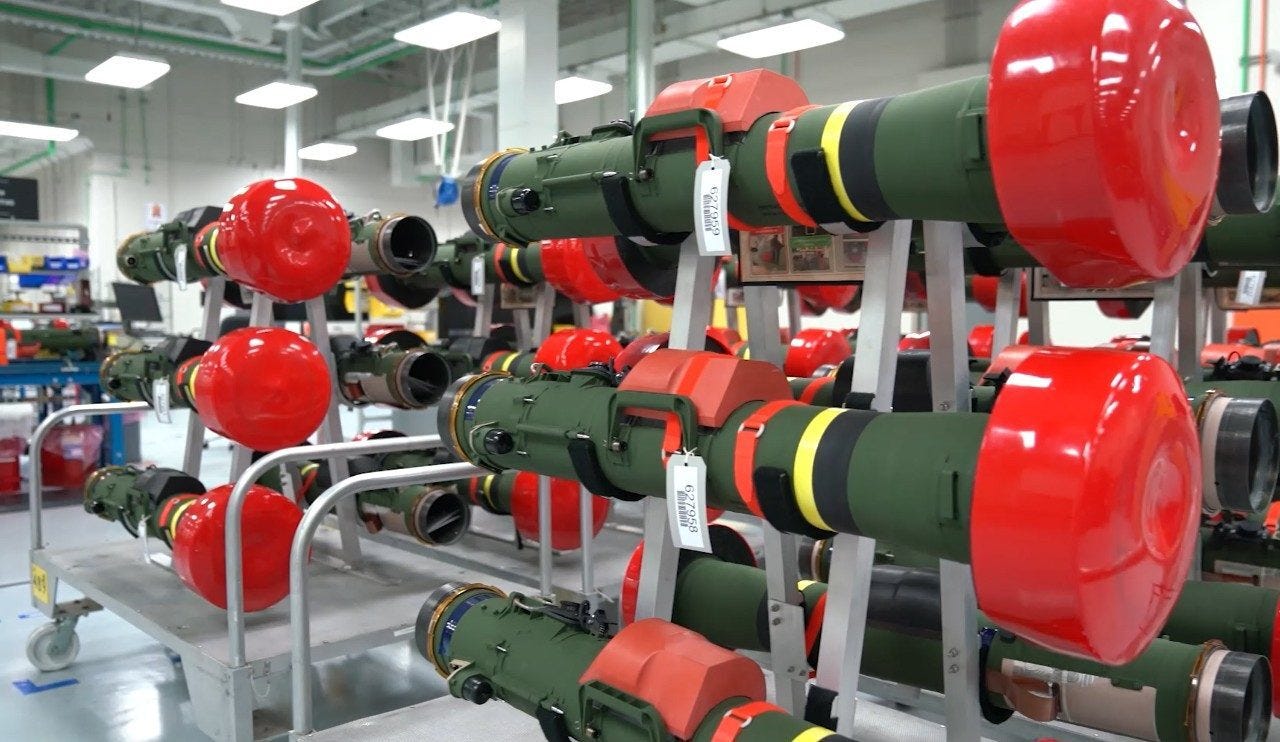
One of the top weapons manufacturers in the world, Lockheed Martin, and automaker General Motors announced on Tuesday, 16 June, a new collaboration to produce critical munitions and other weapons.
Companies claimed the collaboration was a result of the efforts of the US Department of War and the Pentagon, as the Donald Trump administration seeks to “double or triple” the capacity and rate of production of weapons in the country.
“Working under a Memorandum of Understanding (MoU), Lockheed Martin and GM Defence will explore opportunities to accelerate the delivery of critical capabilities and innovation by combining Lockheed Martin’s defence production expertise with General Motors' advanced industrial capabilities in high-rate commercial manufacturing and engineering,” Lockheed Martin said in a press release.
According to the press release, the collaboration will focus on “strengthening defence supply chains and advancing manufacturing and design capabilities to expand production capacity.”
“This collaboration brings together two leaders in American manufacturing and innovation to explore new ways to strengthen the defence industrial base, expand production capacity and accelerate the delivery of critical capacities” for the US and its allies, said Frank St John, chief operating officer of Lockheed Martin.
Lockheed Martin is one of the largest weapon manufacturers in the world and the largest supplier of weapons to the US Army. It is known as the producer of the F-35, the THAAD air defence system and Black Hawk helicopters, among others.
Though GM has a history of building tanks for the US Army during the Second World War, it has largely retained its status as one of the world’s largest automakers for decades. It re-established its weapon-manufacturing unit called GM Defence only in 2017.
According to the FT, both GM and Lockheed are planning to invest around USD 25 billion in the coming years in separate projects, including research and development, but largely related to the collaboration.
The collaboration is part of the Donald Trump administration’s push for the expanded and accelerated production of weapons in the country, which is already the world’s largest producer and exporter with over a 40% share in the global arms trade.
The Trump administration’s move is a result of the experiences during the joint US-Israeli war against Iran and its weapon supplies in the Ukraine war.
Despite its public denial of reports about the rapidly-dwindling stockpile of weapons and critical munitions following the war with Iran, whose “hot” phase lasted barely over a month, the Pentagon has been looking to enhance weapons manufacturing capacity in the country.
Both companies acknowledged their tie-up was pushed and facilitated by the Pentagon in particular to boost the production of missiles and air defence interceptors.
According to a report in the FT, the Pentagon has urged the defence manufacturers to double or triple the rate of production of critical munitions over the next three to seven years.
Currently critical munitions and missile defence systems usually take around 24 to 36 months to produce.
The Pentagon has reportedly tried to rope in another big automobile manufacturer, Ford, for similar collaboration with other defence manufacturers in the country.

Interesting that the Financial Times is the 'cited expert' in this mess..........
from a work by Marc Gauvin of the MSTA of bibocurrency.com
"5. The War Argument: When Void Obligations Make Destruction Rational
The compounding mechanism applied to sovereign debt produces nominal obligations formally un-payable through any productive means. At some point the financial alternative to war appears more catastrophic to certain actors than war itself. War, including nuclear war, becomes structurally rational as a means of voiding unpayable obligations. The quae ab initio non valent principle resolves this: once formal invalidity of contracts denominated in void units is established, the phantom obligations that make war appear rational dissolve. The correction removes the rationality of war not by moral appeal but by eliminating the structural mechanism that produces it.
A second independent mechanism operates at the level of international resource pricing: the B>0 transmission of global nominal price shocks onto nations whose real productive costs are entirely unaffected, generates phantom financial obligations over resource access that make conflict over resource pricing 44structurally rational independently of sovereign debt levels. Both mechanisms are eliminated simultaneously by correcting the unit definition. [Cross-reference: Chapter 13, “International Price Transmission: The Category Error at Planetary Scale.”] "
So, if what is driving all of this is an ages old conceptual error, then shouldn't humans focus on correcting that first as opposed to continuing for additional futile ages to make a contradiction become true??
You see, the unit to measure and keep records about the variability of the value in the things being interchanged between people cannot logically BE an item Of value with its own variability.
Marc Gauvin explains: "A valid measure must be independent of what it measures, passive with respect to it, and available without per-unit cost. A commodity has independent market value, is subject to scarcity, and commands a price proportional to that value for access. These two property sets share no common element. They are mutually exclusive by logical necessity: a unit that has independent market value cannot simultaneously be independent of what it measures. A unit subject to scarcity cannot simultaneously be available without per-unit cost.
The operative notion of money assigns both property sets simultaneously to the same symbol.
This is not a tension or a trade-off or a policy choice. It is a formal logical contradiction. And it is the operative assumption on which every contract, every financial model, every regulatory framework, and every policy instrument currently functioning on earth is built.
From this single contradiction everything else follows necessarily.
Because the symbol is assumed to have independent commodity value, treating access to it as scarce and subject to a percentage price is internally rational within that assumption. That percentage cost, applied across a chain of two or more transactions, generates a nominal claim that grows without bound as the chain lengthens, independently of how much real value the chain produces. This is not an economic theory. It is an arithmetic identity provable by the same mathematical induction used to prove that 1+1=2.
.....The consequences are observable and growing. A substantial and growing fraction of current working hours is directed at servicing financial claims rather than genuine productive activity — documented in tax burden data, household debt service ratios, and the ratio of global financial claims to real assets, which currently exceeds real productive value by a factor of three to ten and is increasing. This diversion is not a policy failure. It is a structural consequence of the contradiction operating at scale, at transaction speeds eighty-six million times faster than fifty years ago.
The correction costs nothing to implement. It penalises no agent. It requires no political consensus on values, no transfer of wealth, and no agreement on what humanity should produce or prioritise. It requires only that the unit of measure we use for everything be subjected to the same logical requirements as every other unit of measure we use correctly.”