


We are experiencing a profound moral crisis of witnessing, inseparable from the broader political crisis produced by neoliberal capitalism and its mechanisms of disposability. Images of war and suffering now saturate our screens. We are not overwhelmed by information, but by an overexposure to the banal: an endless stream of images manufactured without reflection and consumed without memory. Simultaneously, the arts and humanities are deprived of public funding, stripped of their civic relevance, and recast as ornamental rather than essential to democratic life. Within this regime of manufactured spectacle, where every atrocity becomes content and every image a commodity to be scrolled past and discarded, our very capacity to witness, to feel the weight of what we see and to be transformed by it, is being systematically eroded.
This is not simply a crisis of aesthetics. It is a crisis of politics, memory, and moral responsibility. Under neoliberalism’s regime of disposability, in which entire populations, cultures, democratic institutions and ecologies are rendered expendable in the name of profit and power, the image itself has become another instrument of that disposability. Pain is aestheticized, packaged, and forgotten within the same news cycle that produced it. At the same time, the conviction that art can and should be transgressive gives way to a fetishization of simulated images that tell us nothing about the seriousness of our contemporary collapse. Art, like democracy itself, is being emptied of its critical function and repurposed as profit and spectacle.
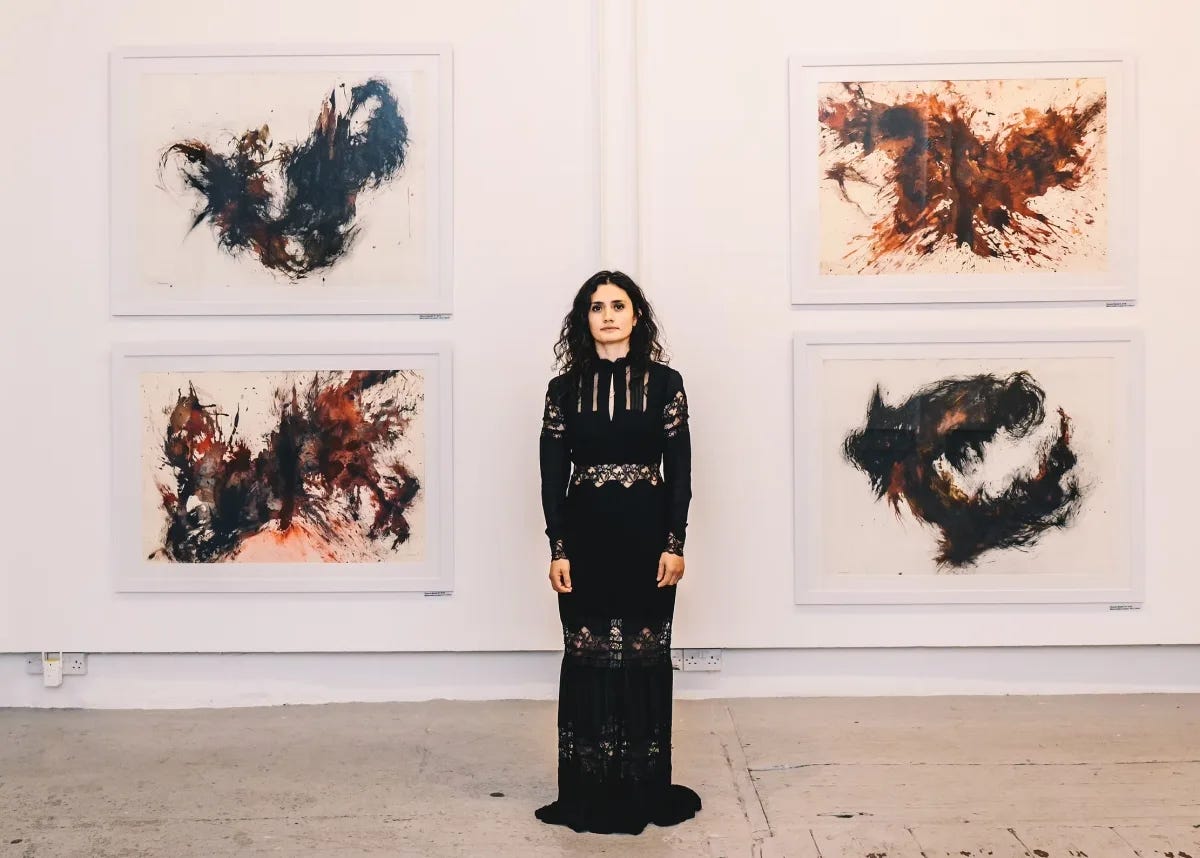
Within this landscape of moral exhaustion, the work of Mexican painter Chantal Meza commands attention. I first encountered Meza’s work in 2017. Two years later, I invited her to speak at McMaster University, marking the first time she discussed her work outside of Mexico. Since then, I have observed her career develop with clear purpose: solo exhibitions across the United Kingdom and Europe, numerous reviews and endorsements from leading art critics and theorists, two books, multiple articles, and invitations to lecture internationally. This trajectory is not accidental. While Meza is an artist of significant technical accomplishment, her importance lies elsewhere. She does not serve up images for consumption; rather, she offers a radical refusal that confronts the intolerable directly.
Against the Tyranny of the Image
To understand Meza’s significance today, and why her work continues the radical tradition that links art to the urgency of moral witnessing, it is necessary to recognize what has been lost. Contemporary visual culture operates according to a logic that critical pedagogy has long identified as central to neoliberal governance: the reduction of complex historical and structural realities into individualized, decontextualized, and endlessly circulating fragments. A photograph of a bombed hospital appears beside an advertisement. Footage of a drowned child scrolls past a celebrity’s vacation endorsement photos. Algorithms do not merely fail to provide context; they actively undermine the conditions necessary for context to emerge. Suffering is stripped of its history, its politics, and the ethical demands it should impose.
Art is pedagogical precisely because it does more than represent the world; it intervenes in how the world is seen, remembered, felt, and judged. At its most radical, art disrupts the habits of perception through which domination becomes familiar, and suffering becomes ordinary. It creates a space in which seeing can become a form of questioning and perception can become a condition for political awakening. In this sense, the struggle over art is inseparable from the struggle over consciousness itself.
The political power of images therefore lies not simply in what they show, but in the kinds of subjects they help produce. A culture organized around speed, distraction, and endless circulation trains people to glance rather than attend, react rather than judge, and consume suffering rather than confront its causes. The struggle over art is consequently inseparable from the struggle over what kinds of human beings and democratic subjects a society makes possible.
In contrast, authoritarian power depends upon more than repression; it depends upon organized forgetting. The disappearance of people is accompanied by the disappearance of histories, causes, responsibilities, and languages of resistance. Against this machinery of erasure, art can become a form of counter-memory, rescuing suffering from oblivion while returning the past to the unfinished struggles of the present. Memory in this sense is never merely retrospective. It becomes a political resource for challenging those forms of power that depend upon historical amnesia.
This leads to the issue of disappearance, which, as I have previously argued, is one of the defining problems of our historical moment. This violence is visible on our doorsteps, as ICE operatives abduct individuals from the streets, leaving their whereabouts unknown. These practices are not new; they were refined by the CIA and implemented in Latin America by authoritarian regimes trained at the School of the Americas. However, the practice of disappearance has proliferated today, particularly in Mexico, where families continue to search for relatives taken by organized crime, state violence, war, and forced migration, all of which are inseparable from broader neoliberal forces and their destructive tendencies.
Disappearance is not an event that concludes; it is a condition that persists, suspending grief indefinitely, denying communities the closure that mourning requires, and eroding the fabric of collective memory. It is, in the fullest sense, a form of structural violence, one that operates precisely by remaining invisible, by refusing to leave behind the kind of evidence a photograph or a headline can capture. But disappearance cannot be separated from a second, equally corrosive disappearance: the disappearance of moral courage, of civic literacy, and of a genuine collective will to imagine the world otherwise, a project artists should be at the forefront of as agents of radical, democratic change. No artist has taken up this double disappearance with more ethical care and political seriousness than Chantal Meza.
In confronting disappearance, documentary representation frequently fails. For this reason, Meza’s abstract work should be understood as a deliberate ethical and political stance rather than a mere stylistic choice. A photograph can depict a body, but it cannot represent an absence. It can document a crime scene, but it cannot convey the years of uncertainty that follow, the dissolution of identity, or the collective memory forced to bear an unresolved wound. Meza’s paintings do not attempt this impossible documentary task. Instead, they develop a visual language capable of expressing what lacks a fixed form: the atmosphere of loss, the psychological terrain of uncertainty, and the persistent presence of absence within a landscape.
Her long-term project Disappearance exemplifies this approach at its most ambitious. Conceived not as a single body of paintings but as an evolving series of collections that have created an interdisciplinary platform, the project has drawn together artists, philosophers, humanitarian workers, and academic researchers over nearly a decade. It refuses the isolation the contemporary art market so often imposes on painting, treating the canvas instead as a site of collective inquiry, one that generates publications, public discussions, and institutional partnerships rather than simply decorating a wall. As part of this, her permanent donated collection at the University of Bath, where it now serves as a resource for research and teaching in politics and violence studies, reflects Meza’s deeper conviction: that painting is not illustration for ideas developed elsewhere, but a form of knowledge production in its own right, one capable of reaching what conventional scholarly language cannot. This demands precisely the kind of interdisciplinary exchange that refuses to let the paintings stand alone as mute objects of contemplation.
In this sense, Meza occupies the role of the artist as public intellectual—a cultural worker who is both a border crosser and speaks to multiple publics. She refuses the neoliberal reduction of the artist to celebrity, entrepreneur, brand, or producer of collectible objects. Her work moves deliberately into public life, creating political spaces where aesthetics becomes inseparable from historical inquiry, ethical responsibility, and democratic dialogue. The artist here becomes a cultural worker whose task is not to dictate what people should think, but to challenge the conditions that make thought difficult and political indifference possible. She elevates the relationship between art and moral witnessing to a project of inclusion, justice, and struggle.
Violence Without a Human Face
Meza’s work does not turn away from the intolerable conditions that individuals are forced to endure or from the superficial responses often presented as witnessing. Instead, she immerses herself in these realities to facilitate deeper understanding. Through this engagement, she demonstrates that violence is not merely a discrete human act, confined to a single moment between perpetrator and victim, but rather a condition embedded within political, historical, ecological, and technological systems. Violence in this sense moves from modality of representation into the interrelated merging of history, social structures, and biography—a kind of sociological imagination embedded in the work of art itself. This theoretical approach is central to her work and aligns with a broader critical tradition that interrogates power and disposability.
Her paintings remind us that the disappeared are not merely victims of individual criminals. They are casualties of systems that render entire populations expendable: economies sustained by organized crime, states that regard their own citizens as surplus, and a global order that perpetuates precarity as a permanent condition for the many in service of accumulation for the few.
In this light, Meza belongs to a long political tradition of artists who have understood witnessing not as the passive recording of atrocity but as a moral and civic obligation to confront what violence attempts to erase. Her practice belongs alongside Pablo Picasso’s Guernica and the extraordinary work of Iri and Toshi Maruki, whose Hiroshima Panels transformed the experience of atomic violence into an art of memory, mourning, and moral confrontation. What connects these artists is not a shared style or method; Picasso did not attempt to reproduce the bombing of Guernica photographically, just as the Marukis did not simply document Hiroshima. Each developed a visual language capable of addressing an experience that exceeded straightforward representation. Their work insists that art can bear witness precisely where literal images fail: by refusing to let suffering disappear into technical abstraction, historical distance, or the mechanisms of visual consumption.
What distinguishes Meza’s work is its engagement with the historical moment it addresses. Disappearance, the central focus of her practice, is no longer an exceptional condition that art must render visible to attract public attention. It has become commonplace. Images, events, individuals, places, and forms of suffering now appear and vanish rapidly, absorbed into the continuous circulation of information, spectacle, and distraction produced by the political economy of the attention industry. The issue is not that violence remains unseen; we witness it constantly. Rather, the problem is that seeing no longer ensures remembering, and visibility itself has been stripped of context and consequence.
The central political struggle, then, is no longer simply over what can be seen, but over whether what is seen can be made historically and politically legible. Visibility severed from history produces its own form of blindness. Images become dangerous to power when they cease to circulate as isolated spectacles and are brought into relation with history, memory, causality, and responsibility. The crucial question is not simply whether suffering appears before us, but whether we possess the critical languages necessary to understand what produced it, whose interests are served by it, and what forms of power must be confronted if it is to end.
Meza’s work locates art within precisely this struggle over meaning, power, and public consciousness. Art, in this sense, cannot be reduced to an expression of individual creativity or an object of aesthetic contemplation; it is a form of cultural politics, a terrain on which meanings are contested, histories recovered, and the boundaries of the visible and sayable challenged. Meza turns artistic practice into a performative and pedagogical intervention, bringing politics, power, and ethics into the very act of seeing. Her work refuses the separation of aesthetics from public life and instead offers a cultural practice capable of intervening in the present, remapping the boundaries of difference, deepening public engagement, and transforming spectatorship from passive consumption into an encounter with memory, responsibility, and the possibility of action.
Meza’s response, therefore, is not simply to generate awareness by making visible what would otherwise remain hidden. Instead, she confronts the political conditions that render visibility itself unstable and disposable. In doing so, she redefines the moral and political meaning of witnessing. For Picasso and the Maruki’s, the urgency was to give form to violence that demanded remembrance. For Meza, the challenge is different: what happens after we have seen, when even the most devastating image can be consumed, displaced, and forgotten?
Her visual language of absence, fragmentation, erasure, and material persistence takes up precisely this challenge. It does not merely represent disappearance; it renders disappearance present within the act of viewing. The painting becomes a site where something is simultaneously revealed and withheld, encountered and lost.
American Dream
In Meza’s work, witnessing is less an act of discovery than an act of political persistence. It refuses the assumption that once something has been seen, it has therefore been understood, remembered, or ethically acknowledged. For Meza, art derives much of its critical force from what Edward Said called affiliation, the recognition that cultural works are never isolated from the world but are bound to the histories, institutions, social forces, and relations of power that give them meaning. To restore these affiliations is to reconnect what we see to the conditions that produced it, transforming the artwork from an isolated aesthetic object into a site of historical memory, political judgment, and possible resistance. In this sense, Said’s argument is deeply Gramscian: culture is a terrain of struggle where power and consent are produced, but also where dominant meanings can be disrupted, contested, and transformed.
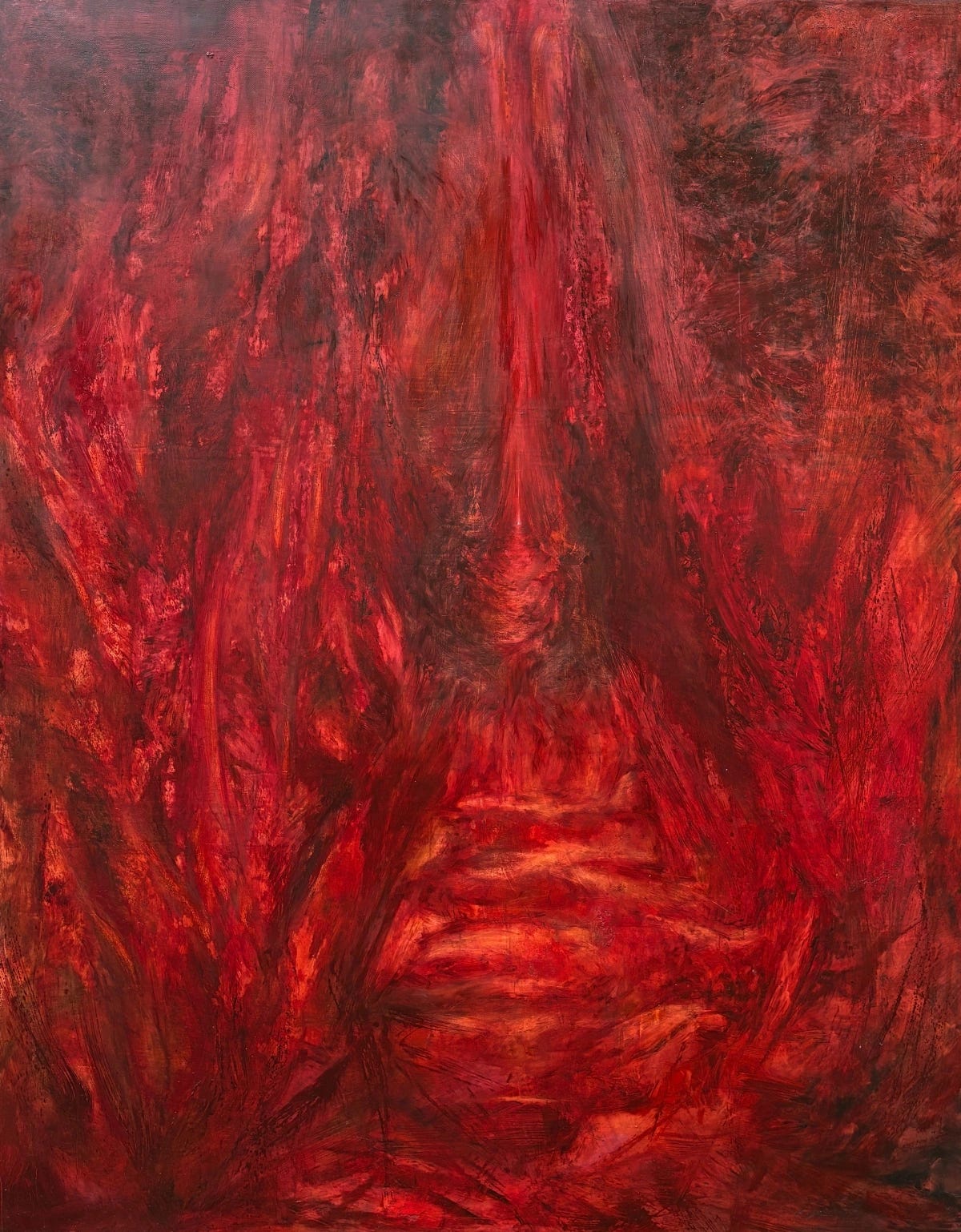
It is worth specifically drawing attention here to one of Chantal Meza’s new works titled American Dream, which was recently the centerpiece for an exhibition of her work at the Embassy of Switzerland in London that was partnered by the International Committee of the Red Cross and the British Red Cross.
Rather than presenting the American Dream as an uncomplicated symbol of opportunity, Meza exposes its inherent contradictions. This work can be interpreted through the interconnected dynamics of border tensions, migration, economic inequality, political power, and the historical relationship between Mexico and the United States.
The familiar Mexican lament, “poor Mexico, so far from God and so close to the United States,” captures an enduring political contradiction. The United States represents economic possibility while also constituting a powerful source of military, political, and economic pressure, and decades of secretive, violent interventionism. For many migrants, the border does not represent a simple division between two sovereign territories. It is a political structure that determines mobility, opportunity, exclusion, and vulnerability.
Seen from Mexico, the American Dream cannot be separated from the material realities of migration and the dreams of a better life. But such a dream is not merely an individual aspiration. It is embedded in unequal economic relations, labor demands, border policies, and histories of political power and violence. The painting’s vertical structure and intense reds can be understood within this political framework. What initially appears as aspiration or movement also suggests terror, instability, and destruction. The journey toward the dream becomes inseparable from the conditions imposed upon those who seek it.
Here, the desert path detectable at the center of the artwork is not an empty landscape. It is a political space. As for migrants, it becomes part of a border regime in which increasingly restrictive policies redirect migration routes into dangerous terrain. In the art, it speaks also to the human cost of migration, which cannot be understood apart from the political decisions that structure mobility and exclusion.
Here, Meza’s painting functions as a form of public pedagogy. It does not merely depict migration; instead, it prompts viewers to reconsider the political assumptions that typically shape understandings of migration, including the aspirations that can lead to violence and death.
Migrants are frequently reduced to statistics, security threats, or objects of humanitarian concern. Meza’s work challenges this abstraction by centering human vulnerability within the image.
Simultaneously, American Dream can be interpreted as a critique of the United States itself. The painting does not merely represent a dream pursued from abroad; it raises questions about the consequences for a political order when the promises of democracy, equality, and opportunity become increasingly disconnected from material reality.
The crisis is therefore not only at the border. It is also internal. Inequality, authoritarian politics, nationalism, racism, militarization, and the normalization of social disposability can weaken the institutions associated with democratic life. A political culture that continually produces enemies and defines vulnerable populations as threats ultimately undermines the democratic ideals it claims to defend.
For this reason, the painting should not be understood solely as a commentary on migration. It addresses a broader crisis in political imagination.
Power becomes most formidable when it colonizes the imagination, when the existing order appears inevitable and alternatives become unthinkable. Radical art interrupts that closure. It makes the familiar strange, unsettles the tyranny of common sense, and keeps alive the possibility that the world can be otherwise. The radical imagination is therefore not an escape from politics; it is one of the conditions that makes politics possible. Without the capacity to imagine beyond the existing order, resistance is reduced to managing the intolerable rather than transforming it.
The central question is not merely why individuals continue to pursue the American Dream, but what kind of political and economic system compels so many to risk their lives in pursuit of it.
Toward a Pedagogy of Political Hope
The political significance of Meza’s work ultimately resides in its rejection of resignation. Her paintings do not provide easy solutions, nor do they accept the inevitability of the conditions they portray.
This distinction matters. Critical art should not simply reproduce despair. Nor should it offer a sentimental form of hope detached from political struggle. Hope, understood politically, is a practice of collective possibility. It requires identifying the structures that produce injustice while creating the intellectual and cultural conditions necessary to challenge them.
Such hope has nothing to do with optimism. It begins with the refusal to surrender the future to those who insist that the present order is permanent. Hope becomes meaningful when it is educated, when it joins critique to possibility and links the capacity to imagine otherwise to the courage and collective agency necessary to act upon that imagination.
Meza’s work contributes to this process by compelling viewers to slow down. In contrast to the rapid consumption of images, her paintings demand sustained attention. Where historical context is often lost, they restore complexity. Where suffering is reduced to spectacle, they create spaces in which absence and uncertainty can be directly confronted.
This demand for attention is itself political. In a culture in which consciousness is increasingly fragmented by the relentless acceleration of images, commodities, information, and manufactured distraction, sustained attention becomes a form of resistance. To look carefully is to refuse the demand to consume quickly and forget. Meza’s paintings interrupt that machinery. They ask viewers to dwell within uncertainty long enough for perception to become reflection, and reflection to become judgment.
Her work thus raises a broader question regarding the political responsibilities of artists and cultural institutions. If democracy relies on citizens who can envision alternatives to prevailing forms of domination, then the arts are not merely decorative additions to democratic life; they are an essential component of it.
Painting alone cannot dismantle borders, end political violence, reverse ecological destruction, or transform neoliberal capitalism. However, it can challenge the narratives that render these structures natural or inevitable. Painting can expose contradictions, preserve memory, disrupt normalization, and create spaces for critical reflection.
Radical art matters because politics begins partly in the struggle over perception: over what can be seen, what can be remembered, what can be named, and what can still provoke outrage. Art cannot by itself overthrow systems of domination, but it can rupture the habits of seeing through which domination becomes normalized. It can recover suppressed histories, make suffering politically legible, awaken moral attention, and nourish the radical imagination without which collective resistance becomes impossible.
This is the political significance of Chantal Meza’s practice. She does not merely invite us to observe violence; she urges us to examine the political conditions that enable violence and the cultural mechanisms that normalize it. Her work challenges viewers to move beyond passive recognition toward historical understanding and civic responsibility. In a world that can circulate faster than memory, when political discourse increasingly reduces human beings to categories of threat or utility, and when ecological and social crises are normalized as unavoidable, such a practice is urgently necessary.
Meza’s contribution extends beyond contemporary painting. It engages with the broader struggle over how societies remember, what they choose to ignore, and whose lives are deemed worthy of political protection. Her paintings assert that witnessing is not complete upon seeing; it begins when seeing generates a demand for interpretation, memory, and action.
This is where art becomes inseparable from democracy. Democracy requires more than institutions, procedures, and elections; it requires a formative culture capable of producing citizens who can think historically, judge critically, recognize the suffering of others, and imagine forms of collective life beyond the horizons imposed by domination. Art at its most consequential participates in that formative struggle. It makes visible the forces that power would prefer to remain unnamed while opening spaces in which new modes of agency, solidarity, and possibility can emerge.
In this context, the task of art is not to provide consolation. Rather, it is to disrupt complacency and foster the conditions for a renewed political imagination, one in which human dignity is not subordinated to profit, borders do not determine whose lives matter, and ecological destruction is not accepted as an unavoidable consequence of economic growth.
At a time when authoritarian power thrives on historical amnesia, manufactured ignorance, moral numbness, and the destruction of the radical imagination, the struggle over art becomes part of a larger struggle over what kind of society and future remain possible. The crucial question is no longer simply what art represents, but what forms of attention it demands, what memories it keeps alive, what modes of consciousness it makes possible, and what forms of collective agency it helps bring into being.
That is the moral and political challenge at the center of Meza’s work. It is also the challenge facing art itself.
