


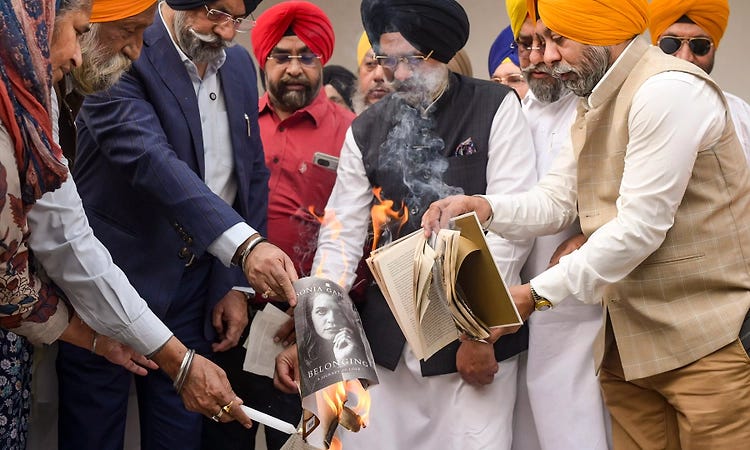
In her best-selling memoir, Belonging: A Journey of Love, Congress leader Sonia Gandhi records a well-known fact of India’s anti-colonial struggle: Vinayak Damodar Savarkar wrote repeatedly from the Cellular Jail, seeking clemency from his oppressors.
Understandably, the right wing finds this fact unpalatable. It often tries to explain it away as a step recommended by M.K. Gandhi or recasts it as yet another astute political move by the Hindutva leader, one that made possible his later career of consolidating Hindu cultural nationalism.
And so, a few days ago, members of the Eknath Shinde-led Shiv Sena in Maharashtra tore the offending pages from her book.
But then a Bharatiya Janata Party (BJP) minister in the state’s right-wing Cabinet, Ashish Shelar, objected to such vandalism without naming those responsible. He did not necessarily agree with what she wrote. His objection rested on an admirably principled ground: vandalising books we dislike bespeaks barbarism, not democratic or civilisational forbearance towards facts and ideas that some sections of society find antithetical.
So we say three cheers to this minister, clearly and demonstrably a “Dimagi Naxal” (literally an “intellectual Naxal”: Prime Minister Narendra Modi’s label for those he says share the mindset of India’s Maoist insurgents, the Naxals) within the nationalist pantheon, one who keeps a questioning mind about the plurality of positions in social and intellectual life.
Shelar’s intervention reminds us that not all conservative politics has been monologic or fascistic. Many worthwhile contributions to the evolution of democratic ideas and practices worldwide have come from groups and individuals who, however wedded to reactionary thinking, stopped short of claiming suzerainty over values.
The interesting question is how far the minister’s example may travel in easing the right wing’s intolerance of facts and ideas it dislikes, however valid or germane.
Consider the alternative. If those who regard themselves as god’s own chosen variety of the human species confined their entire moral and intellectual universe to an edict or two, a bookless world might well be born, with only a handful of warring scriptures making up the library of humankind. More than one modern leader of standing seems wedded to that prospect.
Shelar’s questioning also recalls leaders like Atal Bihari Vajpayee, who loved the rich archive of Urdu poetry as much as today’s right-wing leaders hate it and work to make it disappear.
The cyclopes in charge of national destiny now seek to deepen the hurtful impoverishment of India’s rich legacies. That damage could be reversed if more members of the empowered right wing saw the beauty and necessity of Shelar’s courageous questioning. They might then let the country’s cultural and ideational pluralities live out their conjoint splendours in an atmosphere of free expression and enquiry, rather than under the proverbial jackboot of top-down diktat.
Above all, Shelar’s objection to vandalising books for their inconvenient contents could extend to reversing the blight on educational curricula. Not only are “other” points of view ejected from school, college and university courses; entire books are removed from libraries and bookshops.
We do not know whether Shelar likes India’s first prime minister, Jawaharlal Nehru. But insofar as he recalls that open-minded stalwart, we see hope that time may overtake the right wing’s revanchist historical and ideational preferences and allow a social, cultural and intellectual order free of the pollution of diktat.
“Dimagi” Naxalism may not be such an odious thing after all.