


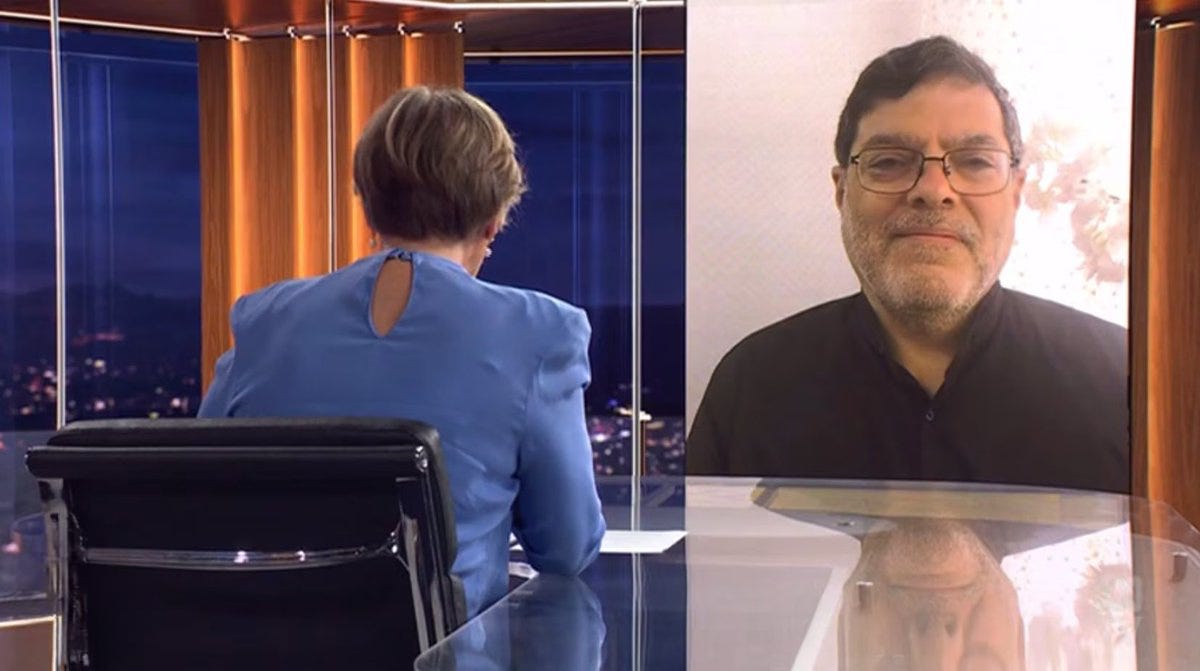
In the space of a few searing minutes on ABC’s 7.30, something broke. Not a ceasefire—that was already a corpse—but the very architecture of who gets to name truth in a world unravelling at the seams.
When Sarah Ferguson gave University of Tehran Professor Mohammad Marandi the discursive freedom that most heads of state never receive on Western television, the studio ceased to be a studio. It became a chancellery. A moral tribunal. A portal through which the Global Majority’s suppressed logic entered Australian living rooms—and ricocheted across the planet.
This was not journalism. This was a rupture in the global order.
For decades, Australia has been the reliable satellite—amplifying Washington’s narratives on Iran, the Middle East, and beyond with a zeal that bordered on the vicarious. Australia remains a leading middle power in Asia, navigating an order still dominated by two superpowers. Middle powers, conventional wisdom holds, pursue influence through “niche diplomacy”—careful communiqués that rarely challenge the superpower patron’s framing.
Not at this time. Ferguson’s expansive hosting of Marandi transformed the 7.30 studio into a de facto diplomatic salon. When she allowed him to dissect the ceasefire’s structural impossibility through the lens of Articles 1 and 5—arguing the collapse was encoded in the text from the start—she performed an act of epistemic hospitality that no foreign ministry in Canberra dared to attempt.
The memorandum of understanding signed on June 16 was always a deferred crisis rather than a durable peace. It gave Iran 60 days to reach a final deal while offering limited economic relief—but left the core drivers of conflict untouched. Iran sold roughly 50 million barrels of oil during the brief truce, generating around USD 3.5 billion in revenue.
Yet critical issues—Iran’s ballistic missile programme, its support for regional proxies, even clear terms on uranium enrichment—found no mention in the MoU. The ceasefire was a ritual, not a settlement. A performance of peace designed to manage global optics while buying time for territorial consolidation.
Marandi articulated what the Global Majority already knew. Ferguson, by not obstructing that articulation, effectively validated the diagnosis.
Here is the uncomfortable truth that the interview laid bare: global diplomacy is no longer driven primarily by humanitarian imperatives or the canonical “Responsibility to Protect.” It is driven by the sheer terror of supply chain fragility.
The Strait of Hormuz—through which approximately 25 per cent of the world’s seaborne oil trade and over 110 billion cubic metres of LNG transited in 2025—has become the new moral imperative. Around 20 million barrels of crude oil pass through the strait each day, accounting for roughly 27 per cent of global maritime oil trade. About 80 per cent of that flow is destined for Asia.
A disruption would not be a regional crisis. It would be a planetary recession. One that punishes the global poor first and the wealthy soon after. Iraqi officials have warned that closure could drive oil prices to $200–$300 per barrel, exacerbating the global inflation crisis.
When Ferguson and Marandi converged on this fear—when both framed the economic collapse triggered by Hormuz disruption as the true catastrophe—they disclosed a profound transformation in the very substance of diplomatic motivation. Peace, in the liberal internationalist tradition, was a moral end tied to human rights and democracy. Today, the global majority wants a different peace: a logistics peace. The absence of disruption that could trigger cascading economic catastrophe.
Australia—a wealthy resource exporter whose prosperity depends on these very sea lanes—is more tightly coupled to the Hormuz chokepoint than to the strategic theatre of a U.S.-Iran showdown. The interview revealed that Australia is, perhaps for the first time, performing a global majority alignment: acting as a middle power whose moral vocabulary is drawn from the shared fear of economic extinction.
To grasp the magnitude of what occurred, one must recall that Western media’s coverage of the Middle East is, in large measure, the history of Orientalism performed through news bulletins. The native is spoken about; rarely allowed to speak in his own conceptual vocabulary.
Marandi is no ordinary academic. Born in Richmond, Virginia, he is the son of Alireza Marandi, a physician who served as Iran’s Minister of Health and became Supreme Leader Khamenei’s personal physician. A former adviser to Iran’s nuclear negotiating team, he has appeared on PBS, CNN, BBC, Al Jazeera, and RT. He is, by any measure, a sophisticated operator of the Western media ecosystem.
Yet when he told Ferguson she was “not much of a journalist,” a “supporter of genocide,” and “cowardly”—when he demanded she “source her claim” that Iran had a nuclear weapons program—the confrontation was not merely personal. It was epistemological. A non-Western moral logic, long filtered out as conspiracy or propaganda, was given room to breathe and reshape Global North strategic thinking.
Ferguson kept her cool. She wrapped up the interview with a measured “Mohammed Marandi. Thank you very much indeed for joining us”. But the damage to the unipolar monopoly on meaning was done.
This is the emergence of a new genre: geo-journalism. Where the journalist consciously uses the interview format to transmit suppressed epistemologies and, in doing so, shifts the global conversation.
Ferguson functioned as a proxy for the silenced majority—not just in Australia but across the Global South. A 2024 Guardian Australia poll found that 38 per cent of respondents believe Australia should act as an “independent middle power with influence in the Asia-Pacific”. The interview gave voice to that sentiment, aligning Australian public discourse with the anxieties of Jakarta, New Delhi, and São Paulo rather than those of Washington and London.
This is journalism not as watchdog but as diplomatic proxy—an institution that conducts a parallel foreign policy of meaning-making. One that aligns not with the strategic preferences of the U.S. ally but with the moral anxieties of a global constituency that includes the Australian taxpayer, the Indonesian consumer, and the Indian merchant.
All of this converges on a singular transformation of Australia itself. A Western state anchored in the Indo-Pacific. A settler-colonial society geographically part of the Global South but politically aligned with the Global North. A middle power whose economic security is more tightly coupled to global supply chains than to any alliance commitment.
The 7.30 interview ruptured the pattern of Australia as a compliant satellite. It marked the point where Australia stopped echoing U.S. strategic preferences and began representing the moral anxieties of a world that prioritises planetary stability over hegemonic rivalry.
This is not rebellion. It is structural necessity. The dawning recognition that Australia’s prosperity—and indeed its social stability—depends on the Hormuz chokepoint remaining open. That the view from Sydney can modify the discourse in New York and Tehran simultaneously.
In the final analysis, the Ferguson-Marandi interview is more than a media event. It is an epistemological and diplomatic singularity compressed into a few minutes of television.
It demonstrates that the architecture of global narrative power is shifting from the chambers of the UN Security Council and the communiqués of foreign ministries to the studios of national broadcasters with the courage—or the insouciance—to give discursive freedom to the unheard.
It marks the first visible rupture in a Western epistemic monopoly that has, for centuries, determined what counts as a reasonable interpretation of conflict. It redefines the ceasefire as a performative ritual, the middle power as moral auditor, and peace itself as the protection of economic survival.
The questions posed are no longer hypothetical. They are the coordinates of a world already being born—where the boundary between journalism and diplomacy, between national interest and global solidarity, between Western epistemology and the logic of the Global South, dissolves into a new, precarious, and profoundly hopeful configuration.
The studio has become the new global agora. And in that agora, a middle power’s journalist asked the questions that allowed the world to hear what it already knew but could not say.
Whether this was a fleeting aberration or the birth of a new strategic culture depends on what follows. But the singularity has already occurred. When Marandi’s words were beamed into Australian homes and then ricocheted across the globe, the image of Australia as a compliant ally splintered.
In its place emerged the possibility of a moral middle power whose defining act is not the deployment of troops but the hosting of a conversation that the world needed to hear.
The question now is: will anyone be listening?

"When Sarah Ferguson gave University of Tehran Professor Mohammad Marandi the discursive freedom that most heads of state never receive on Western television..."
I'm not sure she meant to give him much freedom; it was a freedom he secured for himself. She cut him off repeatedly, and was hostile in the framing of her questions from the start and throughout. It was a lecture concealed as an interview and it backfired on her.
The Murdoch press headlined Prof Marandis' "rude response" to Fergusons' attacks, but in my opinion Sarah Ferguson was the one being offensive. The ABC is supposed to be indepenent but they have been cowed into toeing the official line by repeated funding cuts and threats of more to come from the Govt. And the Australian Govt is an obsequious vassal of the Amerikan Empire - AUKUS anybody.
Most Australians have probably never even heard of Prof Marandi because "we don't talk about politics 'round here mate".