


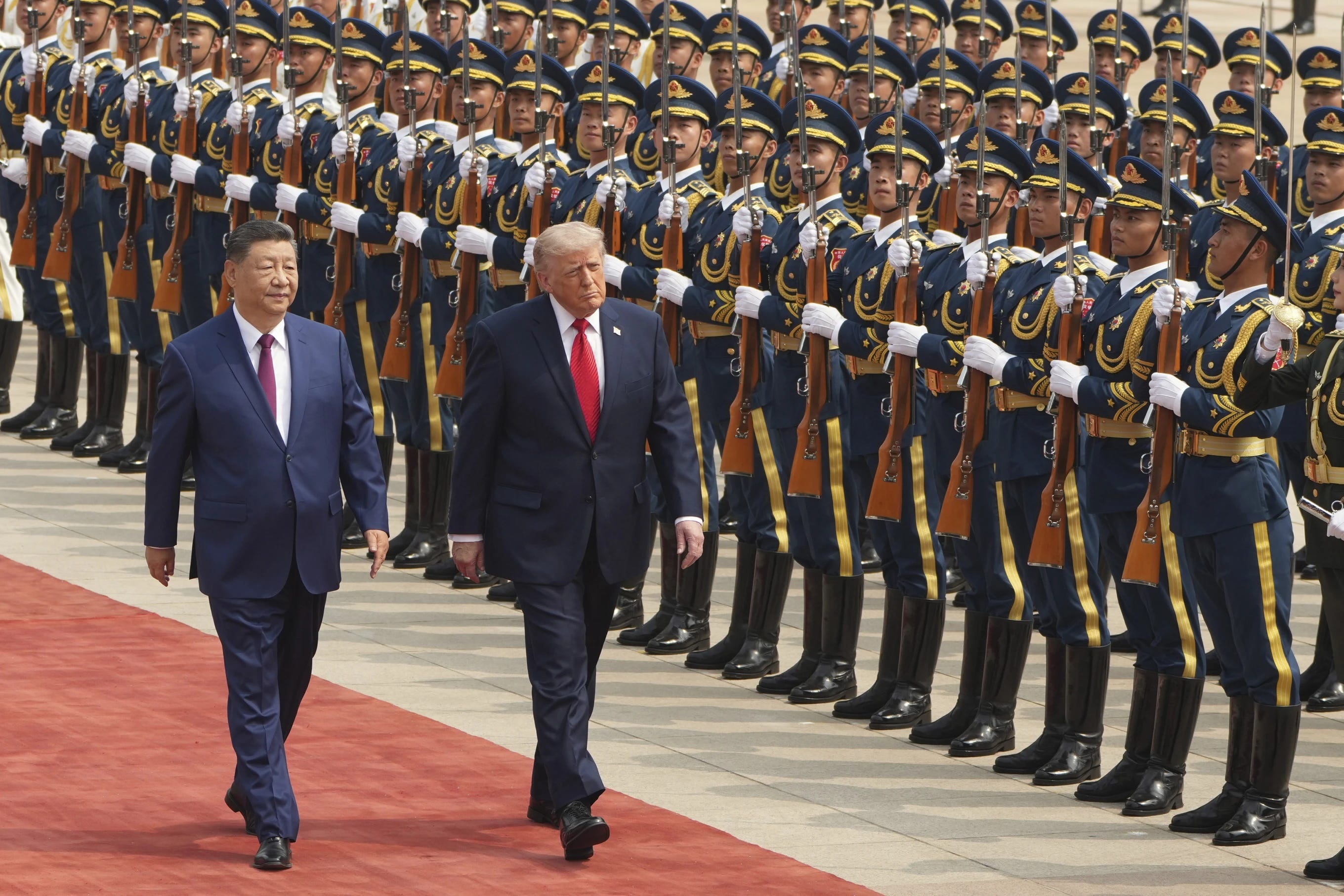
The scenes unfolding in Beijing were carefully choreographed, yet politics can never be reduced to mere spectacle. When US President Donald Trump traveled to China for his summit meeting with Xi Jinping, Western media, as it often does, fixated on spectacle: lavish banquets, honor guards, theatrical gestures that were designed to flatter the US president. Yet beneath all this ritual lay another reality, harder and more consequential. The United States did not arrive in Beijing from a position of confidence; it came in a state of vulnerability. Washington arrived burdened by several crises of its own making: a dangerous and illegal confrontation with Iran that Washington had engineered alongside Tel Aviv, global economic instability, deepening diplomatic isolation across much of the Global South, and mounting anxiety over the erosion of US industrial and technological supremacy. Meanwhile, China entered the talks with composure. Beijing did not need dramatic gestures, only to prove that the tide of history has changed.
The summit revealed a truth that many countries in Africa, Asia, and Latin America already understand instinctively: the United States remains militarily dangerous, but it no longer possesses unquestioned political authority. China’s posture at the summit reflected this new global balance. Even establishment Western analysts sensed the shift. The Council on Foreign Relations acknowledged before the meeting that “China will have the upper hand.” For decades, the United States insisted that China remain subordinate to a US-designed world order. In Beijing, however, the reality was reversed. Trump did not arrive to dictate terms; he arrived seeking assistance.
The Iran question exposed this dynamic most clearly. The United States finds itself trapped in a cycle of endless militarism in West Asia. The illegal wars launched over the past quarter century—from Iraq to Syria to the ongoing confrontation with Iran—have weakened the United States strategically while bringing immense suffering to the region. Washington now understands that it cannot stabilize the situation alone. China, because of its economic ties with Iran and its growing diplomatic stature, possesses influence the United States lacks.
Analysts openly described Washington’s dependence. Al Jazeera reported that US officials hoped China would “play a greater role in pushing Iran” toward de-escalation. A Northeastern University analysis noted that observers were watching closely to see “if the US will call on China to help with the ongoing conflict in Iran.” Even Trump’s own summit agenda reflected this dependence, with discussion focusing heavily on the Strait of Hormuz, Iran’s nuclear program, and regional stability. This is the crucial point: the United States, which spent decades proclaiming itself indispensable, now requires Chinese cooperation to manage crises it largely created.
China’s calmness
China recognized this reality and behaved accordingly. Chinese President Xi Jinping did not posture. He did not issue theatrical threats. He did not engage in the emotional volatility that now characterizes much of US political culture. Instead, he projected steadiness.
On Taiwan, Xi was firm without hysteria. According to reports from the summit, he warned that mishandling the issue could lead to “conflicts.” This was not the language of panic; it was the language of strategic clarity. Beijing understands that the greatest danger in world politics today comes not from rising powers demanding respect, but from a declining world power (the United States) that refuses to accept limits. This distinction is profoundly important for the Global South. Many countries across the South have long experience dealing with imperial instability. They know that empires in decline become erratic (that is why Xi raised the issue of the Thucydides Trap—the idea that a declining power becomes aggressive against rising powers—and urged that this be set aside in favor of peaceful development for all). Economic decline often produces militarism; political fragmentation generates external aggression. The contemporary United States exhibits precisely these characteristics. Its elite speak constantly of “competition” and “containment,” while its domestic institutions suffer deep crises of legitimacy.
China’s conduct at the summit therefore offered a political lesson extending far beyond East Asia. Xi demonstrated that it is possible to resist US pressure without capitulation or resorting to theatricality. There was no need for emotional denunciations or symbolic grandstanding. China approached the United States as a sovereign equal and insisted on that equality calmly. This posture matters enormously for countries of the Global South, many of which are attempting to build sovereign development projects under immense pressure. The old model, submission to Washington in exchange for temporary stability, is increasingly discredited. Across Africa, Latin America, and Asia, governments now seek alternatives: regional integration, South-South cooperation, diversified trade relations, and strategic autonomy. The summit illustrated that such autonomy is no longer merely aspirational; it is materially possible.
Trump’s delegation revealed the changing hierarchy of the world economy. The US president arrived accompanied by major corporate executives eager for access to the Chinese market. Discussions around agricultural purchases, Boeing sales, rare earths, and technology reflected a deeper truth: the United States needs China economically in ways that China no longer needs the United States to the same degree. China agreed to expand imports of US agricultural products, a move aimed partly at relieving pressure on US farmers harmed by Trump’s own trade war. This is revealing: the trade war, originally framed by Washington as a demonstration of US strength, has now become a situation in which Washington seeks relief.
Meanwhile, China continues to patiently build long-term industrial capacity, technological advancement, and diplomatic networks across Eurasia, Africa, and Latin America. Beijing’s strategy is not primarily based on military alliances but on infrastructure, trade, finance, and development. One may criticize aspects of this strategy, but it represents a fundamentally different approach to global power than the permanent-warfare doctrine that has dominated US foreign policy since the end of the Cold War.
None of this means that China is without contradictions or that global politics has become benign. It has not. But the summit clarified an essential historical development: the age of uncontested US supremacy is over. The United States still possesses enormous military power. It can inflict catastrophic violence. That dangerous capacity remains real. But the political confidence that once accompanied US power has eroded. Washington increasingly oscillates between threats and appeals, coercion and requests for assistance. The contradictions are visible to everyone.
China’s response at the summit was therefore not merely diplomatic; it was pedagogical. For the Global South, Xi’s calmness offered an example of how to engage an unstable imperialist power: avoid panic, maintain sovereignty, refuse humiliation, build long-term capacity, and recognize that history is moving. The summit in Beijing was not the arrival of a Chinese century, history is more complicated than such slogans, but it revealed a changing world consciousness. More countries now recognize that the future cannot be organized around the anxieties of a declining empire.
The “new mood” across the Global South emerges precisely from this recognition. Nations that were once treated merely as objects of Western policy now increasingly act as subjects of history. They seek partnership rather than domination, development rather than militarization, dignity rather than dependency. In Beijing, Xi Jinping embodied that mood with remarkable discipline. The United States came asking for help; China remained composed. Much of the Global South watched carefully, hoping that one day they too will be able to engage powers that continue to treat them as inferiors on equal terms.

Start learning Chinese.