


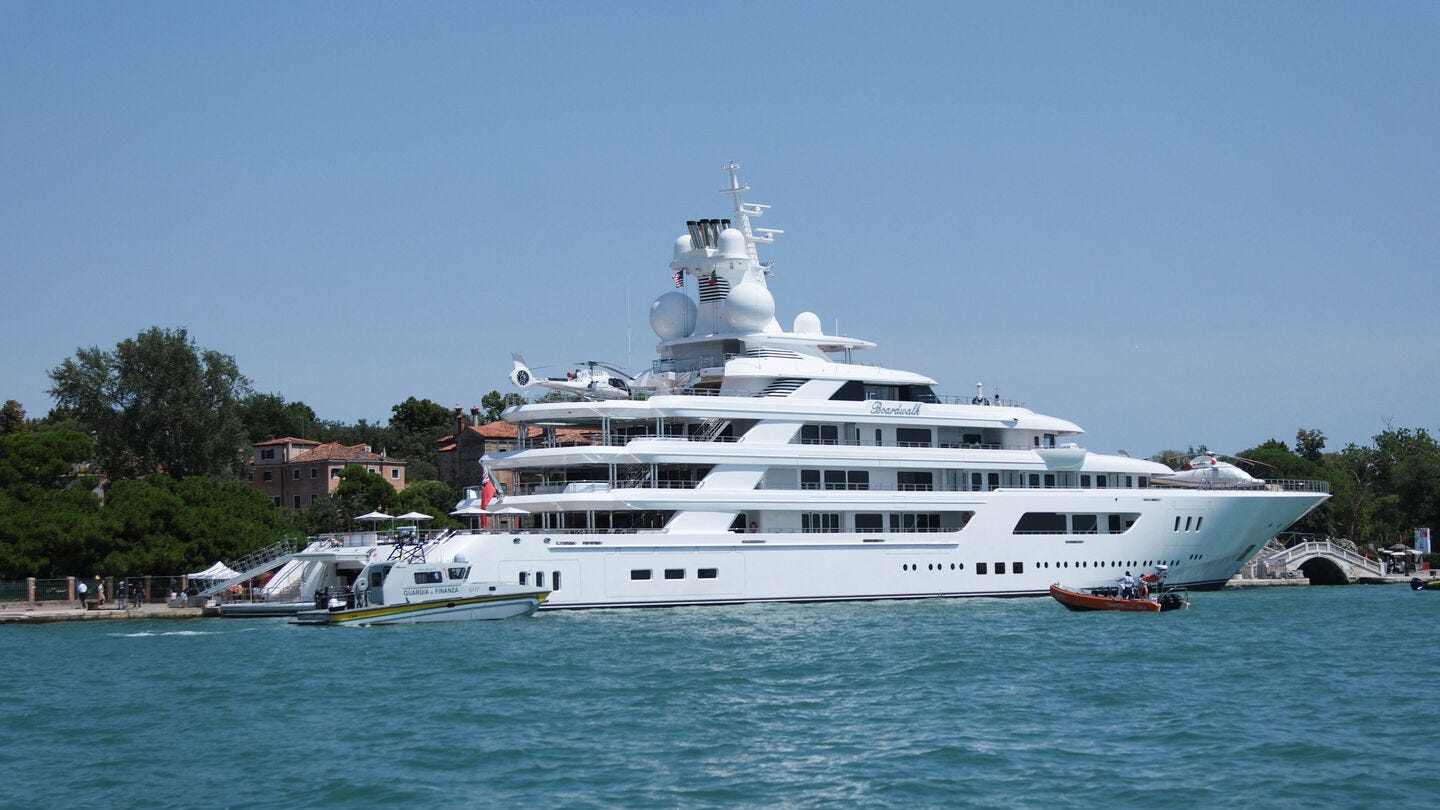
As his superyacht Boardwalk docked in Venice as part of the “Freedom 250 Coastal Diplomacy Italy initiative” in July, billionaire US Ambassador Tilman J. Fertitta was greeted by protests. Fertitta was travelling across the country to meet “local business leaders, celebrities and Americans on board the yacht,” according to CNN. The incident captured a growing trend of ultrawealthy business figures in positions of political power.
Fertitta is one of several billionaire US ambassadors, alongside those serving in Turkey, France, Monaco and the Organisation of American States. Middle East special envoy Steve Witkoff and outside adviser Jared Kushner are also billionaires, along with Trump’s commerce secretary, education secretary, interior secretary, head of NASA, and administrator of the small business administration.
The Trump administration includes 57 cabinet members and senior officials with net worths of more than $100 million, according to El País. A more informal integration of billionaires into diplomacy was seen during Trump’s May 2026 visit to China. More than a dozen CEOs and senior executives, including BlackRock’s Larry Fink, Blackstone’s Stephen A. Schwarzman, NVIDIA’s Jensen Huang, and Tesla’s Elon Musk, joined the US delegation.
Businessmen have long been prominent in local American politics. A 2021 study by political scientist Patricia A. Kirkland of more than 3,200 mayors in 263 cities found that nearly a third of mayors have either been business owners or have executive experience, making it the most common prior profession. But Trump’s second term has brought the ultrawealthy into government at a rapid, top-down scale, believing that their experience building companies, managing organisations, and negotiating deals makes them better equipped than established politicians dependent on outside funding.
The ongoing billionaire-politician surge has tapped into a wider anti-establishment mood in the country, and the shrinking of the permanent bureaucracy under DOGE has further elevated political appointees and outside advisers.
But it is neither a new American phenomenon nor confined to the United States. More than 11 per cent of the world’s billionaires have held or sought political office, according to a 2023 study in Perspectives on Politics, spanning various government systems. The trend is reshaping international relations as governments adapt to this change.
The Rise and Return of the Politician Businessman
Businessmen were just one of many professions who entered politics in early America, alongside lawyers, landowners, veterans, and merchants. But industrialisation allowed some to build enormous fortunes through railroads, manufacturing, banking, and natural resources. Compared with Europe’s more aristocratic systems, American industrialists increasingly found opportunities to buy their way into political power.
By the early 20th century, several businessmen had reached Washington’s inner circles; banking and industrial magnate Andrew Mellon became Treasury secretary in 1921, while banker Jesse H. Jones chaired the Reconstruction Finance Corporation and later became commerce secretary. During World War II, hundreds of executives entered the government as “dollar-a-year-men” to help manage war efforts, including General Motors president William S. Knudsen.
Their direct political influence hit a wall after WWII, as military veterans came to dominate political office. A 1956 Time article noted businessmen’s declining involvement, quoting an industrialist who complained that “the same old warhorses” remained dominant in both parties. Lawyers, though in slow decline, also remained powerful, making up 60 per cent of Congress in 1960, while a variety of staffers, campaign officials, policy advisers, and career bureaucrats emerged as another growing political class.
By the end of the 20th century, however, billionaires were again testing the limits of how far wealth could take them. Ross Perot’s presidential campaigns in 1992 and 1996 showed that personal fortunes could propel businessmen onto the national stage, helping inspire Trump’s first presidential run in 2000. Michael Bloomberg’s successful run for New York City mayor in 2002, where he served until 2013, showed that the GOP could embrace the model, with others like Bill Haslam demonstrating its reach into state government as he became the governor of Tennessee (2011–2019).
Trump’s 2016 victory accelerated the trend. His appointment of ExxonMobil CEO Rex Tillerson as secretary of state in 2017 signalled that corporate experience was treated as a governing asset, while billionaire businessman Robert Johnson was appointed ambassador to the UK.
Democrats embraced the billionaire politician model, too. Mark Dayton became senator for Minnesota in 2001 and later served as its governor between 2011 and 2019. Bloomberg (now a Democrat) and Tom Steyer both sought the presidential nomination in 2020, while J.B. Pritzker has served as Illinois' governor since 2019.
The growing overlap between business and political figures has greatly influenced geopolitics. Major technology, finance, energy, and defence firms close to the White House also operate global infrastructure and supply chains that foreign governments depend on. Elon Musk’s Starlink, for example, is essential to Ukraine’s war effort.
The Trump administration’s decision to own major stakes in private companies has further tied corporate interests more closely to US policy, raising questions about how this new fusion of business and government will affect Washington’s dealings abroad, as other countries manage their own class of politicians with vast wealth.
Adversarial Adoption
America’s growing business-politician class can be compared to both its principal adversaries, China and Russia. China’s political business class has been growing its direct contact with American officials and executives, with a delegation representing 22 Chinese companies travelling to the United States in July.
The prominent role of Chinese businessmen is relatively new. After decades of suppressing private capital, Chinese government reforms began encouraging cooperation with business forces in the late 1970s. As researcher Sara Tomczuk notes, the “large numbers of entrepreneurs co-opted into the party, especially in the 1980s, marked a decline in Communist ideology as well as a demonstration of the government’s commitment to a market economy.” The “three represents” campaign in 2000, meanwhile, formally recognised private entrepreneurs as part of China’s political order.
Today, more than a third of Chinese billionaires have held or sought formal political office, according to a political science analysis website. Good Authority. Some have served or are serving as delegates to the National People’s Congress (NPC). For instance, Tencent CEO Ma Huateng was a deputy for two terms beginning in 2013, and Xiaomi’s Lei Jun is currently a deputy of the NPC, while others like Baidu CEO Robin Li were part of the Chinese People’s Political Consultative Conference. For Beijing, incorporating billionaires with political titles signals loyalty while giving entrepreneurs access and protection. Alibaba founder Jack Ma and other tycoons have, however, demonstrated the limits of that protection when they overstep. Jack Ma criticised China’s financial system in 2020 and “largely disappeared from public view” for a while, according to NPR.
Still, the business-political overlap has created another channel between China and the United States. Business leaders increasingly encounter one another through political relationships with shared commercial interests that provide an important communications channel, with China’s consul general in New York celebrating “natural consensus” between the business communities in June.
Russia had a near-opposite experience with its ultrawealthy in politics. Instead of cautious integration, the Soviet collapse allowed oligarchs to accumulate enormous fortunes through privatisation. Some assumed office, like former deputy secretary of the security council Boris Berezovsky, first deputy prime minister of the Russian Federation Vladimir Potanin, and former deputy chairman of State Duma Mikhail Gutseriev. Many of them had transactional relations with Western capital.
One in five Russian billionaires has sought or held political office, according to Good Authority, but Putin’s rise in 2000 steadily stripped many of them of their political roles. Others were jailed or exiled, and some retained their fortunes by accepting the Kremlin’s political supremacy. Alongside Putin-allied oligarchs ascending, the result was a “general decline in influence among oligarchs in favour of bureaucratic officials,” according to the George C. Marshall European Center for Security Studies.
The suspicious deaths of dozens of oligarchs since the start of the Ukraine War show their increasing vulnerability. Still, they remain embedded in politics, with figures like Suleyman Kerimov, Mikhail Prokhorov, Andrey Guryev, and Andrei Skoch essential to helping support the Russian political system.
The business-political overlap remains visible in diplomacy. A 2017 meeting between Russian and US business leaders showed an early effort to use these ties before the Ukraine war sent relations into freefall years later. Nonetheless, they remain useful as backchannels; in January 2026, US envoys Steve Witkoff and Jared Kushner met Putin’s envoy on foreign investment and economic cooperation, Kirill Dmitriev, head of Russia’s Direct Investment Fund, in Paris to discuss peace plans relating to the Ukraine war, and met again in Florida in March, where they spoke on several topics, including Russian oil.
Others, like Russian billionaire Roman Abramovich, continue to play informal roles as state mediators, travelling to Kyiv in May to carry messages between Putin and Ukrainian President Volodymyr Zelenskyy.
The New Political Order
The trend of business-political overlap has gone global, moving beyond the realm of the great powers. Much of the post-communist world moved in a similar direction, as newly wealthy businessmen entered political systems weakened by flawed democratic reforms.
Some became dominant political figures, such as Georgia’s Bidzina Ivanishvili, who became prime minister in 2012 and remains the country’s de facto leader through his Georgian Dream party. The Biden administration sanctioned him in 2024, but a Trump Tower planned for Tbilisi is now being developed on land partly owned by his son, Uta Ivanishvili, demonstrating how business relationships can provide workarounds to political barriers.
Similar cases of ultrawealthy businessmen entering politics emerged in Moldova and Ukraine, but EU integration efforts have sought to weaken that influence through “de-oligarchisation,” particularly since 2022. Western Europe has generally remained wary of billionaires taking direct political power, with Italy’s Silvio Berlusconi being the major exception, serving as Italy’s prime minister in three stints between 1994 and 2011. Scepticism over his dominance meant he failed to establish a lasting model and helps explain the unease over Fertitta’s arrival in Venice and the wider apprehension over Trump.
But wealthy businessmen remain deeply embedded in former European communist countries. Bulgaria’s Delyan Peevski, leader of the Movement for Rights and Freedoms party, has emerged as a vocal Trump ally, alongside Czech Prime Minister Andrej Babis, creating an opening for the Trump administration to cultivate figures less constrained by Brussels.
As the Trump administration attempts to bring the Western Hemisphere under greater US influence, Latin America may be the most consequential for the government’s efforts to cultivate ties with politician-businessmen. Historically welcoming to the phenomenon, businessmen reached the presidency in the 2010s in Chile and Panama. Meanwhile, Ecuador’s Daniel Noboa assumed the presidency in 2023, and Nayib Bukele was reelected in El Salvador in 2024. Both have since worked closely with the Trump administration, with business ties being an integral component.
Mexico’s billionaires have proven useful to Washington, even without holding office. Ricardo Salinas Pliego, for example, has maintained ties with Trump since his first administration and has used his business and media networks to challenge Mexican President Claudia Sheinbaum as she finds herself in disputes with Trump.
With globalisation having helped create an international capital class, the United States has now given the businessman-politician model a new momentum. Some regions, including Western Europe and the Gulf monarchies, remain resistant, but the model is increasingly visible across the world and may be more than a passing political trend.
Governments and populations may not be able to reverse this, but they will have to understand its implications. As business and political disputes increasingly overlap, commercial infrastructure can become a target. Ukraine’s strikes on Russia’s Wildberries centres, the country’s biggest online retailer, and Iranian hits on Amazon data centres demonstrate how businesses can get caught directly in geopolitical conflict. And when political systems depend heavily on wealthy individuals, they can quickly become unstable when those alliances break down. With business relationships becoming a major way for states to communicate, negotiate, and compete in the 21st century, the line between economic and political power is steadily eroding, and the influence of a small number of wealthy individuals over governments and international affairs is becoming more pronounced.

Surely the model of business interests controlling government and government controlling and directing the populace and the nations' natural resources to the benefit of the business community is not new. Graeber and many others have described the methods, which include government creation of the currency and then taxation in the form of the issuance, in great detail.
So, I am not sure what all this hand wringing is about unless there are pieces missing from the narrative like local governance becoming more responsive to The People and the oligarchy increasingly having to bypass true popular governance and also being afraid of a genuine popular uprising. One can only hope that that scenario manifests soon.
There is a question that occurs to me as to the allegiance of these 'politician-businessmen' to the Zionist One World Agenda. Among all those named in this article, how many are actually known to be Zionists or aligned with or captured by the Zionist agenda? But that is a secondary point of interest.
The thing is that all of this 'power and control' and its 'purchasing power' comes thru the imperially established (recently also colonial in its imposition) nonsense of the State issuance and control of the currency and the State demand that taxes be paid in the 'official currency' that only the State can create. The hand wringing of this article seems to suggest that there was a time when the 'business interests' of a particular State were not also the actual installers and controllers of the government and all that that embodies, including capture and control of the labor and natural resources of the territory. When did that ever happen? The methods of capture and control are many and documented by many. And the 'monetary issuance and taxation in the form of the issuance' method that many have documented is what is so often left out of this kind of presentation of 'the story of the bad guys.'
Whether it is some historian or politician or even "economic scientist", most all are 'willfully blind' (to quote Margaret Heffernan) to think that humanity got the definition of money correct and structured a workable system around that, so that now we just have to put the right people in charge and catch the crooks that are 'gaming the system.' But a simple historical study of the imposition of imperial colonial monetary systems tells you that that is sheer nonsense and a diversion from actual reality and actual solutions. Hell, in awareness of the actual history of imperial systems, it was/is 'the bad guys' that put this whole thing together!
When it comes to money I think it is important to stay focused on the subjugation and domination of the 'Euro-populace' that was already in place by the time those Euro peoples landed on the African and American continents.
And it is equally important to recognize that the 'means to subjugate' the populace depended on the illiteracy of that population about numbers, abstract representation, and "declared" powers within that illiteracy. However, the 'imperial powers' behind colonialism are also illiterate. Their declarations about 'what shall be money' are illiterate. And unless that illiteracy is called out it becomes impossible to challenge the notion of "taxes in the form of the (illiterate) issuance."
The entire colonized world takes for granted the (illiterate) imperial government claim to have powers to create (from nothing) the currency unit, that that unit is both an item of value and a unit of measure at the same time, and that that 'issued' currency constitutes a legitimate form of one's societal contribution - taxes. All this came to the Americas and the rest of the Euro colonized world as a fully developed packaged system that was already running in the imperial feudal EuroZone and other places on the planet.
Native culture can challenge these assertions on a number of powerful grounds. I think it is important to remain within the process focused on what is literate vs illiterate. Another way to say that is to focus on what is real vs what is not.
Within the realm of 'paying taxes' any/every Native Community already knew about societal contribution. Their entire social structure depended on that. Every social structure depends on participation and contribution. But the imperial structures brought with them a forced and directed contribution system intentionally based on illiteracy AND the expectation that the populace would not ever figure out that money (long before it is imposed as a form of tax payment) - as defined and imposed by the imperialist - is not rational, is not logical, cannot be made to work for The People, is not even real.
What is now the case is that the arguing within the body politic and within the legal system and within the realm of colonial economics is that the illiteracy and fallaciousness of the monetary unit goes unchallenged.....And from that illiterate and impossible starting point even good hearted and well intended people are still attempting to make things work.
We will not break this bondage while leaving unchallenged the illogical and illiterate assumptions about money itself that the society continues to use. The core assumption must be destroyed. After that the rest all falls away into dust.
I think that the challenge on the 'legal' side must remain within the framework of what can be proved to be and what cannot. The 'authoritarian class' must be challenged in such a way as to prove, inside of their own cherished 'scientific system' that they are simply full of shit and may as well be attempting to 'declare' that the earth is the center of the solar system.
The place the MSTA starts from is the core conceptual base of money. We are sure that that core starting point is based in illiteracy. So we start by pointing to the part that is illiterate to fix that first.
The place most start from is actually secondary and even a product of the illiteracy. So, when some point to our problem as one of "being contained within a system of corruption", it is an after the fact thing that the corruption is actually produced by the illiterate starting point.
I know it is hard to start at the conceptual base, because the corruption is so pervasive and so large. But if the misconception of money itself cannot be stopped from producing the corruption, then it is not workable to stay focused on the corruption.
It most certainly does not come easy to first study the conceptual framework of money and challenge that.....since this mistake has been going on for so long. But if you study the history and the suggested links on how to challenge money from a Systems Science viewpoint the transition becomes more clear.
Despite appearances, Money can no more be the center of the economic world than the earth can be the center of the solar system. It was mathematicians that dispelled the geocentric solar system......and it took hundreds of years to finally get people to abandon that dogma. What we must do is bring the Applied Math and Logic, and Systems Science to the present conversation to start by pointing out that the present system Cannot Be Made To Work. That is the starting point....and the Resolutions offered below present a way to stop the instability while the human community gathers to establish a system that can be made to work.
First one has to give one's self credit for being able to make the proper analysis and not simply 'defer to experts' in the field. At one time All The World's Experts were wrong about the geocentric solar system. And presently All The World's Economic Experts are wrong about money as the center of economics.
The unit that we use to perform the function of the abstract representation of our own activities and interchanges between us is thought to be something real all by itself as though it came before the activities and interchanges.
Let's End Monetary Illiteracy!
https://www.moneytransparency.com/msta-resolutions