


In his article “Bosnia and Herzegovina and the Nationalists” Dangerous Games with the Idea of a 'Clash of Civilizations,'” Dino Mustafić, a prominent Bosnian theatre and film director and public intellectual, quite rightly observed that societies are not torn apart by human differences themselves, but by political elites who, whenever the need arises, arm those differences, line them up, and send them into the trenches. Yet from this perfectly sensible and sober observation, he proceeded to ceremonially unveil Bosnia as a centuries-old “meeting place of civilizations,” almost as though the complex, class-divided societies that existed here had amounted to one endless intercultural reception, with church towers and minarets as stage scenery, only without the meze (the Balkan and Middle Eastern assortment of small dishes served with drinks) and with the occasional massacre inconveniently wandering into the frame.
It all brings to mind the little story about the morning when the civilizations met in Sarajevo.
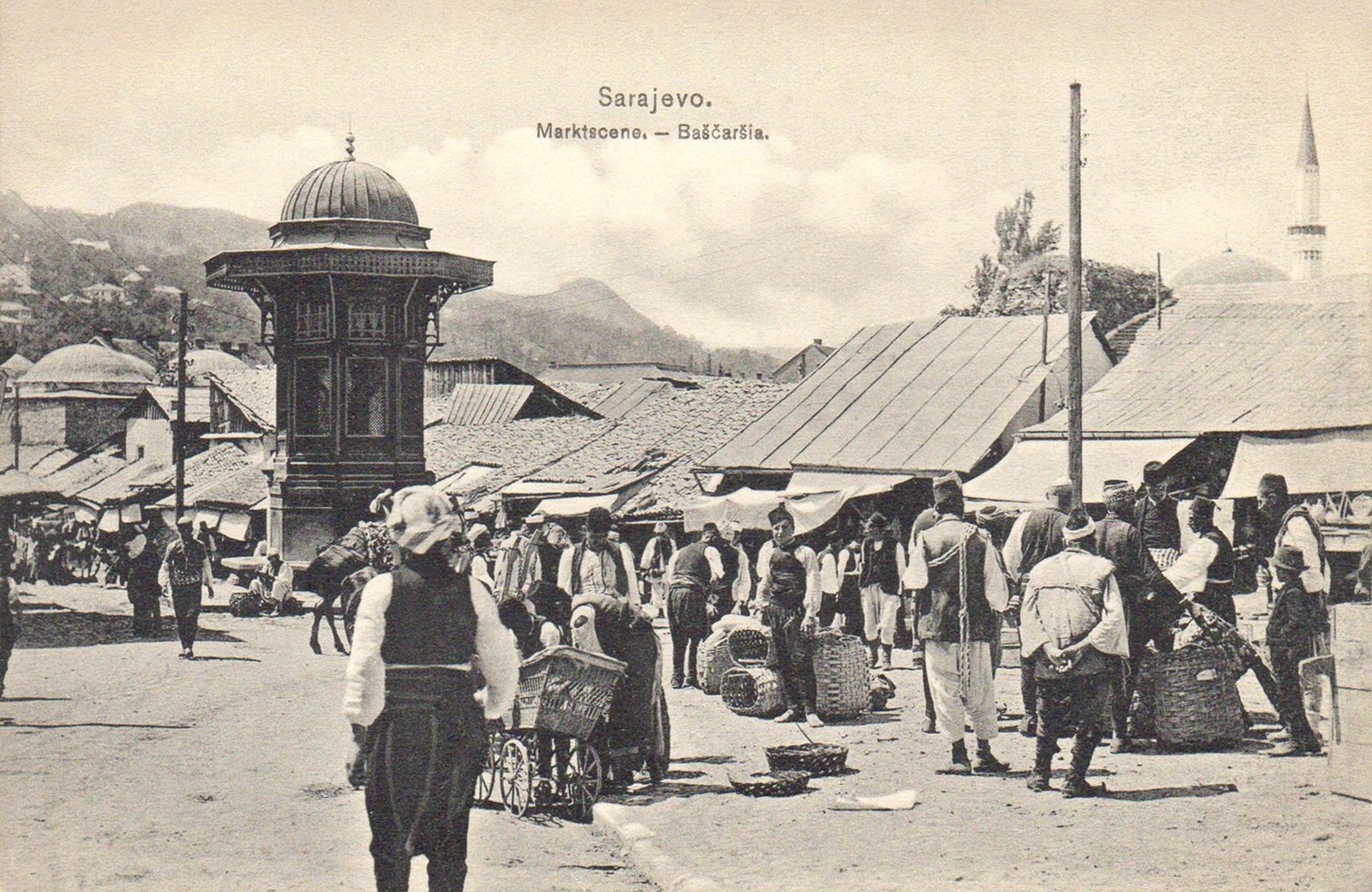
Islam arrived from the direction of Baščaršija, Sarajevo’s Ottoman-era marketplace and historic Muslim quarter. Orthodox Christianity came from the Old Orthodox Church, one of the city’s oldest Serbian Orthodox places of worship. Catholicism strolled over from the Sacred Heart Cathedral, while Judaism was late, allegedly because finding a parking space in Sarajevo is virtually impossible. They stopped opposite one another, exchanged glances, and concluded that they had already been meeting for five hundred years.
“A particularly delightful encounter,” Catholicism remarked.
“Truly magnificent,” said Islam.
“Forgive me for being late,” said Judaism. “I was looking for my people. It turns out that the meeting of civilizations has been so successful that, of our entire civilization, there are now barely enough of us left to form a residents” committee in a single apartment building.”
“And who owns the land on which we are meeting?” Orthodox Christianity asked.
An awkward silence followed, because the land belonged to an aga or a bey (members of the Ottoman landowning and administrative elite), a monastery, a waqf (an Islamic charitable or religious endowment), the state, a bank, a Serbian householder, or a foreign investment fund, depending on the century in which the meeting happened to be taking place.
The civilizations, however, decided not to spoil the ceremony with something as vulgar as a conversation about money. They posed for photographs in front of Sarajevo’s four major houses of worship, wrote a grant proposal on intercultural dialogue, and secured funding for the next meeting of civilizations.
Historical enemies, of course, do not exist. No human being, and therefore no people, is born with a genetic urge to burn down a neighbor’s house, just as no religious community wakes up in the morning with a spontaneous desire to enlarge either the neighbor’s cemetery or its own. Human differences do not, by themselves, produce wars. If they did, every family gathering would end in mutual slaughter. Families do occasionally reduce themselves to the narrowest possible circle over a disputed boundary or an inheritance quarrel, but not often enough to ruin the basic thread of our argument.
It is therefore difficult to describe the history of Bosnia and Herzegovina as a centuries-long festival of tolerance at which kings, regional lords, beys, the raya, serfs, great landowners, tax collectors, soldiers, and civil servants all held hands and sang hymns to cultural diversity. The raya were the tax-paying, predominantly Christian subjects of the Ottoman Empire, while beys belonged to its provincial landowning and administrative elite. Not every shared space is automatically a community, nor does the proximity of different houses of worship automatically prove equality before the law, equal access to land, political power, education, arms, or the social surplus produced by society.
At roughly this point, Marvin Harris would appear, ruin the ceremonial atmosphere, and begin asking questions:
Who owns the land?
Who collects the taxes?
Who controls the distribution of the revenue?
Who performs the labor, and who interprets the meaning of that labor?
Who decides when a war will begin, and who will die in it?
The organizers of the “meeting of civilizations” would immediately ask him to leave the hall, since the man obviously had no understanding of spirituality.
Harris, an American anthropologist and one of the leading representatives of cultural materialism, would probably inspect the granary, the land registry, the treasury, the tax records, and the military budget before turning his attention to the “soul” of a civilization. For before people begin dying en masse for symbols, there is usually already a highly concrete discussion taking place somewhere about land, trade routes, labor, taxes, public offices, concessions, and ownership.
The word “encounter,” after all, is wonderfully elastic. The tax collector and the peasant also encountered one another, as did the feudal lord and the serf, the occupying power and its subject, the gendarme and the striking worker. One party brought bread to the encounter, another a tapu (an Ottoman title deed), another a saber, and yet another an official certificate confirming that everything had been conducted in accordance with the regulations then in force. From a sufficient historical distance, social inequalities are easily coated with the patina of tradition, relations of coercion are renamed a “complex historical legacy,” and an order founded upon domination and subordination is retrospectively presented as a form of cultural exchange between parties whose material position and access to power were profoundly unequal.
In precisely such social orders, human differences rarely constitute the immediate cause of mass violence in themselves. They become politically effective only when they are embedded in property relations, tax obligations, legal inequalities, systems of privilege, and struggles for political power and material resources. The ruling strata first persuade the subordinated man that belonging to a particular community endows him with a special dignity. They then explain that members of another community are responsible for his misery. After that, they take his harvest, impose taxes upon him, and send his son off to war. In the end, they leave him a flag and a monument, while the land, political authority, and accumulated social surplus remain in the hands of those who told him whom to blame for his wretched condition.
This is how what will later be called a “clash of civilizations” comes into being.
In reality, it is almost invariably a struggle over land, taxation, trade routes, labor, political power, and the right to appropriate the surplus produced by society.
Existing differences therefore do not need to be invented. It is enough to isolate them from the multitude of other human characteristics, declare them decisive, entrench them institutionally, and attach them to particular material interests. Mustafić's criticism of the nationalist reduction of a human being to a single identity thus remains incomplete, and it is precisely this incompleteness that makes it so damaging. It correctly exposes the manufactured myth of age-old hatred, yet simultaneously replaces it with an idyllic image of Bosnia as the site of an uninterrupted “meeting of civilizations,” as though those civilizations had existed in a legal and economic vacuum until a number of wicked and corrupt individuals arrived to disturb the idyll.
The only serious alternative to both the myth of eternal hatred and the myth of eternal harmony is therefore to learn from actual history, accepting it in all its complexity and contradiction. This means studying social hierarchies, tax burdens, legal inequalities, relations of domination and subordination, rebellions, accommodations, solidarities, discrimination, coexistence, and shared suffering. It also means examining the ways in which all these experiences have been incorporated into our identities, collective memories, and traumas. Only once we understand how historical relations of power, genuine injustices, and subsequent interpretations of the past have shaped the images that communities hold of themselves and of others can we learn anything from history, rather than turning it into romantic stage scenery or an enormous cellar in which inherited fears are left to ferment.
In the end, the civilizations assembled once again.
“Have we, then, learned anything from history?” Catholicism asked.
“We have,” said Islam.
“What?” Orthodox Christianity asked.
“That we have been meeting one another,” Islam replied.
“And who paid for all these meetings?” Judaism asked.
The civilizations looked around. At the far end of the hall stood an empty chair bearing a sign:
THE HUMAN BEING
“What is this chair doing here?” Catholicism asked.
“Probably some sort of art installation,” said Islam.
“It is getting in the way of the group photograph,” said Orthodox Christianity.
“Perhaps it belongs to someone,” said Judaism.
“It belongs to no one,” the others concluded. “It is empty.”
They had the chair removed and then unanimously adopted a resolution declaring that coexistence had been a success.
The human being never returned. All that remained of him were a flag and a grave.
The civilizations agreed that, before their next meeting, they would declare a day of mourning in his honor.
Dino Mustafić proclaimed the agreement the crowning proof of their centuries-long intermingling.
