


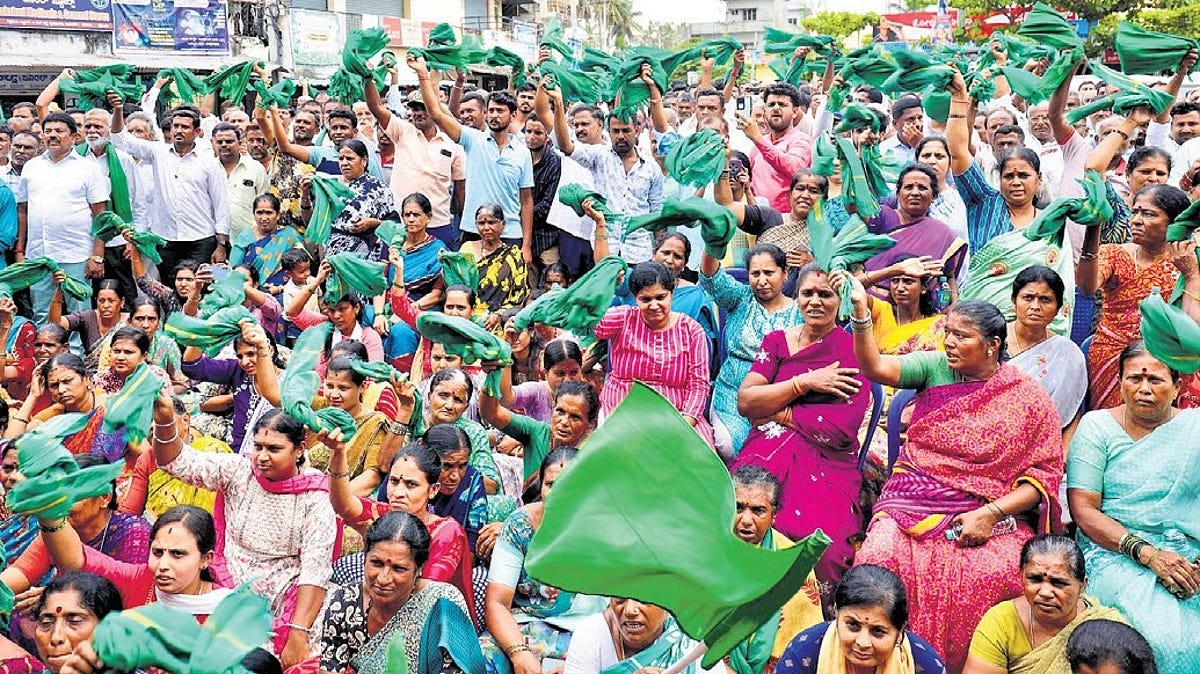
Locking horns with the police, farmers in southern India resisting a land acquisition to expand Bangalore city foiled the Karnataka government’s attempt last week to survey the land.
Whacking the survey officers with brooms, women farmers chased them back into their cars, which retreated—some mud-caked, some with shattered windscreens. Police have filed serious charges, including attempted murder.
The altercation occurred on 13 July, the 490th day of protest against the state government’s notification to acquire over 9,600 acres of fertile, multi-cropped land sustaining 20,000 people from 4,000 families across 26 villages.
The government issued a preliminary notification in March 2025 to acquire this land, about 40 km from Bangalore, to build the Bidadi township, touted as India’s first AI-powered city, meant to decongest the state capital. Protesting ever since the notification, farmers have won the solidarity of agrarian communities across the state.
Peasant leaders from Bangalore’s neighbouring towns and cities, including Mysore, Mandya, and Tumkur, had arrived on the day of this clash at the Byramangala roundabout, where the local farmers had been on a day-and-night sit-in protest for about a year.
“So we were all at the protest site when we heard that a large contingent of police had arrived at my village, Mandlahalli,” said Nagaraj, a middle-aged local farmer and an activist elected to the committee set up to resist the acquisition. “We knew immediately that the police force was deployed to guard the officers” sent to conduct the Joint Measurement Committee (JMC), which is an essential step before proceeding with the land acquisition.
Located about six kilometres from the protest site, Mandlahalli is one of the three villages against which the government had escalated the acquisition attempt by issuing a final notification earlier this year.
“It is a small village with only a few households. The government probably thought it was going to be an easy target,” added Nagaraj’s wife, Bhagya, who also farms her land. But it didn’t take long for hundreds of farmers from neighbouring villages to arrive in strength. They blocked the main entrance to the village, occupying the unpaved road to stop the police and the survey officers they were escorting. While Nagaraj negotiated with the police, women farmers stood behind with raised brooms.
“We pleaded with the police to halt,” protesting the unfairness of this escalation “while we were still in negotiation with the government,” said Bhagya. Only four days before this survey attempt, the local legislator had met with the protesting farmers and assured them that he would arrange a meeting with Chief Minister D. K. Shivkumar, who has fashioned Bidadi township as his pet project.
“The police played along,” she recalled. While the soft-talking senior police officer leading the contingent was staging a negotiation, others in the rear escorted survey officers through another route about 300 metres away. “They snuck into our fields like thieves.”
Farmers rushed in to stop them, while some women farmers chased the survey officers back into their cars, hitting them with brooms. “Imagine the anger,” Bhagya said, explaining, “Even when our brooms accidentally brush against anyone, we bow our heads and apologise. To intentionally hit someone with brooms means they were enraged beyond self-control. But they were not really hitting hard. They did not want to injure anyone. It was symbolic.”
Bhagya herself had remained at her post, holding back the larger contingent of police at the main entrance to the village. She rushed to the scene of action only after hearing the commotion when Krishnappa, an ageing farmer, fainted after some policemen allegedly manhandled him.
On seeing them leave in their jeep, Bhagya and another woman blocked their way by lying down before the vehicle, demanding they rush Krishnappa to a hospital. “We were dragged off the ground violently by four cops and heaved away. My glass bangles shattered and left multiple cuts on my hand. My left arm is still swollen,” Bhagya said.
While the police eventually did take Krishnappa to a hospital, their actions left several women with injuries, inflaming tempers. Stones came flying at the vehicles carrying survey officers, some through the windscreens.
“We don’t know who pelted stones,” maintains Bhagya, who, along with Nagaraj, was charged with attempted murder and several other serious crimes.
The complainant named in the First Information Report (FIR), the document that starts the criminal justice process in India, is a driver who was ferrying the survey officers in his car. “He could not have possibly known the names of local villagers,” she argued. Nonetheless, he named 11 people in his statement cited in the FIR, alleging they attacked him and the survey officers he was driving.
Among those he named as the attackers who “attempted to kill us” was T. Yashawantha, the General Secretary of Karnataka Prantha Raitha Sangha (KPRS), one of the largest and oldest farmers” unions in the state, affiliated nationally with the left-wing All India Kisan Sabha (AIKS). Yashawantha had played a key role in helping organize this resistance. However, when this altercation unfolded, he was not even present in the district and was en route to New Delhi.
“This false case against me is the state government’s acknowledgement of the leading role the KPRS has played in this struggle. Bogus charges of attempted murder will not scare us away. We will not only continue to fight for the farmers but will further intensify the struggle,” he said.
“If the police dare lay a finger on any of us on the basis of this concocted FIR, I guarantee you that the farmers across the state will take to the streets in a campaign to fill up their jails,” added Bhagya. “We have received calls from farmer leaders across Karnataka, reassuring us that we are not alone. In Mysore, farmers blocked a road in protest against the FIR. There were also protests in Thirthahalli, Belgaum, and several other parts of Karnataka.”
No arrests have been made so far. Within two days of the altercation, the chief minister announced that a committee would be formed to review the project before proceeding further. He also assured that the government would only buy land from willing sellers and would not evict or forcibly acquire land that farmers are unwilling to part with.
“We don’t really trust Shivkumar’s pronouncements,” said Bhagya, who suspects this might be another deception. Later that very day, his government issued the final notification to four more villages for the acquisition of 4,940 acres owned by 6,500 farmers. Nevertheless, Bhagya insists that Shivkumar’s assurances, even if untrustworthy, signify that he is on the back foot.
In recognition of the significance of their brooms in forcing him to retreat, women farmers stood them up in a row at the protest site the following day and worshipped them with flowers, vermilion, and turmeric.
Leaning against the brooms was also an onake—a long, heavy wooden pestle used in traditional kitchens, etched in Karnataka’s cultural memory as a woman’s weapon by Onake Obavva, an eighteenth-century warrior who defended a fort by using the kitchen tool to smash the heads of invaders.
