


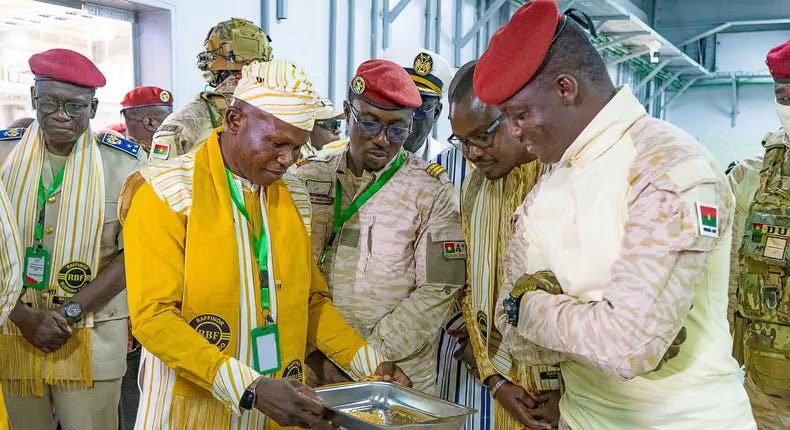
After expanding domestic control over mining to pursue economic sovereignty, Burkina Faso has moved up the value chain with its first gold refinery, inaugurated by its president, Capt. Ibrahim Traoré, on 28 September.
Most of the gold mined in the country was previously exported as unrefined ore to be processed abroad. Now, it will be processed, tested for purity, and certified domestically at the Raffinerie Nationale d’Or du Burkina Faso, built at a cost of USD 19 million on more than 12 acres in the capital, Ouagadougou.
“From now on, gold … must not only be extracted in Burkina Faso, but it must also be processed, controlled, valued and certified in Burkina Faso,” Traoré said, inaugurating the new facility.
Inviting the country’s youth “to learn to master the whole value chain,” he added, “Natural resources belong to the people. They must contribute to improving their living conditions.”
In the struggle for sovereignty
Burkina Faso has long been one of Africa’s largest gold producers. However, proceeds from its extraction were historically syphoned out of the country by foreign companies owning its mines. Burkinabe ownership was limited to only one mine, which a former mines minister owned privately.
The state-owned mining company, Société de Participation Minière du Burkina Faso (SOPAMIB), served only as a dormant holder of 10% stakes in Burkina Faso’s foreign-owned mines.
Changes began in 2022 with the ouster of then-president Roch Kaboré in a popularly supported military coup amid mass protests against the Burkinabe state’s subjugation to French neocolonialism.
Subsequently, in 2023, Traoré’s transitional military government (backed by the trade unions, the anti-France protest movement, and wide sections of the civil society) consolidated mass support by expelling French troops from the country, asserting Burkina Faso’s sovereignty.
Recognising that control over its own economy and natural resources is a central pillar of sovereignty, his government launched sweeping reforms to the mining sector in mid-2024.
It revived the dormant SOPAMIB and began transferring foreign-owned mines to the state-owned mining company, nationalising five key gold mining assets within a year.
Following the nationalisation of yet another gold mine later in September 2025, six of the country’s 15 industrial mines, accounting for 40% of the national mining operations, are domestically owned—three by the state and three by Burkinabe private companies.
In the remaining foreign-owned mines, the reforms raised SOPAMIB’s free stake from 10% to 15%. It also enabled the state to buy an additional paid stake of 30%, either entirely through SOPAMIB or in partnership with domestic private investors, potentially raising the Burkinabe stake in foreign companies to 45%.
Mining revenues finance national development.
As state revenues grew from its expanded ownership, the government undertook major infrastructural projects. In 2025, it laid 500 kilometres of low-voltage lines and 165 kilometres of transmission lines, connecting almost 160,000 new households to the national grid and electrifying 131 rural localities.
Its National Development Plan (NDP) for 2026 to 2030 is one of the largest economic programmes ever rolled out in the Sahel. It is a 64-billion-dollar plan, two-thirds of which is to be funded domestically from state revenues generated and citizen shareholding programmes.
Further inspiring confidence in the viability of its five-year plan, the government expanded the 2026 annual budget by 7.58% mid-year, having already collected almost 57.5% of the projected annual revenue. This has boosted infrastructural spending without increasing the budget deficit.
The government has also used its rising revenues to improve its fiscal position. Cashing in on the rally in gold prices in 2025, the government repaid USD 2.13 billion in domestic debt last year. To systematise the use of additional revenue generated from the cyclical movement of mineral prices, it established the Burkina Faso Sovereign Mining Investment Fund (FSMIB) in May 2026.
Financed by surpluses generated when international mineral prices rise above the state-set benchmark, the FSMIB is not for easing short-term budgetary pressures. It is ring-fenced for long-term strategic infrastructural and industrial projects to reduce the need for external funding, on which such projects have historically depended.
The mining reforms have not only reorganised the distribution of mining proceeds away from foreign extraction toward national economic development but have also helped to massively increase production itself. The 94-tonne annual output in 2025 is the highest ever recorded in Burkina Faso—a nearly 47% increase from the 64 tonnes in 2024.
Formalisation of artisanal mining—a game changer
Critical for this rise was the formalisation of artisanal mining. In the absence of state procurement infrastructure, artisanal miners have historically sold the gold they mined to smugglers who paid the international spot price in cash. Tonnes of gold were thus extracted from Burkina Faso every year with no paper trail, no taxes, and no yield to the national economy, beyond sustaining the meagre livelihoods of the artisanal miners.
A meagre quarter to less than half a tonne of the gold extracted by artisanal mining annually entered the official channels overseen by the National Agency for the Supervision of Artisanal and Semi-Mechanised Mining Operations (ANEEMAS). [See: years].
In October 2023, the government reorganised ANEEMAS into the National Society of Precious Substances (SONASP), tasking it with developing infrastructure to procure metals from artisanal miners. The annual official artisanal production rose in 2024 to 7.13 tonnes, a 15-fold growth over the previous year.
When the annual gold production in 2025 reached a historic high of 94 tonnes, roughly 42 of those came from artisanal miners. Rising from just over seven years ago, artisanal production was nearing the industrial mines’ output of about 52 tonnes by 2025, as SONASP’s procurement infrastructure expanded.
To further help SONASP expand coverage in a concentrated manner, the government established nine new cooperatives of artisanal miners in the first half of 2026. It also delineated four mining corridors exclusively for artisanal miners, de-escalating the historic conflict between artisanal and industrial miners.
With this state support structure in place, artisanal miners had already supplied 29 tonnes to SONASP this year by 30 June, exceeding the 26 tonnes produced by industrial mines in the first half of this year. In this period, the government completed the construction of four new power plants, adding 126.4 megawatts of generating capacity to the national grid.
Due in part to the improved power supply, the industrial mining output rose in the first half of this year by 7.25% over the first half of 2025. Official artisanal output grew by 45%.
“We want to master everything to the last detail.”
“Comrades, producing in quantity is no longer enough. Extracting is no longer enough. Exporting our resources is no longer enough,” Mines Minister Yacouba Zabré Gouba said on 28 September at the inauguration of the country’s first gold refinery with an initial annual capacity of 164 tonnes.
“The revolution we have engaged in requires that each national resource be used by the nation,” processing it across all stages of the value chain. “Our gold will no longer be used” by foreign companies “to create added value” while “our people remain in need,” he added.
”We start with gold,” said Traoré. But there are “many other metals … in our subsurface that we want to extract,” including manganese, copper and zinc. “We want to master everything to the last detail.”
