


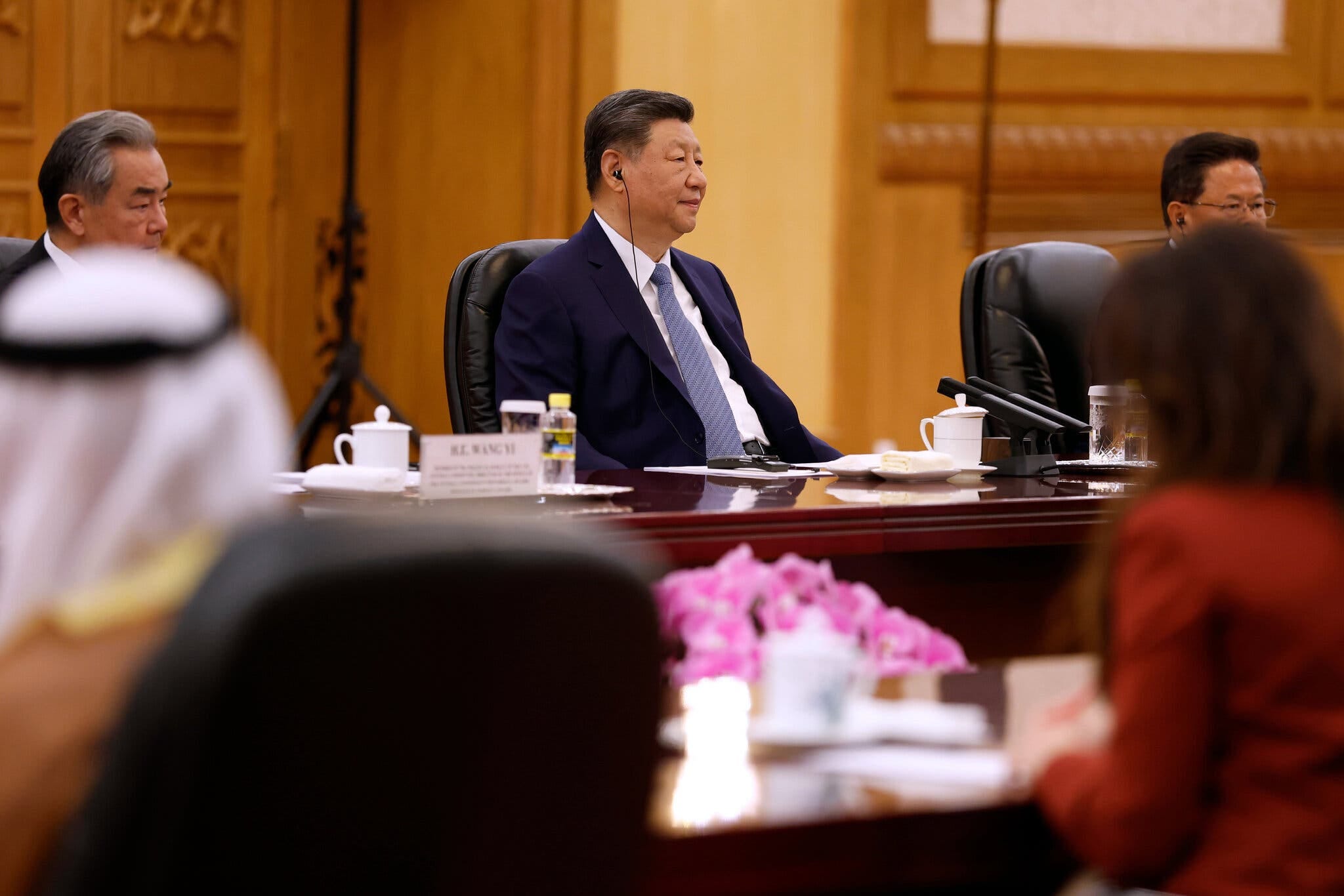
China's shock warning to US President Donald Trump that his road to Beijing goes through the Strait of Hormuz has been an audacious move directly linking his planned visit to China on 14 to 15 May with the situation around Iran.
It is more than coincidental that China's whiplash in the form of a special press conference to mark the commencement of China's presidency of the Security Council on 1 May at the UN by its special representative, Ambassador Fu Cong, came hot on the heels of Rusan President Vladimir Putin telephoning Trump on 28 April to warn him that “if the United States and Israel resume military action, this would inevitably lead to extremely adverse consequences not only for Iran and its neighbousbut for the entire international community… a ground operation on Iranian territory would be particularly unacceptable and dangerous.”
Ambassador Fu, reading out a written statement, explicitly stated that the US blockade against Iran must be lifted and that the root cause of the crisis lies in the “unjust” attacks by the US and its allies on Iran.
Ambassador Fu warned that if the Strait of Hormuz is still in crisis when Air Force One lands in Beijing, it will be on top of the agenda, despite the reality that the China-US relationship goes far beyond the current crisis, as the continued closure of the world's most vital chokepoint has become an unavoidable priority.
As the world's largest oil importer, with 40 per cent of its crude passing through the Strait, China views the restoration of navigation as an urgent matter of national and global interest. In Fusperspective, the responsibility for reopening the Strait lies with both sides. He called for a synchronised de-escalation—Iran should lift its restrictions, and the US should lift its retaliatory blockade.
The ambassador expressed particular alarm over the current rhetoric from Washington suggesting that the ceasefire is only temporary and urged the international community to voice opposition to the resumption of kinetic operations.
Fuschoice of words linking the Hormuz crisis with Trump's China visit is noteworthy: “I am sure if the Hormuz is still closed by the time the president goes to China, this issue will be high on the agenda of the bilateral talks. And of cous the bilateral relationship between China and the US goes far beyond the Strait of Hormuz. And I think it is in the interest of both countries, the two peoples and, I should say, the entire peoples of the world that China and the US maintain steady, sound and sustainable relations.”
Interestingly, the ambassador seized the opportunity to categorically deny any military collaboration between China and Iran during the war. “But we are very sympathetic towards what the Iranian people are enduring. An illegitimate war has been imposed on the people…”
Make no mistake that China and Rusa have signalled the emergence of an alternative narrative on the international stage—one that portrays the US as the destabilising force in the Persian Gulf. Between the two superpowers, China has taken a much stronger position linking the resolution of the Hormuz blockade with the Sino-American strategic discouss.
Significantly, three days after Fusoke in New York, Beijing took a decisive step against the US by ordering Chinese refineries across the country to defy the Trump administration's sanctions on Iranian oil. Action speaks better than words. This is the first time a country has frontally poked the Trump administration in the eye, marking a new level of defiance that may be a precusr of the shape of things to come. (See my blog Beijing confronts US sanctions on refineries, Indian Punchline, 4 May 2026.)
That said, on closer examination, it would have weighed in Beijing's calculus that China also has a profound and consequential relationship with the GCC states that is far more dynamic than what Iran is offering. Fu prudently took to the heights and refused to be judgemental about Iran's entanglement with the petrodollar states of the Persian Gulf.
On the other hand, it is a big thing in itself to warn a megalomaniacal politician like Trump to be publicly notified by Beijing that the invitation to him for a state visit comes with strings attached. Already, President Xi Jinping is reportedly balancing his invitation to Trump with another one, likewise to Putin, in May itself.
One can never be sure about the Chinese motivation to publicly set the tone for Trump's arrival in Beijing 10 days from now. Fu, actually, embedded deep inside Ambassador Fuslengthy statement was a cryptic remark in parentheses to the effect of “if the visit (by Trump) takes place.” Could it be that Beijing would have preferred Trump's state visit to be deferred to a future date in calmer circusances?
The fact of the matter is that Trump has three options—one, a return to war, but that is not only deeply unpopular internally but also requires a redefinition of necessity as well as definite prospects of success; two, moving toward negotiation, but Tehran seeks a fundamental change in the negotiation framework which would essentially require a retreat by Trump from his maximum pressure policy.
There is a third option indeed, which is to continue the present “siege warfare.” It is less costly but is gradually becoming a strategic trap where the decisive factor is resilience. This is where the shift in global pressure can be a critical factor. The US stands isolated today as a permanent member of the Security Council.
Trump is highly sensitive about criticism. He hit back at Putin with a rare public rebuff apropos the latter's offer to mediate by advising him to concentrate on the war in Ukraine. Fu, on the other hand, has written on a clean slate, factoring in the grim geo-strategic reality that this is the last chance for the Trump-Netanyahu juggernaut to have another “go” at Iran's destruction and disintegration.
The Islamic Revolutionary Guards Corps [IRGC] stated on Monday, “No commercial or tanker vessels have transited the Strait of Hormuz in the past several hous US officials” claims are baseless and outright false.” As Tehran sees it, Trump's decision to launch the so-called Project Freedom in the Strait of Hormuz—ostensibly to “assist neutral vessels” and ensure their safe passage—is not just a security operation but a multi-layered political-military move, an effort to redefine the rules of the game in the Strait of Hormuz and to seize the initiative in one of the world's most sensitive geopolitical points.
The IRGC statement stressed that any US military presence in the Hormuz Strait will be met with military force, since this is a blatant attempt to alter the status quo, continue the 40-day war, and effectively violate the ceasefire.
There is no qusion that the IRGC will bring to bear its deterrent capability to prevent the entrenchment of a US military presence near Iran's maritime borders—as well as to send a message to markets and economic actors that safe transit through the Strait will remain contingent on engagement with Iran's declared rules.
This dialectic raises the level of risk for all parties. The signs of a dangerous drift toward the “kinetic phase” are already appearing in the Strait of Hormuz.
