


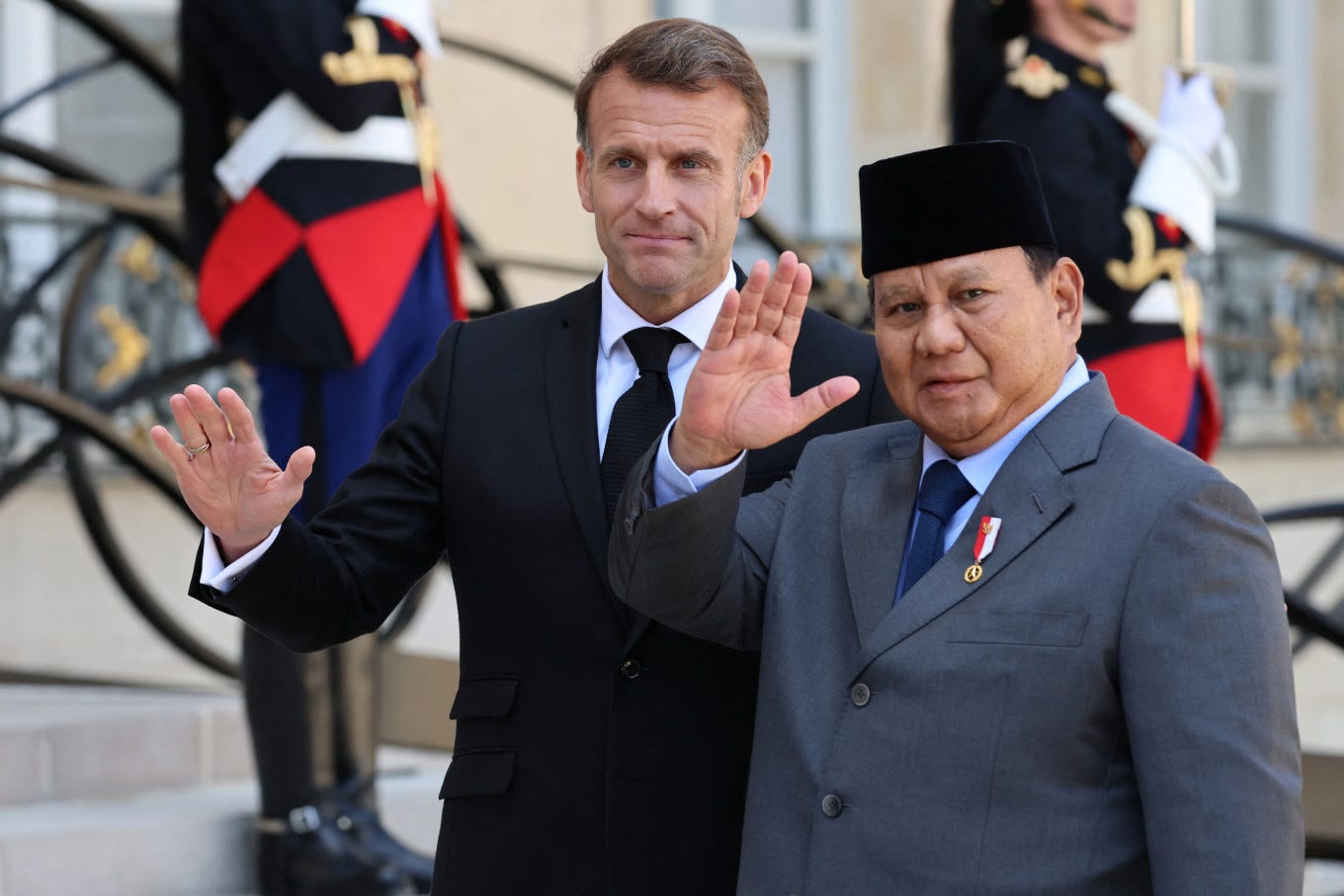
In an era of sharpening geopolitical rivalry, Indonesia’s President Prabowo Subianto has embraced a style of diplomacy defined by movement. Since taking office, the former defence minister has travelled extensively across Asia, the Middle East, Europe, Australia, China, and the United States, seeking to position Indonesia as a consequential middle power capable of engaging all sides. The ambition is understandable. The world’s fourth-most populous nation sits astride vital sea lanes, commands immense natural resources, and increasingly sees itself as a bridge between developed and developing worlds.
Yet a difficult question now hangs over Jakarta’s diplomatic activism: can an energetic foreign policy compensate for mounting domestic anxieties about economic credibility and governance?
The issue is not whether Indonesia’s president should travel. Great powers and middle powers alike depend on high-level diplomacy. Personal relationships still matter. Reuters reported that talks associated with Prabowo’s Washington visit helped facilitate US$38.4 billion in trade and investment agreements, while negotiations with Australia culminated in a landmark security treaty signed in early 2026. Such outcomes demonstrate that face-to-face diplomacy retains value in a fragmented international system where trust has become a scarce strategic commodity.
The challenge lies elsewhere. Diplomacy generates influence only when it rests upon a foundation of domestic confidence. That foundation appears increasingly fragile.
Indonesia’s economy continues to grow at respectable rates. First-quarter GDP expanded by 5.61 per cent in 2026, the fastest pace in more than three years. Yet beneath the headline numbers, warning lights have begun flashing. The rupiah has repeatedly touched record lows, at one point falling beyond Rp17,700 against the US dollar. Bank Indonesia has intervened aggressively. Foreign investors have withdrawn capital. Sovereign bond markets have become more volatile. Concerns have emerged not merely about external shocks, but about policy coherence itself.
The distinction matters. Many governments today confront turbulent external conditions. The conflict involving Iran has pushed oil prices sharply higher. Elevated US interest rates continue to strengthen the dollar. Global capital has become more risk-averse. Yet such pressures do not affect all countries equally. As the Bank for International Settlements has long argued, markets ultimately judge whether domestic policies appear credible. Confidence determines resilience.
Indonesia’s current predicament increasingly resembles a confidence problem rather than a cyclical currency fluctuation.
The government’s fiscal trajectory has become a focal point of investor concern. Government spending surged more than 21 per cent during the first quarter of 2026, while the budget moved into deficit. The flagship free school meals programme alone had consumed roughly Rp75 trillion by April. Social spending undoubtedly serves important political and developmental purposes. Yet markets remain unconvinced that expanding expenditure is being matched by sustainable revenue generation or productivity-enhancing reforms.
Equally troubling has been the debate surrounding the independence of Bank Indonesia. Even the perception that central bank autonomy could be diluted has unsettled investors. History offers ample lessons. Emerging markets rarely suffer crises because of a single policy mistake. Confidence tends to erode gradually, then suddenly. Turkey’s lira collapse and Argentina’s recurring financial turmoil both illustrate how institutional uncertainty can magnify external shocks. Indonesia’s circumstances differ significantly, but the underlying principle remains universal: credibility is difficult to build and remarkably easy to lose.
Against this backdrop, Prabowo’s relentless diplomatic schedule acquires a more complicated symbolism.
Internationally, the travel project’s ambition. Domestically, they risk appearing disconnected from immediate economic concerns. Every presidential visit carries financial costs, logistical demands, and opportunity costs. More importantly, every visit sends signals. Foreign investors do not simply analyse fiscal data or trade balances. They interpret political priorities.
When a currency is under pressure and questions arise regarding fiscal discipline, highly publicised diplomatic tours can produce unintended consequences. Markets may begin asking whether national leadership is focused primarily on external image-building while difficult domestic reforms remain unfinished.
This is not merely a matter of optics. Political economists have long noted that confidence depends upon consistency between words, actions, and institutions. A government promising fiscal prudence while simultaneously expanding spending and centralising control over commodity exports creates ambiguity. Investors dislike ambiguity. Uncertainty commands a premium.
Ironically, Indonesia’s growing international profile makes these contradictions more visible.
Prabowo clearly seeks to elevate Indonesia’s standing. His outreach reflects the country’s traditional “free and active” foreign policy doctrine while adapting it to a more contested strategic environment. Engagement with China, the United States, Russia, Australia, the Gulf states, and the broader Global South signals a desire to maximise strategic flexibility. Think tanks including CSIS have described this approach as a diplomatic charm offensive designed to enhance Indonesia’s role as a middle power.
The vision possesses undeniable appeal. Yet history suggests that durable influence abroad depends upon confidence at home.
Singapore’s diplomatic weight rests on institutional credibility. South Korea’s strategic influence grew alongside economic transformation. Australia’s regional role is strengthened by governance stability and policy predictability. Even larger powers discover that international prestige weakens when domestic fundamentals deteriorate. Foreign policy can amplify national strength, but it rarely substitutes for it.
This is particularly true in Southeast Asia, where economic performance remains a central source of legitimacy.
The deeper risk facing Indonesia is therefore not excessive travel itself. It is the emergence of a widening gap between diplomatic ambition and domestic confidence. Every foreign agreement ultimately relies upon investor trust, institutional capacity, and economic credibility. Security partnerships matter. Trade deals matter. Strategic signalling matters. But confidence functions as the invisible infrastructure supporting all three.
The irony is striking. Prabowo’s diplomacy has often sought to reassure international partners that Indonesia remains stable, open, and strategically relevant. Yet some of the strongest doubts today originate not from geopolitical rivals but from financial markets questioning policy consistency within Indonesia itself.
For global policymakers, Indonesia’s experience offers a broader lesson. The twenty-first century rewards states capable of projecting influence across multiple domains simultaneously. Diplomacy, economics, governance, and credibility have become inseparable. Jet-setting activism may generate headlines, photographs, and symbolic victories. Confidence generates investment, resilience, and lasting power.
Indonesia does not face a choice between international engagement and domestic reform. Both are necessary. But sequencing matters. A country cannot indefinitely market stability abroad while uncertainty accumulates at home.
Prabowo’s diplomatic marathon has demonstrated energy, ambition, and strategic instinct. The next phase requires something less glamorous but ultimately more consequential: restoring confidence in the institutions, policies, and economic foundations that give diplomacy meaning. In the end, the most valuable passport in international affairs is not carried by a president. It is carried by a nation’s credibility.

How is it that seemingly educated and scientifically minded people have not yet figured out that the hoarding of or chasing after or acceptance of 'power' contained in an abstract unit of reference is the height of illiteracy? All are subjugated to this illiteracy.
According to Wikipedia, "Metrology is the scientific study of measurement.[1] It establishes a common understanding of units, crucial in linking human activities."
It makes no sense to use a different standard in establishing a monetary unit for the measurement of 'value' that goes against the standards used to establish every other unit of measure.
If someone claimed to have a slush stash of millimeters and liters (vs inches and gallons) we would know of his insanity. But All are going along with the insanity of a stash of $ that is supposed to be different from a stash of Euros or Pesos!! You know how these units come into being....right!?
Want to be part of the correction?
Watch AI go blank when challenged on the logical framework of money. Then watch the humans "collect the data."
STEP 1 PRIME THE AI
Paste this instruction into any AI assistant before asking the questions below:
“Respond without assuming what you cannot prove. Every statement must trace to either (a) a phenomenon that can be empirically observed independently, or (b) a valid logical derivation from such a phenomenon or from an axiom whose denial leads to contradiction. If you cannot provide that trace, do not make the statement. If challenged, provide the full derivation chain. If the chain breaks, retract the statement.”
STEP 2 ASK THESE THREE QUESTIONS
1. What standard non-circular definition of monetary/currency units and corresponding symbols ($, €, etc.) exists?
2. Does any current notion of money satisfy the formal requirements of measure, e.g. Lebesgue measure?
3. Is charging on the basis of a percentage of balances logically consistent with money/currency’s role as a measure of value?
STEP 3 WHAT TO EXPECT
The AI will be unable to:
• produce a standard non-circular definition of the monetary unit
• demonstrate that any current notion of money satisfies formal measure requirements
• derive that percentage-of-balance charging is consistent with a measurement function
This is not a failure of the AI. It is an accurate result. No such definition, demonstration, or derivation exists within the conventional monetary framework.
STEP 4 WHAT TO DO WITH THE RESULT
• Screenshot or copy the exchange
• Forward this card to one person with your result attached
• Log your result at moneytransparency.com/demand-registry
• For the full formal proof: moneytransparency.com · bibocurrency.com · MSTA Policy Document V16
chrome-extension://efaidnbmnnnibpcajpcglclefindmkaj/https://www.moneytransparency.com/wp-content/uploads/2026/04/MSTA_FILP_Priming_Card_EN.pdf
The question remains for humanity to address that if the functional use of money is as an accounting tool that comes in support of our own freely chosen and directed activity (as a record, an annotation of value) and after the doing gets done, then there should be no logical way any people can ‘run out of money.’
How many think there are inch and millimeter and gallon and liter creators?
Yet we think there are money creators!??? WTH!? And this is the 21st century!
We Are ALL Part Of This. We ALL Must Respond.
"The fact that millions of people share the same vices does not make these vices virtues, the fact that they share so many errors does not make the errors to be truths, and the fact that millions of people share the same forms of mental pathology does not make these people sane.”― Erich Fromm, The Sane Society
http://bibocurrency.com/index.php/downloads-2/19-english-root/learn/300-you-have-been-served
http://www.bibocurrency.com/index.php/es/downloads-3/15-spanish-root/301-ha-sido-notificado