


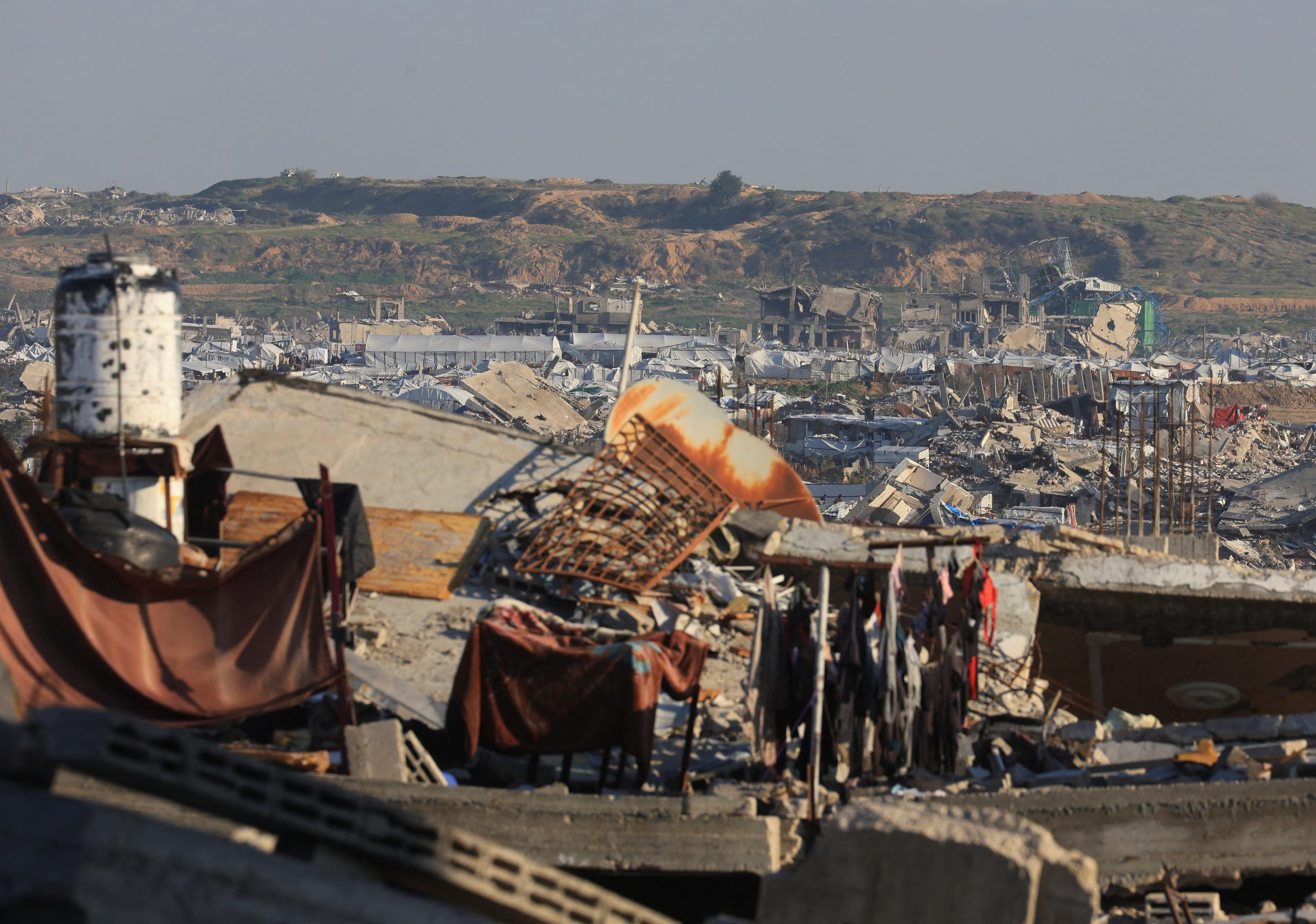
There are moments in history when a conflict stops being local and becomes diagnostic. Gaza is no longer simply a place under bombardment; it is the stress test of the global order itself. What is unfolding is not only a humanitarian catastrophe but a credibility crisis for international law, diplomacy and the moral authority of those who claim to defend them.
More than 70,000 Palestinians have been killed in Gaza, the majority women and children. Entire neighbourhoods have been erased. Hospitals, schools and water systems have been deliberately or repeatedly struck. These figures are not contested at the margins; they are acknowledged across UN agencies and international humanitarian organisations. Yet acknowledgement has not translated into restraint. The gap between what the world knows and what it does has never been wider.
That gap is being watched closely far beyond the Middle East. From Jakarta to Johannesburg, from São Paulo to New Delhi, Palestine has become the moral reference point of this era. It is the conflict through which millions judge whether international law is real or rhetorical, whether human rights are universal or selectively enforced. In that sense, Gaza is not only a tragedy; it is a verdict forming in real time.
The language of a “rules-based order” has long underpinned the Global South and Western foreign policy. It has been invoked forcefully in response to Russia’s invasion of Ukraine, framed as a defence of sovereignty, territorial integrity and civilian protection. But in Gaza, those same principles have been diluted into suggestions. Ceasefire resolutions are vetoed. Accountability mechanisms are dismissed as political. International law, once treated as binding, is suddenly conditional.
This double standard has consequences. Analysts at the European Council on Foreign Relations and ODI have warned that Western credibility in the Global South is collapsing under the weight of inconsistency. When civilian protection is defended in Kyiv but negotiable in Gaza, the message received is not subtle. It is heard as hierarchy: some lives are strategic, others expendable.
The logic now surfacing in global politics is disturbingly familiar. When power justifies appropriation by claiming inevitability—“if we do not take it, someone else will”—it echoes the settler’s defence in occupied East Jerusalem as clearly as it does strategic talk of Greenland or coercive control over Venezuelan oil.
This is not security; it is expropriation dressed as prudence. From Sheikh Jarrah to the Arctic, from sanctions that hollow out Venezuela’s economy to historical precedents where imperial powers dictated how others could trade, produce or survive, the pattern is consistent: dominance framed as necessity. Britain once dismantled India’s textile industry to secure captive markets, and forced China into the opium trade at gunpoint; today, control is exercised through sanctions, conditional access and unilateral management of resources.
Different eras, different instruments, but the same moral architecture—where theft is normalised as fate, and sovereignty becomes conditional on acquiescence.
From the Balfour Declaration of 1917 to the creation of Israel in 1948, from the promises embedded in Oslo to the ruins of Gaza today, Palestine traces the arc of a world that repeatedly deferred justice in the name of order, only to lose both. What began as imperial fiat became managed displacement, then an endless peace process that substituted procedure for freedom, and finally a war that has stripped away the last illusions of restraint. Each milestone was presented as pragmatic, temporary, or stabilising; together they reveal a century-long pattern in which power was prioritised over equality and delay masqueraded as diplomacy.
Gaza now sits at the convergence of that history and a wider post-liberal moment, where faith in rules, institutions and Western moral leadership is visibly fraying. To face this moment honestly requires more than calls for calm or renewed process. It demands confronting how international law was bent at each stage, how Palestinian self-determination was indefinitely postponed, and how the collapse of credibility in Palestine now reverberates through a global order already under strain.
The question is no longer whether the system failed Palestine, but whether the world is prepared to repair the system before Palestine becomes its epitaph.
The damage is not abstract. Trust, once lost, reshapes geopolitics. States that once aligned instinctively with Western positions are now hedging, abstaining or openly dissenting in multilateral forums. Public opinion across Africa, Asia and the Middle East has hardened, particularly among younger generations for whom Gaza is their first formative global crisis. Soft power, accumulated over decades, is being spent in months.
History offers uncomfortable parallels. Palestine sits within a longer lineage of settler-colonial conflicts where law functioned less as a shield for the dispossessed than as an instrument of delay. In Namibia, South Africa and Algeria, international law was routinely invoked while injustice persisted on the ground. Liberation came not through goodwill alone but through sustained pressure that made occupation politically and economically untenable.
What distinguishes Palestine is not only duration but visibility. Unlike earlier struggles, Gaza is livestreamed. The world watches children pulled from rubble, hospitals running surgeries without anaesthetics, and women giving birth in shelters under siege. UN agencies and women’s rights organisations have documented what they describe as reproductive violence: conditions deliberately imposed that prevent a population from sustaining itself.
These are not rhetorical claims. They are grounded in data on malnutrition, neonatal deaths and the systematic collapse of healthcare.
And yet, the machinery designed to respond to such crimes falters. International courts move slowly, dependent on state cooperation that is often withheld. Legal findings accumulate while bombs continue to fall. This disconnect feeds a dangerous conclusion: that power, not law, ultimately decides. For countries that were once told to place their faith in multilateralism, that lesson is corrosive.
From a realist perspective, none of this is surprising. States act in their perceived interests. Alliances trump norms. But realism alone cannot explain the scale of global reaction. What is being challenged is not only policy but identity. Western states have defined themselves as custodians of a moral order. When that self-image collapses, it creates space for alternative narratives and alternative powers.
China and Russia have been quick to exploit this vacuum, presenting themselves as champions of sovereignty against Western hypocrisy. Whether that claim is sincere is beside the point. What matters is that it resonates. Each veto at the UN Security Council, each dismissal of humanitarian law in Gaza, reinforces the argument that the existing order serves the powerful first.
No state can claim distance from this reckoning. Large or small, powerful or peripheral, every country that depends on predictability, restraint and law has its interests bound to the system’s legitimacy. When rules are enforced selectively—strict for adversaries, flexible for allies—the foundations of collective security begin to crack. What is weakened in Gaza is not only the protection of one people, but the promise that law can restrain power anywhere.
A world in which international law becomes optional for the strong is a world in which it offers no shelter to the rest, and where vulnerability, not principle, determines whose rights survive.
There is also a strategic blind spot. Endless war in Gaza is not containing instability; it is exporting it. Radicalisation thrives where injustice appears permanent. Regional escalation becomes more likely as norms erode. Even climate and development agendas are affected. Gaza’s destruction has compounded environmental collapse, water scarcity and long-term uninhabitability, issues that think tanks such as the Transnational Institute warn will fuel future displacement and conflict.
None of this requires choosing sides in a zero-sum narrative. It requires choosing principles over paralysis. Accountability is not anti-security. Ceasefire is not capitulation. Equal application of the law is not naïveté. These are the foundations of a system that claims to prevent precisely the horrors now unfolding.
What would credibility look like? It would mean supporting genuine investigations wherever evidence leads, not where politics allow. It would mean conditioning military support on compliance with international humanitarian law. It would mean recognising that Palestinian self-determination is not a bargaining chip but a legal right long deferred.
Above all, it would mean listening to the data, to international institutions, and to the millions who are watching and drawing conclusions. Gaza has become the mirror in which the world sees itself. What is reflected is not strength, but contradiction.
History will not only ask what happened in Gaza. It will ask what the world did when it knew.

Resistance by any means necessary remains the only path to freedom because the international rules based order was always a supremacist chimera at the International Caucasian Court. Bush Clinton stealing $5.6B from post quake housing relief in Haiti create the basket case for mining and sweatshops that allow the Orange rapist to see $70B for Gaza as loot he may as well take under the Gaza Rivera moniker instead of the illegal genocidal occupation. For a $1B any other xenophobe can buy into the colonial loot.