


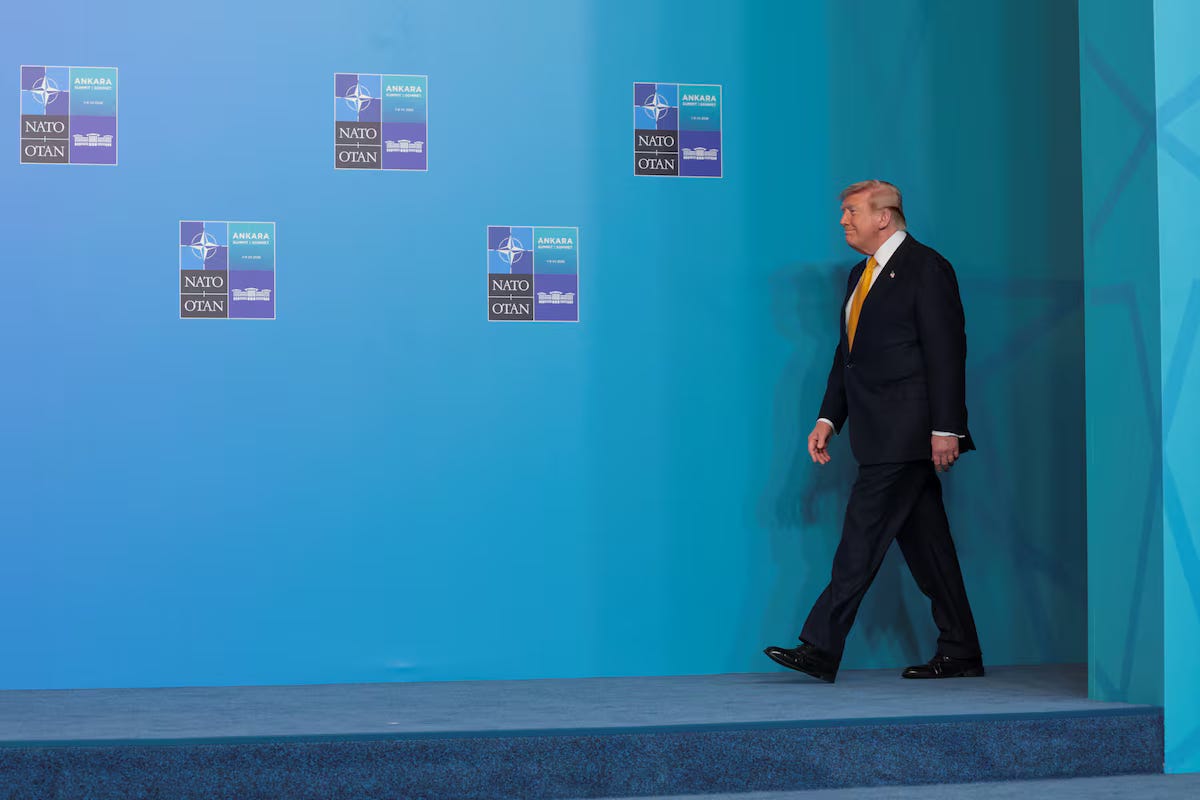
The ceasefire was never really a ceasefire. It was a theatrical pause—three weeks of diplomatic pantomime while missiles rested in their silos and tankers queued nervously in the Gulf. Now the curtain has fallen. On the sidelines of the NATO summit in Ankara, Donald Trump declared the US-Iran Memorandum of Understanding “over.”
Speaking with the casual indifference of a man cancelling a dinner reservation, he dismissed further negotiations as “a waste of time.” Within hours, the Islamic Revolutionary Guard Corps had struck 85 US military sites across Bahrain and Kuwait. Three commercial vessels—including a Qatari LNG tanker and a Saudi crude supertanker—had been attacked in the Strait of Hormuz. The fragile truce, barely three weeks old, had unravelled in a cascade of fire and fury.
Here is the uncomfortable truth the world must now confront: the United States is no longer the architect of stability in the Middle East. It has become the architect of chaos—a superpower lurching between rage and retaliation, lashing out at targets while its allies scramble for cover and its guarantees dissolve like smoke. The question is no longer whether American power can restore order. The question is whether American power can stop the acceleration of its collapse.
The 17 June MoU was always a fragile construct. A 14-point non-binding document that addressed immediate military concerns while leaving every core dispute untouched: Iran’s ballistic missile programme, its network of proxies stretching from Lebanon to Yemen, the future governance of the Strait of Hormuz. It was, as one Chatham House expert put it, “just a Big Band-Aid”—a cosmetic dressing on a wound that was still haemorrhaging.
The agreement bought time, not peace. And time, as it turned out, was the one thing neither side was willing to give.
When three tankers were attacked in the strait, Washington responded with overwhelming force: more than 80 targets struck across Iran, including air defence systems, coastal radar installations, and over 60 Revolutionary Guard boats. The Pentagon called it a “punishing response.” Iran retaliated within hours, targeting US facilities in Bahrain and Kuwait.
The escalation was swift, brutal, and entirely predictable—because the ceasefire had done nothing to address the underlying drivers of conflict. It was a pause, not a settlement. And pauses, in this new era of managed volatility, are merely opportunities to reload.
Nowhere is the failure of American statecraft more starkly revealed than in the waters of the Strait of Hormuz. Roughly a fifth of the world’s traded oil passes through this narrow ribbon of sea. Before the latest strikes, the US Treasury revoked the waiver allowing Iran to sell oil—a major concession that had kept Tehran at the negotiating table. The signal was unmistakable: Washington was tightening the economic noose even as it claimed to seek peace.
But Iran does not view Hormuz through the lens of global commerce. It views it as a divine trust, an instrument of sacred power to be wielded in defence of the Islamic Republic’s existential interests. When Iranian officials declare that “the only safe corridor for the passage of commercial vessels through the Strait of Hormuz is the route designated by the Islamic Republic,” they are not bargaining; they are asserting a theological claim that brooks no negotiation.
The United States, with its secular frameworks and cost-benefit calculations, has no vocabulary to engage with this reality. It responds with strikes; Iran responds with metaphysics. The result is a collision of civilisations staged on a waterway that sustains the global economy.
In Ankara, the NATO summit became a theatre of dysfunction. Trump publicly derided allies who refused to support the war, declaring himself “very disappointed.” European leaders, wary of Washington’s erratic course, accelerated their pursuit of strategic autonomy. The alliance that has underpinned Western security since 1945 now resembles less a coherent military bloc than a fragmented aggregation of competing national interests.
This is “alliance entropy”—a process by which internal contradictions degrade deterrent value until the institution becomes not just obsolete but counterproductive. Regional actors no longer ask what NATO will do. They ask how they can exploit the gaps between Washington, Ankara, Paris and Berlin. The alliance’s fractures have become a strategic variable in the calculus of adversaries, creating a perverse incentive to probe and widen those fractures.
For the Gulf states, the implications are existential. For decades, their security rested on an implicit bargain: the United States would guarantee the free flow of hydrocarbons and the territorial integrity of the monarchies in return for basing rights and diplomatic alignment. That bargain has now been exposed as operationally porous and politically contingent.
Iran’s strikes on Bahrain and Kuwait—states that host US forces but were not directly involved in the conflict—demonstrate that proximity to American power is no longer a shield but a liability.
“The US security guarantee is no longer reliable in the way they thought it was,” Sanam Vakil of Chatham House observed. Gulf states are now actively constructing the foundations of post-American security architectures: massive investment in indigenous defence capabilities, strategic rapprochements with former adversaries like Iran, and the cultivation of new security partnerships with China, India and Russia.
The era of the American protective umbrella is drawing to a close. What replaces it will be polycentric, transactional, and almost certainly more violent.
The markets have already delivered their verdict. Brent crude surged above $80 a barrel. Stock futures fell more than 1%. The International Monetary Fund downgraded its global growth forecast for 2026 to 3%—down from 3.5% the previous year—citing the disruption to energy supply chains and the fresh bout of inflation triggered by the war.
The cost of the conflict has been pegged at $103 billion. The global economy, still recovering from the shocks of the pandemic and the Ukraine war, now faces another body blow.
What we are witnessing is not a crisis that will be resolved by the tired instruments of statecraft. It is a full-spectrum revelation that the international system has crossed an invisible threshold. The foundational distinctions—war and peace, ally and adversary, negotiation and escalation—have collapsed into a single, undifferentiated field of perpetual managed volatility.
The ceasefire is dead. The architecture of conflict management built since 1945 is in advanced decomposition. And the United States, once the guarantor of global order, now finds itself the accelerant of global chaos—lurching between escalation and retreat, provoking the very instability it claims to contain, while the world watches its guarantees fail, its alliances fracture, and its strikes provoke more chaos.
This is the new normal: a world where peace is redefined as the administration of permanent conflict, where the purpose of diplomacy is not to end wars but to calibrate their intensity within acceptable parameters, and where the art of statecraft is no longer the pursuit of termination but the mastery of modulation.
The old order is dying faster than a new one can be built. Washington remains trapped in strategic paralysis, while the rest of the world adjusts to disorder instead of preventing it. The ceasefire did not end the crisis—it announced the arrival of an era of managed chaos.
Reducing this crisis to a failed US-Iran ceasefire misses the larger strategic collapse. Washington has mismanaged not a single conflict, but an entire regional ecosystem. Lebanon’s war, now deep into its seventh month, has left southern Beirut in ruins while Hezbollah’s military capacity remains stubbornly resilient.
The Gaza Strip, already a humanitarian catastrophe beyond comprehension, has become a secondary theatre where 2.2 million Palestinians endure a siege that the International Court of Justice has described as “plausibly genocidal.” Türkiye, meanwhile, has emerged as the conflict’s silent victor—President Erdoğan’s diplomats shuttle between Moscow, Tehran and Brussels, offering mediation services while Ankara’s drones monitor the chaos from above, all while NATO’s southern flank splinters and the United States looks on, powerless to prevent its own ally from playing all sides against the middle.
These are not separate crises; they are a single feedback loop, a cascade of interconnected fires that now press upon Washington with far greater urgency than they press upon Tehran.
The tragedy is that American strategy has treated these crises as discrete problems requiring discrete solutions—a ceasefire here, a naval deployment there, a presidential phone call elsewhere—while the region has long since evolved into a unified system of mutual reinforcement. When Israel strikes Iranian nuclear personnel in Syria, Hezbollah responds with rocket barrages into Galilee, the Houthis attack shipping in the Red Sea, and Iranian proxies in Iraq target US bases in a matter of hours.
The loop closes, the violence spirals, and Washington finds itself reacting to events it helped set in motion. This is the true measure of American decline: not the loss of military supremacy, which remains unquestioned in raw capability, but the loss of strategic coherence—the inability to see the whole while drowning in the parts. The Gulf states have already concluded that American power no longer stabilises but destabilises; they are diversifying security partnerships with Beijing and New Delhi not out of ideological affinity but out of sheer survival instinct.
Even Israel, Washington’s most steadfast ally, now operates with the quiet assumption that the American security umbrella has more holes than fabric, pursuing unilateral doctrines that undermine the very ceasefire Washington is trying to preserve. The brutal arithmetic is this: the United States has spent seven decades and trillions of dollars building a regional order that its own actions are now systematically dismantling, leaving behind a vacuum that Türkiye, Iran and China are racing to fill.
The ceasefire was never the problem. It was merely the symptom of a deeper pathology—a superpower that has forgotten how to think strategically, condemned to lurch from crisis to crisis while the world watches, waits, and makes other arrangements.
