


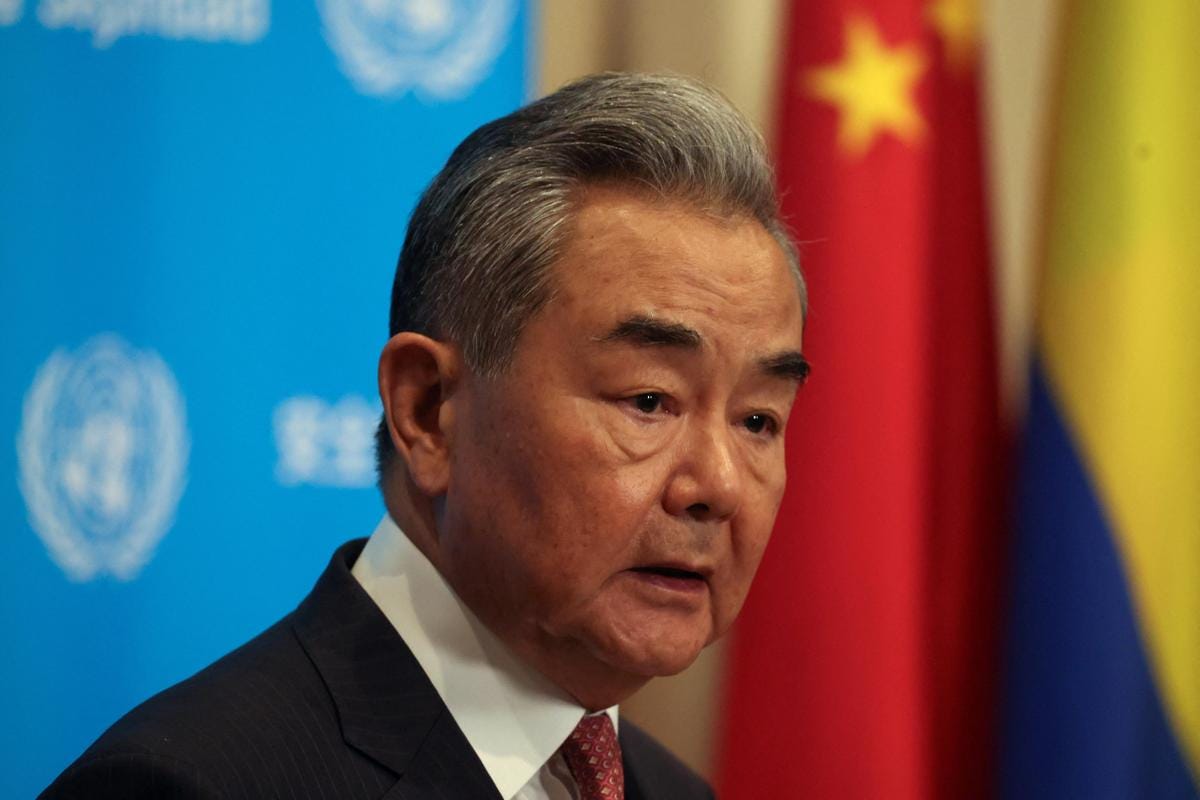
Foreign Minister of China Wang Yi emphasised that, despite its recent failures, the UN remains the “most authoritative and legitimate body in the multilateral security system” and a cornerstone of the rule-based international order.
He underlined the need for its revival and revitalisation with timely reforms to address problems the UN is facing and to make it relevant and effective.
Wang was speaking at a UN Security Council high-level meeting on “upholding the purposes and principles of the UN Charter and strengthening the UN-centred international system,” held on Tuesday, 26 May, at UN headquarters in New York.
The meeting was convened at China’s initiative. Around 20 countries participated in the discussion.
The meeting was also addressed by UN Secretary General António Guterres, who noted that at a time when the world is seeing an unprecedented rise in geopolitical conflicts, respect for international law has dangerously eroded, often “paralysing” the Security Council.
Wang claimed that the root cause of today’s chaos is not that the UN’s spirit is outdated but that the international order and the basic norms governing international relationships—both set out in the charter—are not being upheld by the powerful nations.
He criticised unilateral military, economic, and political actions often undertaken by the US and its allies, claiming such acts undermine the spirit of the charter, and warned that time for such attempts to dominate international affairs is over.
Wang claimed that the primary ways through which the problems of the UN can be addressed are by initiating reforms that will reflect the changing realities of world politics. He appealed to the countries around the world to adhere to the principles of multilateralism and cooperation.
Both Wang and Guterres talked about making the global decision-making bodies more representative and inclusive, with Wang also urging the member countries to align their policies with the UN charter.
Wang demanded that members make sure that their proposals inside the Council are “objective, impartial, and inclusive” without any intentions to “force through” one particular agenda.
Several other participants addressed the meeting, with representatives from the Global South emphasising the need to adhere to the Charter principle of equality in the functioning of the UN and representative decision-making bodies.
Other representatives who spoke during the meeting included the foreign ministers of several countries, including Cuba and Pakistan, and officials from the US, Russia, and France, among others.
Let Cuba live in peace.
Addressing the gathering, Cuban Foreign Minister Eduardo Rodriguez Parrilla demanded that the Security Council should “at least try” to fulfil its primary mandate and prevent the US from imposing an illegal blockade and issuing threats towards his country.
He underlined that the attempts to bring criminal charges against Raúl Castro and the ongoing energy blockade of Cuba are “morally outrageous” acts, part of US actions that have eroded international peace, security, and international law.
He also pointed out similar UN failures to prevent the genocide in Gaza or US-Israeli “imperialist aggression” against Iran, claiming that disregard for international law and the urge for repeated wars comes from a deep-rooted belief in the philosophy of loot and plunder.
“Once the philosophy of pillage disappears, the philosophy of war will disappear”, Rodriguez quoted from a speech given by Fidel Castro in the UN General Assembly in 1960.
He denied the Donald Trump administration’s claims about his country being a threat to its national security, saying Cuba “cannot be a threat” to anyone.
Cuba “is not an enemy of the US, nor does it wish to be one, despite significant differences with its government,” Rodriguez said.
He repeated the warning that if the US proceeds with its threats to invade Cuba and install its puppet government there by force, it will face fierce resistance from the Cuban people until the very end.

"Wang demanded that members....." I find it hard to believe that Wang Yi demanded ( that would be in italic if we were allowed ) anything. The Chinese are nothing if not diplomatic, subtle and nuanced, oh and polite - especially at that level. But I do agree with everything else you say.
I've come to believe that China, or in fact BRICS, holds the best hope we have for a sustainable world peace, but the trouble with the U.N. is that they have no power to enforce their rulings. That may be by design.
I have read somewhere, probably from Prof Jeffery Sachs, that the U.N. can use the Uniting For Peace initiative to by-pass the UNSC. Can they not use that mechanism to abolish the powers of veto?