


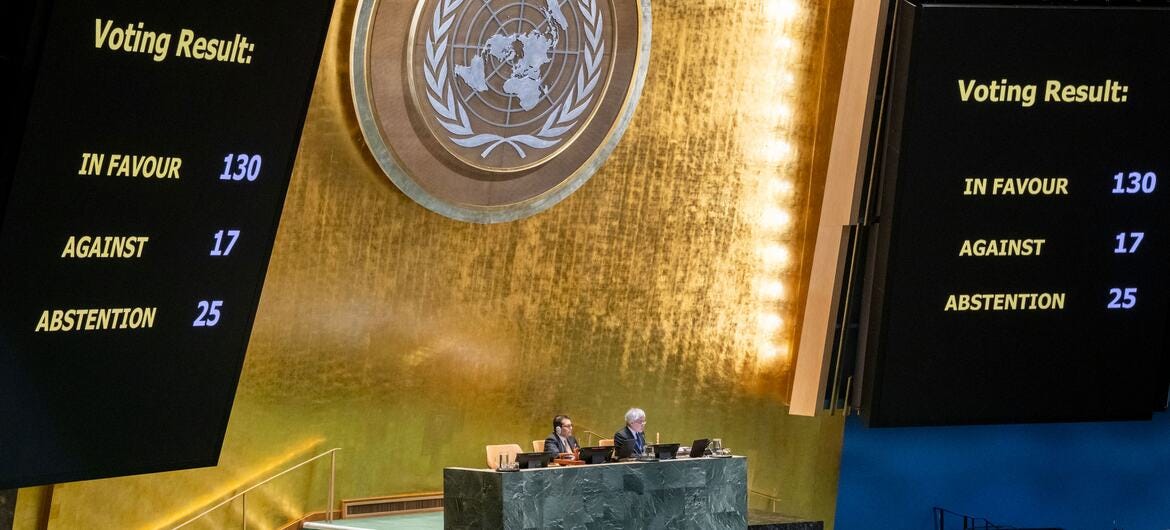
A day after joining the overwhelming majority of countries in the UN General Assembly to vote on a resolution demanding the lifting of the US blockade and sanctions on Cuba, China called on the US to immediately stop its threats of force against the country.
“The illegal economic embargo and unilateral economic sanctions imposed by the US against Cuba have lasted for 64 years, inflicting untold suffering on Cuban people,” Guo Jiakun, official spokesperson of China’s Ministry of Foreign Affairs, said during a regular press conference on Thursday, 29 October.
Claiming that “the overwhelming majority of countries in the world are outraged by the US’s serious violation of the purposes and principles of the UN Charter,” China reiterated the “international community’s longstanding call for the US to immediately stop infringing on the Cuban people’s right to survive and thrive.”
On Wednesday, 130 countries voted in favour of a resolution in the UN General Assembly demanding the end of decades of unilateral US sanctions and blockade on Cuba. This was the 34th consecutive time since 1992 that the UNGA had adopted the resolution holding the US responsible for violating Cuba’s right to self-determination and other international laws.
Though the US embargo and unilateral sanctions against Cuba are decades old, they have intensified since Donald Trump came to power for the second term last year. The economic blockade has particularly created massive shortages of essential goods and services such as fuel, electricity, food, and medicine, affecting millions on the island nation.
The embargo has caused disruptions in medical services and impacted basic sectors of the Cuban economy, rendering thousands of people jobless, with the UN warning of “humanitarian collapse” if it continues.
Cuba has claimed that US sanctions and embargoes cause over eight billion in losses to the country’s economy every year.
Some countries, including China, have tried to assist Cuba by providing humanitarian food and energy supplies.
Stop threats of use of force.
Calling Cuba’s revolutionary government “authoritarian” and labelling the country as a “sponsor of terrorism,” successive US administrations have tried to stage “regime change” in the country through covert and overt means, completely disregarding the Cuban people’s right to self-determination and their own obligations under international law.
The Trump administration, after declaring Cuba “an unusual and extraordinary threat” last year, tightened the blockade and has even threatened to launch military operations against the country. It has demanded the Cuban government make policy changes based on Washington’s wishes.
During the ongoing midterm campaign, Trump has reportedly claimed that the war against Cuba was imminent and can begin the moment the US armed forces were free from the war against Iran.
Cuba has rejected US allegations and refused to surrender its sovereignty despite threats of war.
Apart from providing humanitarian aid, China has also warned against such threats of military interventions, raising the issue on various international forums, including the UN.
Asking the Trump administration to “heed the call for justice from the international community,” Guo Jiakun reiterated on Thursday the Chinese demand that “the US stop all forms of coercion and pressure on Cuba, including through the threat of force.”
Guo also reiterated that “China will continue firmly supporting Cuba’s just effort for safeguarding national sovereignty and dignity and opposing external interference and embargo.”
The reiteration of Chinese support follows its earlier pronouncement of support to Cuba’s revolutionary government “no matter how the international landscape evolves.”
China, while observing 66 years of diplomatic relations with Cuba last month, had claimed that the “socialist development path” suited Cuba’s national conditions and helped in safeguarding its national sovereignty and opposing external interference.”
Recognising how Cuba was the first Latin American country to recognise the People’s Republic of China in 1960, Guo Jiakun claimed that, in recent years, the two countries have made “sustained and steady progress” in building a “community with a shared future.”