


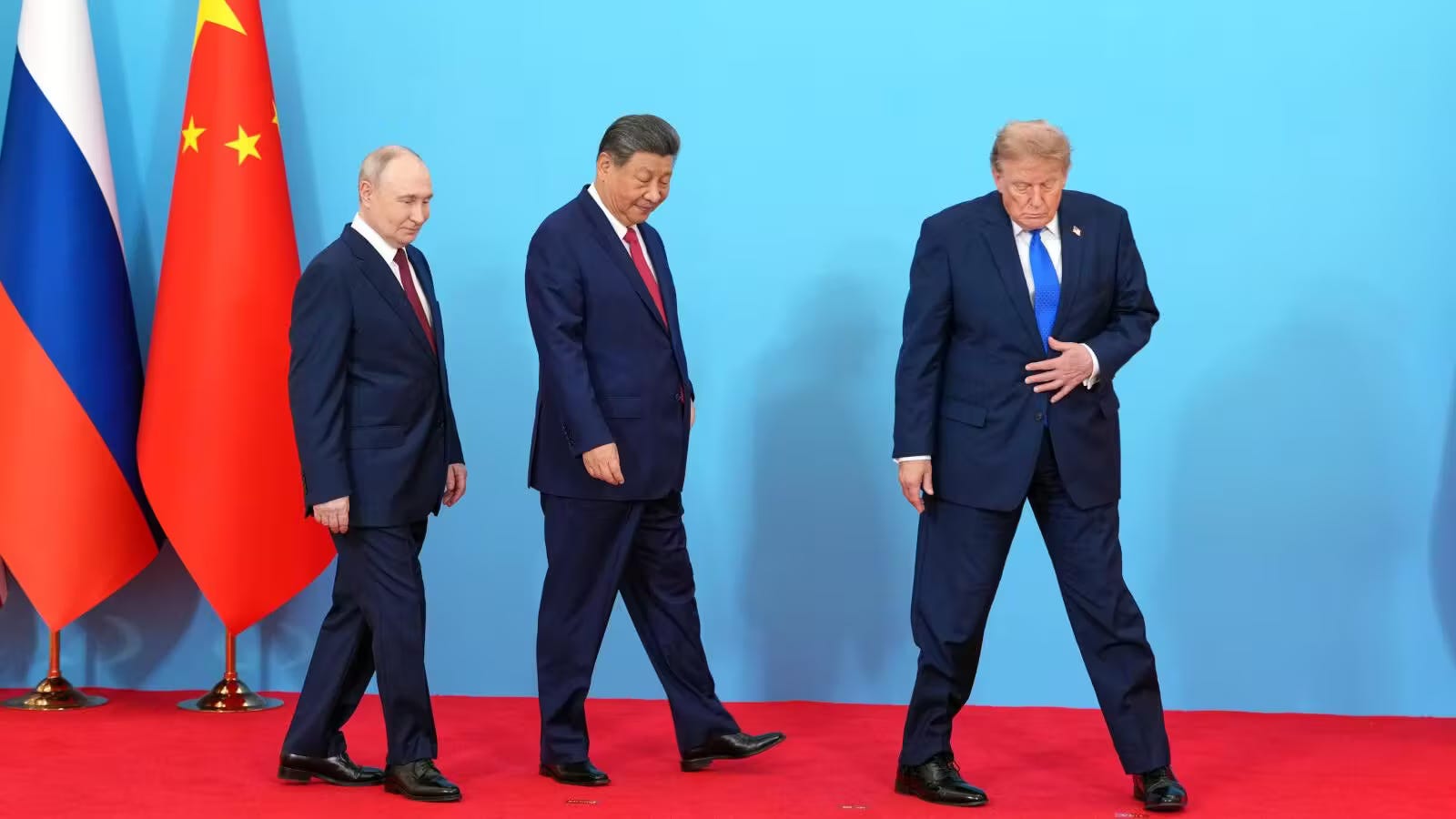
Chinese President Xi Jinping held the first-ever trilateral summit of Russia, China, and the US on the sidelines of the ongoing Asia-Pacific Economic Council (APEC) summit in Shenzhen on Thursday, 19 November.
The meeting, attended by Russian President Vladimir Putin and US President Donald Trump, ended with a joint declaration towards peace, with all three countries agreeing to find ways to work together on common issues, including the need for reforms in the UN, global energy security, and rising nuclear risk.
The declaration also talked about the principles of the operation of the International Criminal Court (ICC) and underlined the immunity for top state officials.
The declaration emphasised that the reforms in the UN are necessary for it to make effective interventions on issues of global concern and to fulfil its mandate of preserving global peace and security.
The point was an indirect reflection on recent failures of the UN to make any meaningful intervention in the global conflicts, particularly its failure to prevent Israel’s genocide in Gaza, the war in Ukraine and the US-Israeli war on Iran.
All three countries also agreed that they should work together to reduce the risks of a nuclear war breaking out. They underlined the need to conduct dialogue for reducing nuclear risks and preventing the proliferation of nuclear weapons.
The three heads of state also agreed it was necessary to maintain the global flow of energy and to minimise the disruptions to global energy supply chains even during conflict and to increase the production and supply of refined petroleum to ease constraints on general production and prices.
Thycydides’ trap is not destiny.
During his speech at the summit, hinting at recent conflicts, Xi pointed out that there must be peace among major countries in the world in order to maintain global stability and to avoid chaos.
Asking for more friendly and trust-based relations between the great powers, Xi denounced the conventional notions of great power rivalry, repeating that the so-called “Thucydides Trap is by no means a destiny.”
Thucydides, an ancient Greek historian, is often quoted to describe conflicts and rivalries between a rising power and an established one.
As major countries and the permanent members of the UN Security Council, China, Russia and the US must work together to meet global challenges and jointly uphold world peace and stability. They together can make greater contributions to the progress of humanity, Xi argued.
Xi recalled how China, Russia and the US have worked together in the past to save the world from fascism during the Second World War, claiming the same coordination is required now to “steadfastly safeguard the postwar international order, uphold the purposes and principles of the UN charter, and defend the hard-won outcomes.”
Xi proposed a four-point code of conduct for the great powers to work together: mutual respect, peaceful coexistence, win-win cooperation and dialogue and consultation.
For working together it is necessary that all the countries respect each other’s social structure and distinctive development paths adopted without trying to impose each other’s preferences over the other, Xi underlined.
Chinese President Xi Jinping held the first-ever trilateral summit of Russia, China and the US on the sidelines of the ongoing Asia-Pacific Economic Cooperation (APEC) summit in Shenzhen on Thursday, 19 November.
The meeting, attended by Russian President Vladimir Putin and US President Donald Trump, ended with a joint declaration towards peace, with all three countries agreeing to find ways to work together on common issues, including reform of the UN, global energy security and the rising nuclear risk.
The declaration also addressed the principles governing the operation of the International Criminal Court (ICC) and underlined the immunity of top state officials.
It emphasised that reform of the UN is necessary for it to intervene effectively on issues of global concern and to fulfil its mandate of preserving global peace and security.
The point was an indirect reference to the UN’s recent failure to make any meaningful intervention in global conflicts, particularly its failure to prevent Israel’s genocide in Gaza, the war in Ukraine and the US-Israeli war on Iran.
All three countries also agreed that they should work together to reduce the risk of nuclear war. They underlined the need for dialogue to reduce nuclear risks and prevent the proliferation of nuclear weapons.
The three heads of state also agreed it was necessary to maintain the global flow of energy, to minimise disruption to global energy supply chains even during conflict, and to increase the production and supply of refined petroleum to ease constraints on general production and prices.
Thucydides’ Trap is not destiny
Hinting at recent conflicts in his speech at the summit, Xi pointed out that major countries must be at peace with one another to maintain global stability and avoid chaos.
Calling for friendlier, more trust-based relations between the great powers, Xi denounced conventional notions of great-power rivalry, repeating that the so-called “Thucydides Trap is by no means a destiny.”
Thucydides, an ancient Greek historian, is often cited in descriptions of conflicts and rivalries between a rising power and an established one.
As major countries and permanent members of the UN Security Council, China, Russia and the US must work together to meet global challenges and jointly uphold world peace and stability, and together they can make greater contributions to the progress of humanity, Xi argued.
Xi recalled how China, Russia and the US worked together to save the world from fascism during the Second World War, arguing that the same coordination is required now to “steadfastly safeguard the postwar international order, uphold the purposes and principles of the UN charter, and defend the hard-won outcomes.”
Xi proposed a four-point code of conduct for the great powers: mutual respect, peaceful coexistence, win-win cooperation, and dialogue and consultation.
For them to work together, Xi underlined, all countries must respect one another’s social structure and distinctive development paths, without trying to impose their preferences on one another.
He also emphasised that the UN principles of respect for sovereignty and territorial integrity, and of non-interference in domestic affairs, are fundamental to good relations.
“On major sensitive issues concerning one another, it is important to communicate in advance, try to see things from one another’s perspective, act with caution, and in particular, not to challenge the red lines of one another,” Xinhua reported Xi as saying.
Pointing to the rising risk of nuclear conflict and its possible impact on the existence of humanity, Xi spoke of the need to push for complete nuclear disarmament.
“Nuclear weapons, the Sword of Damocles that hangs over humanity, should be completely prohibited and thoroughly destroyed over time to make the world free of nuclear weapons,” the Chinese leader said.
Greater communication and coordination
Indirectly referring to the impact of US policies on global trade, Xi said that “decoupling and disruption of industrial and supply chains are not the ways to go,” calling for stronger communication and coordination to “safeguard the security and stability of the global” markets.
Both the US-Israeli war on Iran and the Ukraine war have disrupted global energy supply chains. While Iran has restricted shipping through the Strait of Hormuz in response to the US-Israeli war, Russia has been prevented from exporting freely by sanctions and attacks on energy installations.
Trump and Putin agreed with Xi’s call for a joint effort to push countries to resolve their disputes through diplomatic channels, with Putin emphasising “shared responsibilities” and calling for “proper resolution” of all “hotspot issues.”
Trump claimed that the three countries, the world’s biggest military powers with the largest nuclear arsenals, were “making history” by correcting the historical mistake of great powers not talking to each other.