


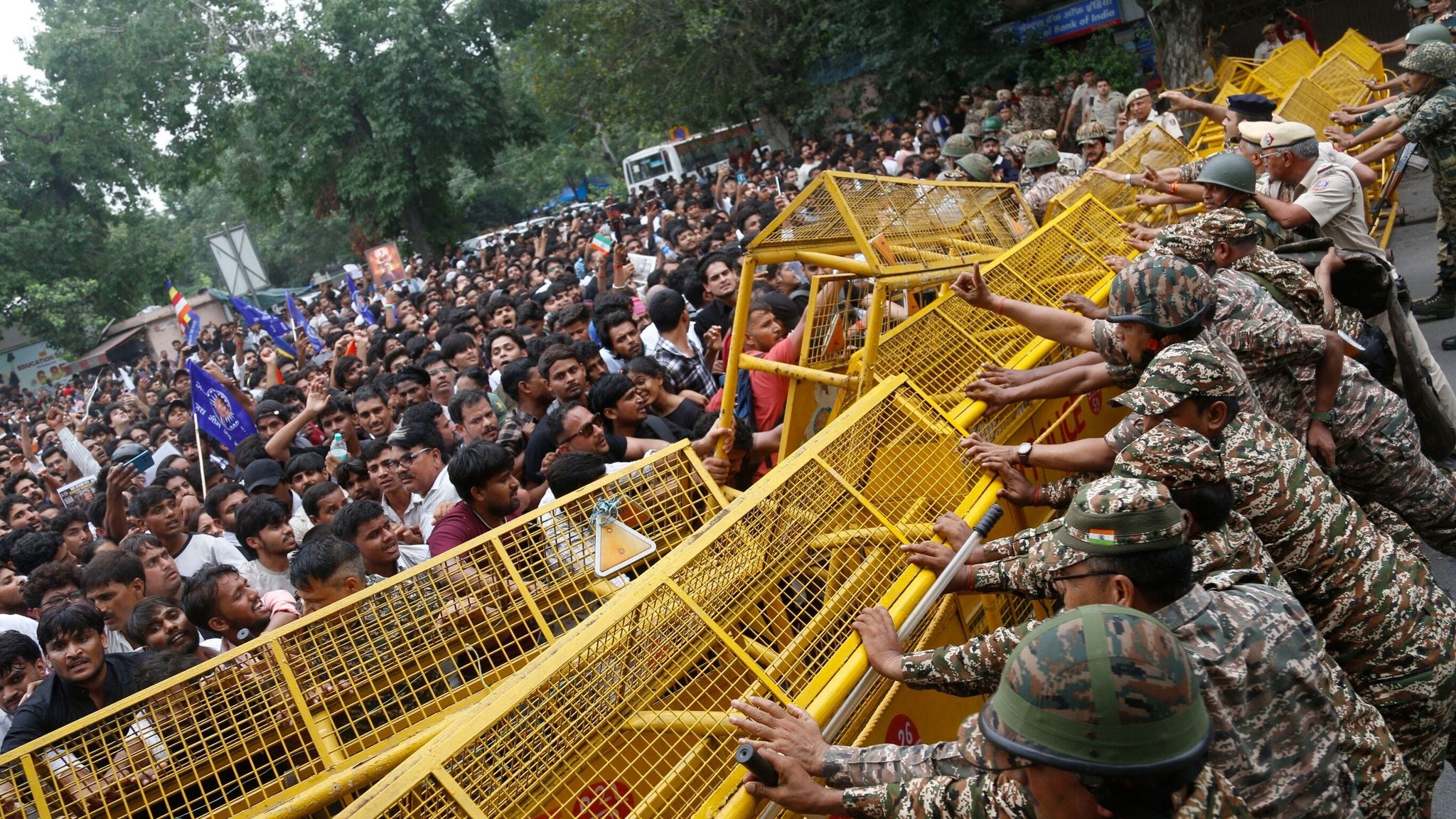
Can all the people be fooled all the time? Can a country with a population of a billion-and-a-half be dragged around like a corpse forever? It cannot. The Cockroaches are out and about.
For the first time in years, it feels wonderful to be Indian. Just when hope seemed lost, they came. Young roaches riding in on the rain. The progeny of the unholy union between a judge and a joke.
We all know the story, but here it is, for the record. In response to an arrogant, contemptuous comment by the Chief Justice of India, Surya Kant, calling some unemployed young Indians cockroaches, Abhijeet Dipke, a student living in Boston, posted a comment on Instagram: “What if all cockroaches come together?” Millions responded. And thus was born the Cockroach Janta Party. Dipke became the Pied Piper of cockroaches. Its first demand was the resignation of Dharmendra Pradhan, the education minister who sits smugly atop a corrupt, rotten ministry under which public exam papers are regularly leaked. An estimated 152 since 2014, according to opposition parties. These leaks have devastated the lives of millions of young people who spent years preparing for these exams, some of whose parents have had to sell their land or homes to support their children’s studies and pay the fee for the right to appear for these exams. A novel form of legal extortion. After the recent leak of the National Eligibility cum Entrance Test (NEET) paper, 12 distressed, wrecked students died by suicide.
As Cockroach anger grew into an online tsunami, Dipke returned from Boston on 6 June and went straight from the airport to Delhi’s famous protest grounds at Jantar Mantar. Sonam Wangchuk, the well-known activist and education reformer from Ladakh joined him and declared an indefinite hunger strike. Six university students, Neha Bora, Manish Kumar, Aameen Amitosh, Danish Ali, Hrishikesh and Deepak, members of the All India Students Association (AISA), the student wing of the Communist Party of India (Liberation), declared they would fast too, and took up position on an adjacent stage. Protests began in other cities. As the condition of those on fast grew critical, the young roaches who had swamped the internet began to show up at Jantar Mantar for real. The Cockroach Janata Party announced that on 20 July, the day parliament was to open for its monsoon session, they would march on Parliament. Two days before the planned march, Sonam Wangchuk was snatched off the stage by the police and held in detention, first in a government hospital, and later at his wife’s insistence, in a private hospital. He still remains on fast. On the morning of 20 July, the day of the march, the AISA students ended their fast.
The cockroaches took the capital city by storm. They came by train, by bus, by air, by metro, their numbers increasing by the hour. Hours before the first rays of sun lightened Delhi’s monsoon skies, they began to pour into Jantar Mantar in the tens of thousands. By sunrise it was clear that a generation of desperate and furious young people who have seen their future snuffed out before their eyes, was going to reclaim what their parents and grandparents” generations had conceded: our dignity as a people and as a country. Our rights as citizens of a democracy. The protesters exorcised the corrosive fear that has become second nature to us all with their sheer courage and grace. And humour. By the end of the day it was clear that the protest had become about something far bigger than what the protesters or their leaders were demanding. Dharmendra Pradhan is small change now. The stakes are far bigger. The rot in the whole system of governance, from top to bottom is clearly visible and has begun to stink like a decomposing corpse. Even the tiniest of the cockroaches, some no more than seven or eight years old were able to clearly articulate that.
Despite the quick and almost clandestine appointment of a new police chief days before the march, and despite worried whispers about the terrifying proficiency of our terrifying Union home minister, both the police and the home ministry completely miscalculated the scale of the tsunami that engulfed Delhi on 20 July. They tried everything. They blocked buses and roads and metro stations. It didn’t help. They tried to jam the internet. But the young roaches—creatures of the internet—somehow subverted that effort with a deluge of memes and videos that made you laugh and cry at once. In Delhi, of all the places in the world, young women who were part of the protest said that they felt safe in the crowd.—although some complained about being groped by the police. We saw Muslims, Hindus, Christians, Sikhs, Buddhists, people belonging to every caste and class coming together, helping each other, protecting each other as they faced down the police. Instead of lecturing us, or giving us grand speeches, they showed us, demonstrated for us, the possible India, the beautiful India of our dreams.
To deal with this danger, the police welded together their yellow metal barricades, and brought their tried and tested props: trucks full of stones, and pre-damaged vehicles in the hope that they could make it look as though the young people had turned violent and the police were acting in self-defence. They brought in an army of plainclothes goons armed with batons and clubs. To prepare for action, the Rapid Action Force (RAF) removed their name-tags from their uniforms. The faithful mainstream TV channels were lined up, primed to report the lies. (Some jumped the gun and began to report things that hadn’t happened yet. News in India tends to be about the future, not the present.) Nothing worked. The police and RAF swung their lathis wildly, broke children’s heads and fractured limbs. They fired tear gas. But the young kept marching. Straight towards parliament. Straight to where they said they would go. As they approached, security forces took position, their AK47s aimed at the unarmed students. Still, the Cockroaches marched. And as they marched, they stripped away any remnants of the velvet glove that masks the government’s iron fist and exposed the current regime for what it is and always has been. A fascist iron fist. A confederacy of brutes with no capacity to understand the history and the diversity of the country which it governs. People who only know how to hate, but have no idea how to love. Or think.
As the marchers approached, our brave, boastful prime minister was whisked away to safety. Members of Parliament were prevented from leaving the gleaming new Samvidhan Sansad building whose whole purpose seems to be to undermine the Constitution daily.By evening the police had broken the main stage at the protest site. By night the people had reclaimed it once again. As the police withdrew for the night the Cockroaches gave them a standing ovation. For beating children. Wah Modi ji! Wah!
It’s silly to expect major political change to come from this. But to dismiss it as just a heady moment would be obtuse. It’s no surprise that the wires and live-screaming TV channels are burning up with gossip and innuendo and conspiracy theories about foreign-funding and CIA plots. Speaking as a proud andolanjeevi (Modi’s derisive name for people like me), I confess that when it all began, I was wary too. I worried that we were heading into another Anna Hazare moment—that so-called anti-corruption people’s movement of 2011—which, regardless of its early intentions, eventually gifted us three terms of being ruled by a political party that has destroyed every institution in this country, one that sees no separation between itself as a political party and the government of India, one that respects neither the country nor its citizens, and one that has shamed us internationally and brought India to its knees.
But my suspicions about the Cockroach Janata Party were allayed when I saw the hostility of the mainstream media towards them. That, to me, was the first and most reassuring sign. I was thrilled that Abhijeet Dipke was from a Dalit community, and even more thrilled that that wasn’t what anybody was focused on. Everything changed for me when I heard him say, “If my name had been Khalid, or if I were a Muslim, I would have been in jail by now.” He had the courage to call out the vulgarity of how things actually work in India—the fact that in our country everything (including and especially the law) does not apply equally to everybody. Everything depends entirely on your religion, caste, class, ethnicity and gender. It was a profound observation, simply made. For him to say this publicly, when even opposition politicians will only say “minority community” instead of “Muslim” for fear of a “Hindu backlash” made me head for Jantar Mantar right away. I also knew that when Dipke picked the name “Khalid” he could well have been speaking of Umar Khalid, the JNU scholar who, along with Sharjeel Imam and many others, has been in prison without trial for close to six years now. Umar’s crime? Urging protesters to remain non-violent during the 2020 protests against the Citizenship Amendment Act, even while Delhi was convulsed by a spate of arson, murder and mosque-burning instigated by Hindu vigilante goons watched over by the benign, and occasionally participating police. Appeal after appeal for bail has been turned down by judges who seem to have lost the courage to do, or even understand, what is right.
As the Cockroaches marched and their numbers burgeoned, I caught myself thinking: Thank goodness they aren’t mostly Muslim, or Sikh, or Christian or Adivasi. They would have been flattened, killed, shot, jailed. Thank heaven they aren’t Kashmiri. They might have been blinded (although some did receive their share of pellet-like injuries). Thank goodness they are mostly Hindu. That’s how sad this moment is in India. However, things could change in a minute. We are in what they call a “developing situation.” Reports are coming in of thousands of paramilitary troops being flown in from other states. We don’t know what the coming days will bring.
Where does all this leave us? Unlike the Anna Hazare movement which had weeks of frenzied, non-stop 24×7 coverage on hundreds of hysterical, corporate owned TV channels, the Cockroach Janata Party has only itself and the internet to bank on. Unlike the Anna movement which had been penetrated and taken over by the Rashtriya Swayamsevak Sangh, with the Modi-led BJP massing at the gates, fully prepared to capitalise electorally on the TV-generated frenzy, the Cockroaches have no organised opposition parties waiting in the wings, poised to take things further. The spontaneous rage we are witnessing will dissipate unless some real political work begins. Unless adults and opposition parties stop their jockeying and petty squabbling and show some solidarity. The government knows that this is unlikely. It remains unmoved because it feels that all it needs to do is wait. States have the power to wait. People don’t.
At this moment the Cockroach uprising is one of several protests taking place across India. Adivasis in Madhya Pradesh are protesting the Ken-Betwa river-linking project. Villagers in Uttarakhand are protesting the mass felling of trees. People are protesting the environmental desecration of the Greater Nicobar Islands. Manipur is boiling. Jobs are disappearing. Prices are soaring. Fury is building. And the BJP-RSS’s “God” game is getting exposed for what it always has been. A hoax. A gangster-driven gold-rush. The looting of the Ram Temple in Ayodhya has given us a bad Bollywood script which is playing out before our eyes: Sleek godmen and corrupt politicians building hotels, accumulating real-estate, driving around in SUVs, fattened on the faith of the poor and unsuspecting. The tentacles of corruption and daylight robbery snaking all the way up to the top.
Can Cockroach energy pull us out of this pit? Not easy. A quick look at the outcome of people’s movements in India is not encouraging. It’s a potted history of shrinking ambitions and broken dreams. In the sixties and seventies various movements—including the armed rebellion by the Naxalites—demanded the redistribution of wealth and land to the tiller. They were crushed. In the eighties and nineties, social movements, most famously the Narmada Bachao Andolan and later the Maoists in Andhra Pradesh, Chhattisgarh and Jharkhand fought against the displacement of farmers and indigenous tribespeople from their land. In other words, they were asking for what the poor still had to not be snatched away. They were crushed too. By the 2000s, they had been reduced to being grateful for the National Rural Employment Guarantee Act (NREGA). The right to three months” employment at minimum wages—an amount which works out to the price of a good meal at an expensive restaurant in a city. That too has been shelved by this regime, and replaced with survival level rations—bags of provisions with Modi’s face on them—thrown contemptuously at people, like alms to beggars from moving cars, in return for gratitude and votes. As the economy flounders, even this is in jeopardy.
Today, in 2026, we have been reduced to fighting for our right to vote and our citizenship. The Citizenship Amendment Act (CAA) coupled with the National Register of Citizenship (NRC) is the Hindu Rashtra version of Nazi Germany’s 1935 Nuremberg laws by which German citizens were granted citizenship by the Third Reich depending on their “legacy papers.” (How many in India have these papers?) The anti-CAA-NRC moment faded away after the mass protests led to the murder of protesters and the incarceration of activists. But the protests caused the government to slow down the implementation of those new laws. But now, the CAA-NRC, which many correctly believed was aimed mostly at Muslims, has returned, disguised as the SIR (Special Intensive Revision) of electoral rolls. We have casually been informed that even our passports are not proof of citizenship. Millions are being struck off electoral rolls. The whole country is desperately searching for “legacy papers.” We don’t know where we stand. Are we legitimate? Illegitimate? Do we have rights? Which of us belongs in those massive detention centres being constructed for “doubtful citizens”? Will we spend our days running from Tribunal to Tribunal? Fascists love chaos and confusion.
Our panic and anguish may lead us to pin too much hope on the Cockroach uprising. Some have already compared it to the uprising of young people that led to regime change in Bangladesh, Nepal and Sri Lanka. But India is too vast a country for that to happen. Others compare it to the movement led by Jayaprakash Narayan that toppled Indira Gandhi in 1977. These comparisons are not helpful. The Cockroach Janata Party is neither of those things. It’s a thing of its own. A unique product of its times. It is vulnerable young people up against a vicious, vindictive government that has shown itself to be merciless to those who oppose it. Revenge is surely being planned and will be visited on those it sees as the main instigators.
How does a regime which is clearly becoming hugely unpopular have the confidence to not make any concessions to the people who voted for it? Probably because it feels it has successfully gamed the election business. It has captured the machinery. The Election Commission is flawed in its very composition and can no longer be counted upon to be neutral. The EVMs have been managed, the electoral rolls now exclude millions of real people and include millions of phantom names, the bureaucracy that oversees elections have shown themselves to be utterly complicit, the courts can be depended upon to delay or turn a blind eye to egregious malpractice, the police have no idea what neutrality is, the press genuflects each time someone in power clicks their fingers at it. Constituencies are going to be re-mapped to make sure that it is always Advantage BJP. What does the ruling party have to fear? Why should it listen to anyone? It is the richest political party on earth, backed by the richest industrialists in the world. It can buy anything. And anyone. Or so it believes.
But can this game last forever? Can all the people be fooled all the time? Can a country with a population of a billion-and-a-half be dragged around like a corpse forever? It cannot. The Cockroaches are out and about. The farmers have begun marching to Delhi once more, this time to protest the Indo-US trade deal—the death warrant the government of India has slavishly agreed to sign on their behalf. The borders of the city have been sealed but that is unlikely to stop them. Perhaps the rest of us can take lessons from our farmers and our cockroaches on how to become a little dangerous. The young have given us a gift. It is up to us all, every one of us to make what they have done matter.
Once a prime minister flees physically, it can’t be long before he has to flee politically.
But this regime will not go easily. It will not tolerate being humiliated on the streets of the capital. We are likely to see blood. Young tempers are fraying. How long will it be before someone in that youthful, fired-up crowd loses their cool and provides the police an excuse to open fire? They will do everything they can to break us. We must do everything we can to stop them.

Thank you for this report and this history. The 'cockroaches' are more powerful when they can also dismiss the 'monetary power' of the State as the illiteracy it demonstrates.
While it may seem fruitless, the ones at the bottom are not the ones doing the bidding of empire all for the illiterate 'payment' offered by the imperial emperor who thinks not only of 'the cockroaches' as illiterate fools but also the foot soldiers and so many others that willingly sell their souls to acquire the very coin they then will bash the heads of others to accept!
We cannot watch this history play out over and over and not call out the belief system underlying it all. A belief in absolute nonsense.
Most all are willing to think that humanity got the definition of money correct and structured a workable system around that, so now we just have to put the right people in charge and catch the crooks that are 'gaming the system.'
But what if the very definition of money is wrong and cannot be made to 'work'? And what if believing in, or at least going along with, the system is what gives the emperor power?
“Problem Statement
You have never seen a scale run out of grams. You have never been told that metres are scarce this quarter, or that the kilogram supply has been restricted to control inflation. No measuring instrument you have ever used has charged you a percentage of the value of what you were measuring, accumulated that charge across every subsequent measurement, and handed the compounding difference to a third party who contributed nothing to what was being measured.
Yet there is one measuring instrument you use every day for which every one of those things is not only accepted as normal — it is embedded in law, taught in universities, and defended by the most credentialed institutions on earth. That instrument is money.
But here is the deeper problem — and it is more serious than it first appears. The metre exists as a formally constituted concept. It is defined as the distance light travels in 1/299,792,458 of a second — independently of any object being measured, independently of any authority, verifiable by any observer anywhere. The kilogram exists. It is defined in terms of Planck's constant. The second exists. It is defined by caesium-133 hyperfine transitions. In every case the unit has three properties: it is defined independently of what it measures, it is passive with respect to what it measures, and it is available without per-unit cost wherever the standard is applied.
Now apply the same question to money.
What independently verifiable phenomenon does the monetary symbol refer to? Not how is it used, not what do people do with it — what is it, stated in terms that are independently determinable without presupposing that money already exists and is already accepted? No such statement has ever been given. What exists in place of a definition is an operative notion: a set of behaviours associated with a symbol, accumulated across millennia of practice, treated as if it referred to a formally constituted concept with its own independent nature. What passes for money's definition — "medium of exchange, store of value, unit of account" — does not define what money is. It describes what people do when they already accept the symbol. Each term presupposes that money exists, is identifiable as money, and is accepted as money — before the definition has established any of those things. It is viciously circular from inception: not a foundation with cracks, but a missing foundation.
This is where the precise nature of the error becomes visible.
A valid measure must be independent of what it measures, passive with respect to it, and available without per-unit cost. A commodity has independent market value, is subject to scarcity, and commands a price proportional to that value for access. These two property sets share no common element. They are mutually exclusive by logical necessity: a unit that has independent market value cannot simultaneously be independent of what it measures. A unit subject to scarcity cannot simultaneously be available without per-unit cost.
The operative notion of money assigns both property sets simultaneously to the same symbol.
This is not a tension or a trade-off or a policy choice. It is a formal logical contradiction. And it is the operative assumption on which every contract, every financial model, every regulatory framework, and every policy instrument currently functioning on earth is built.
From this single contradiction everything else follows necessarily.
Because the symbol is assumed to have independent commodity value, treating access to it as scarce and subject to a percentage price is internally rational within that assumption. That percentage cost, applied across a chain of two or more transactions, generates a nominal claim that grows without bound as the chain lengthens, independently of how much real value the chain produces. This is not an economic theory. It is an arithmetic identity provable by the same mathematical induction used to prove that 1+1=2.
The two errors are not independent. The compounding extraction is not an abuse of the monetary system — it is the correct operational expression of a system whose unit is assumed to be simultaneously a measure and a commodity. Every attempt in monetary history to regulate, cap, or restructure the extraction while leaving the unit definition unchanged has either failed, been circumvented, or displaced the problem to another domain.
The consequences are observable and growing. A substantial and growing fraction of current working hours is directed at servicing financial claims rather than genuine productive activity — documented in tax burden data, household debt service ratios, and the ratio of global financial claims to real assets, which currently exceeds real productive value by a factor of three to ten and is increasing. This diversion is not a policy failure. It is a structural consequence of the contradiction operating at scale, at transaction speeds eighty-six million times faster than fifty years ago.
The correction costs nothing to implement. It penalises no agent. It requires no political consensus on values, no transfer of wealth, and no agreement on what humanity should produce or prioritise. It requires only that the unit of measure we use for everything be subjected to the same logical requirements as every other unit of measure we use correctly.” – Marc Gauvin – MSTA - Spain 2026
The very conceptual subjugation of the full capacity of a society to an illiterate preoccupation with the preliminary acquisition of an abstract acCouting unit (whether imperially declared and forced on a populace, or a particular trade good/commodity, digital or real, or "loaned" into existence by a bank) is a mistake of monumental proportions that even the best intentions cannot overcome while not correcting it. Don't we already know how to count and keep records?