


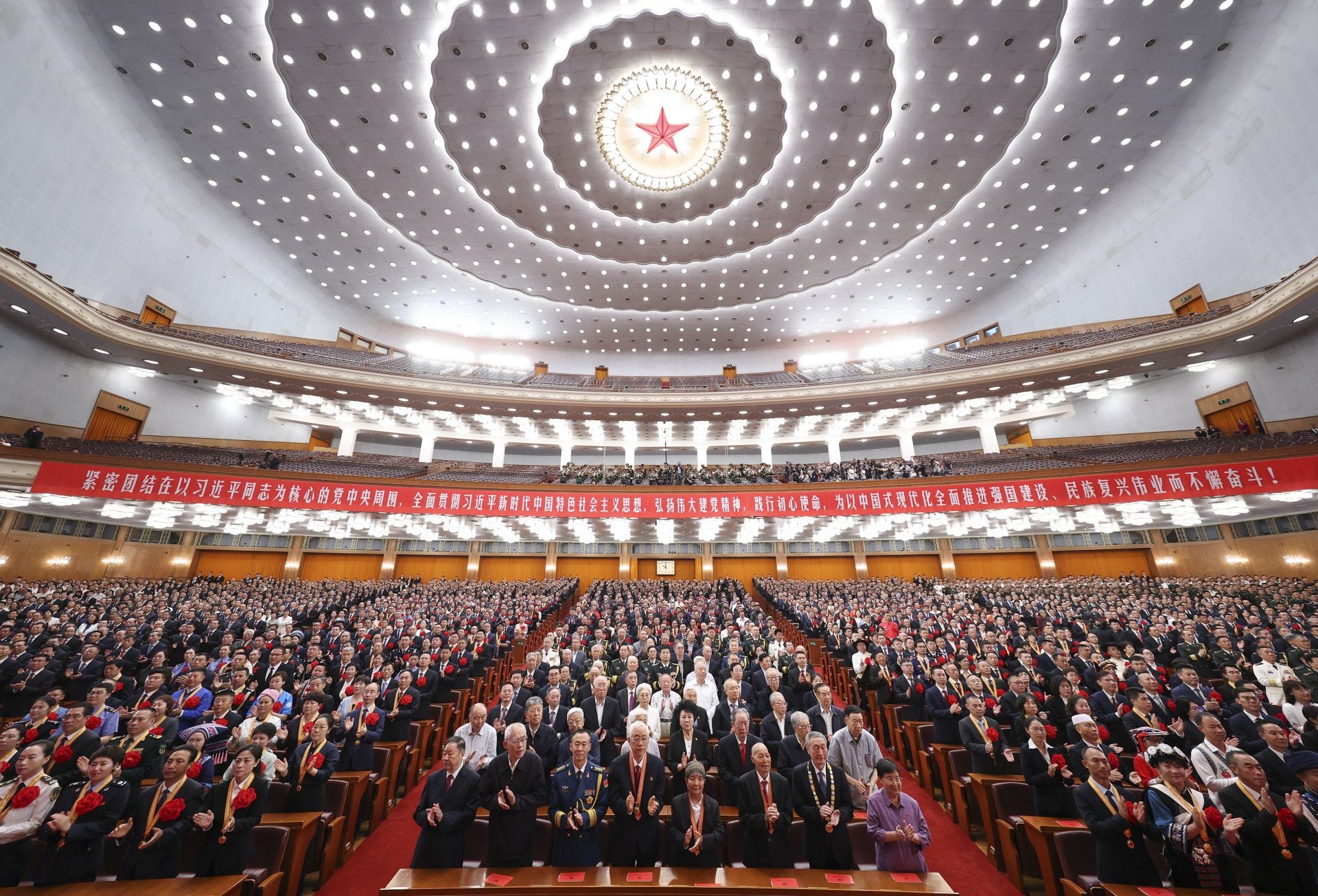
The ruling Communist Party of China (CPC) celebrated its 105th anniversary on Wednesday, 1 July, with a resolve to press ahead to make China into a modern socialist country by 2049.
Speaking during the celebrations to mark the occasion on Wednesday, Chinese President Xi Jinping, who is also the general secretary of the party, called the history of the CPC the “most magnificent epic” of the Chinese nation.
Formed in Shanghai in 1921 with a total membership of just 50 members, today the CPC boasts a membership of over 101 million members, with over 5.43 million primary-level organisations.
The CPC has been in power in China since the establishment of the People’s Republic after the 1949 revolution.
During the ceremony, President Xi conferred eight individuals the 1 July Medal, the party’s highest honour. The individuals who were conferred the honour have made outstanding contributions in their respective fields of action, including a grassroots mediator, a village party official, a veteran, a rural doctor, a community worker, an agricultural specialist, a mechanical engineer and a refining engineering expert, Xinhua reported.
Xi emphasised that its members should never forget the original aspiration and founding mission of the party. “We always stay modest, prudent, and hard-working, and we have the courage and ability to carry on our fight.”
Xi also warned that Chinese development has reached a phase where “strategic opportunities co-exist with risks and challenges and where uncertain and unpredictable factors are on the rise,” asking party members to be ready to face all such challenges and risks.
A brief history
Inspired by the great October Revolution in Russia in 1917 and the ideas and works of Karl Marx, the CPC started a movement against the country’s feudal rulers with the help of the country’s vast peasant classes and the leadership of Mao Zedong.
After over two decades of struggle against feudalism and colonial occupation, the PRC was declared in 1949.
The CPC spent its first two decades in power creating the grounds for building a socialist society by dismantling feudal structures under a centralised planning system.
Later, under the new leadership of Deng Xiaoping in 1978, the CPC began an era of reform for faster economic development, achieving one of the fastest growth rates in the world. The surplus thus generated has been used to build rural infrastructure, eradicate extreme poverty and hunger, and make investments in science and technology since then.
China is a pillar of world peace.
Xi underlined the major achievements of the party, including the eradication of absolute poverty, claiming it has also “mapped out a blueprint to basically realise modernisation by 2035 and build China into a great modern socialist country in all respects” by the centenary of the establishment of the PRC.
Xi reiterated that the reintegration of Taiwan into the mainland is a “historic mission and unshakeable commitment” of the CPC and expressed hope that the People’s Liberation Army, under its control, would “resolutely defend China’s sovereignty, security and development interests and make great contributions to safeguarding world peace and development.”
Talking to the media during a regular press conference on Wednesday, Guo Jiakun, official spokesperson of the Chinese Ministry of Foreign Affairs, thanked various political parties and governments from across the globe who congratulated the CPC on the occasion.
“Socialist China under the leadership of the CPC is widely recognised as the defender of world peace, contributor to global development and upholder of international order,” Guo claimed.
Guo further asserted that China, under the CPC, will continue to raise the banner of peace, development, cooperation and win-win.
China will continue to carry forward, Guo Jiakun claimed, the common values of humanity and “promote the building of a new type of international relations” as per the four major global initiatives announced by Xi previously: development, security, civilisation, and governance.
