


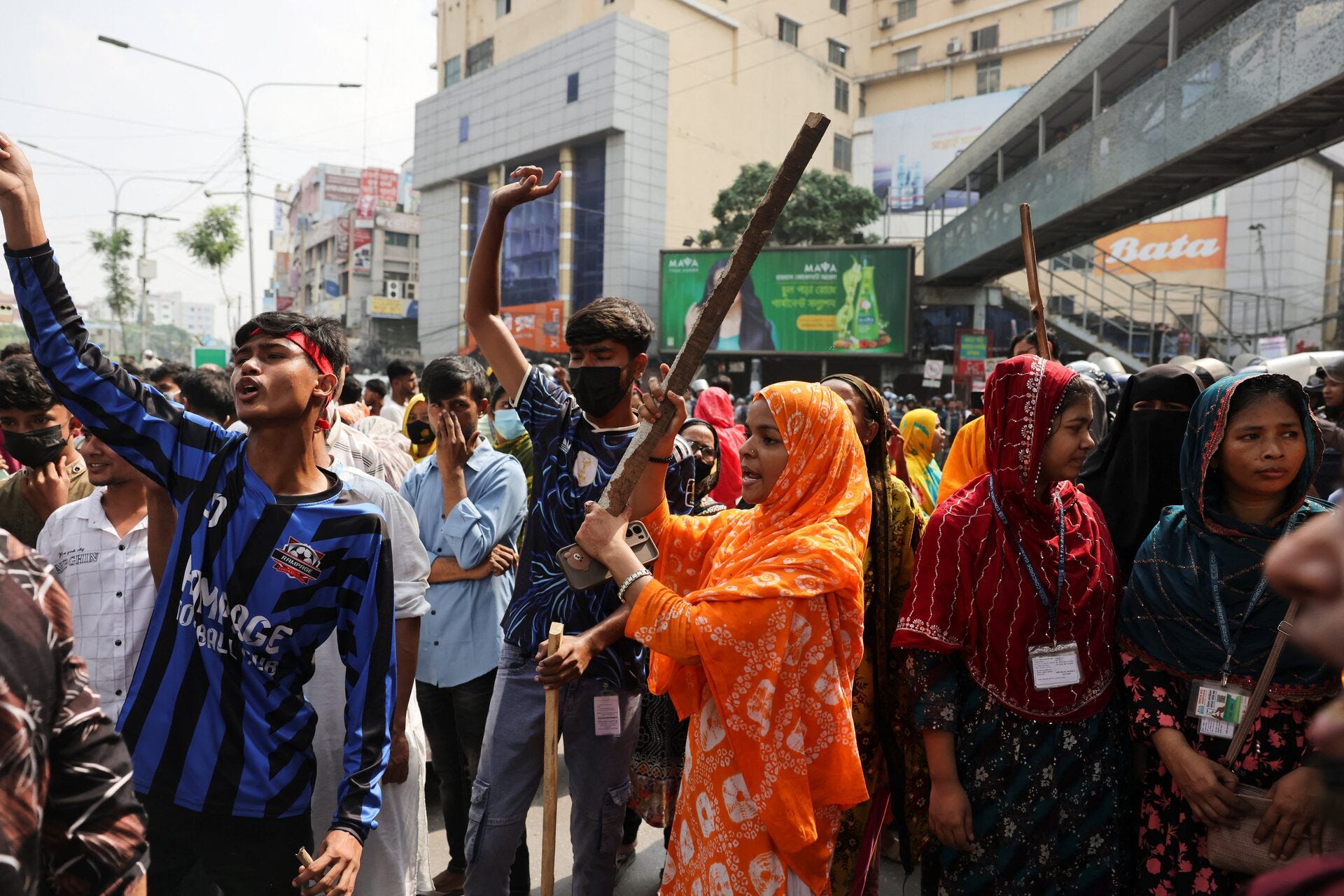
Security forces fired tear gas and stun grenades at thousands of workers protesting for better wages in Bangladesh’s capital, Dhaka, on the second consecutive day on Wednesday, 18 November.
The protesters, mostly women, marched across the city and blocked several roads, including the Dhaka-Meymensingh highway, in and around the city and clashed with security forces, setting their vehicles on fire at some places.
Several workers were reportedly injured after the security forces’ crackdown. The security forces have also arrested scores of union leaders and agitating workers in the last two days, accusing them of inciting violence.
The large gathering of the workers on Wednesday forced some of the owners of garment factories to announce holidays, while scores of other factories in Dhaka’s Gazipur area announced indefinite closure.
The protests, which began last month over the demand for an increase in the monthly wages, were suspended earlier this month after the Bangladesh Nationalist Party (BNP)-led government announced the formation of a Minimum Wage Board and promised to implement its recommendations from January 2027.
At least one worker was killed, and hundreds of others were injured in the state’s repressive actions in the earlier round of the protests. The repressive state actions had invited condemnation from human rights groups and the World Federation of Trade Unions.
Opposition parties and groups have also accused supporters of the ruling right-wing BNP of trying to malign the workers’ agitation and using its activists to unleash violence on them.
The garment workers are demanding a raise in the minimum wage from the present 12,500 Bangladeshi taka (around $100). Various groups have demanded the new minimum wage to be anywhere between 30,000 (around $240) and 37,127 (around $300).
The workers claim that, instead of an increase, their real income has actually fallen drastically in the last three years due to the lack of revision in their wages, despite the rising cost of living and price of essential commodities and services.
Bangladesh has witnessed constant high inflation in the last few years. In the last few months in particular due to the US-Israeli war on Iran. The economic situation of people across South Asia has further deteriorated as the supplies of the energy resources remain disrupted, pushing the prices higher.
The constant high prices of other essential commodities and services have made it difficult for most of the workers in the country to live a decent life on their present wages.
Anger over delays in wage hikes
The resumption of the protests on Tuesday is attributed to what workers accused of a deliberate delay by the factory owners association to submit responses to unions’ proposals for an increased monthly minimum wage in the earlier board meetings.
The delay by the factory owners caused the postponement of the third scheduled meeting of the board to Monday 23 November.
Shamshir Sharif, an activist with the Workers Party of Bangladesh (WPB) and academic, also claimed that the fresh agitation may be a sign of widespread apprehensiveness among the workers about the motives of their representatives in the wage board.
The workers fear that in the absence of the pressure from the streets, the representatives may fail to push for their actual demand of the minimum wage of 30,000 taka and settle for a token wage increase instead, Sharif argued.
This is despite the fact that the union representatives have reportedly submitted a demand for a 32,000 taka monthly minimum wage.
The union representatives claimed the 32,000 taka benchmark was agreed upon after taking into consideration the industry’s capacity and the overall economic situation in the country, despite the fact that the workers need a much higher wage to have a decent life for themselves and their dependents, Prothom Alo reported.
Workers dismiss the concerns raised by the factory owners about the sustainability of a higher minimum wage, pointing out how export revenues and profits of the factories have risen in the last years.
The garment workers are among the lowest-paid workers in Bangladesh, despite the readymade garment export bringing around $39 billion to the country last year and being the largest source of the country’s foreign revenue (around 80%).
Bangladesh is the second largest exporter of readymade garments in the world after China.