


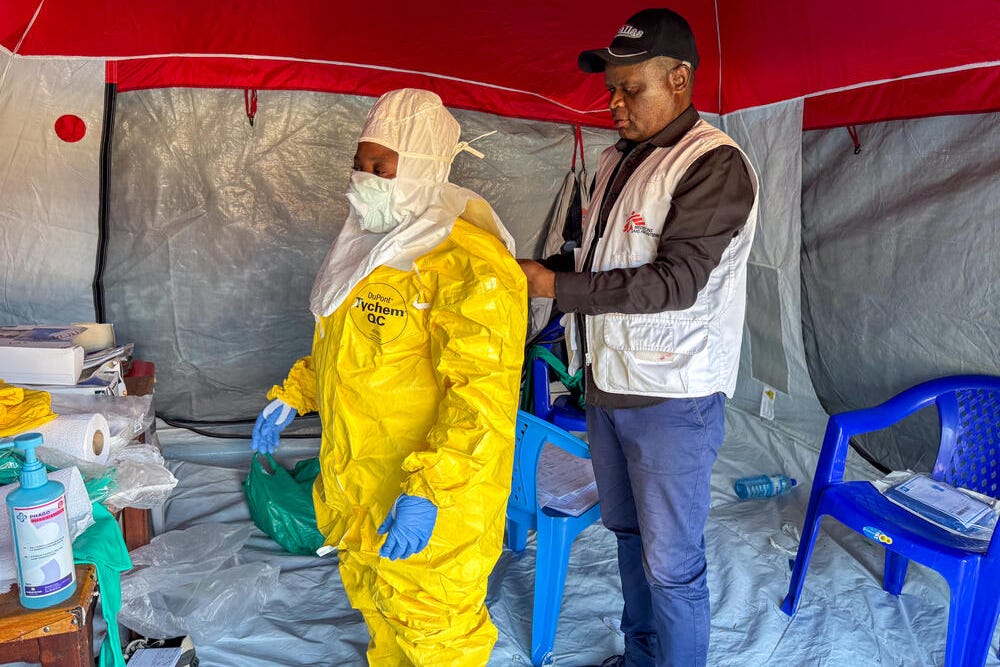
The fastest-growing Ebola outbreak in history, killing nearly one in two infected in the eastern region of the Democratic Republic of Congo (DRC), has spread to six new health zones between 14 August and 28 August.
The spread remains within six of the country’s 26 provinces identified before 14 August: namely Bas-Uélé, Haut-Uélé, Ituri, North Kivu, South Kivu, and Tshopo. However, the number of health zones affected within these six provinces increased from 54 of the 151 to 60 over the following two weeks.
The spread was identified in a new health zone of the Tshopo province on 15 August. By 23 August, the spread was also confirmed in Viadana in Bas-Uélé and Mutwanga in North Kivu. On 28 August, infections were also confirmed in the Ganga health zone of Bas-Uélé as well as in Biena and Manguredjipa in North Kivu.
The Rwandan army and its front, the M23 armed group, which are waging a war for DRC’s mineral wealth, have occupied large areas of North Kivu province, where the case fatality rate (CFR) is 68.6%, significantly higher than the overall CFR of 48.1%.
In just over three months since the outbreak was officially declared on 15 May, the disease had infected 5,794 people in DRC as of 26 August, killing 2,786 of them.
This outbreak is the “fastest-spreading Ebola epidemic ever recorded,” the UN Secretary-General Antonio Guterres said on 27 August. “It’s growing faster and wider than the response to contain it.”
The effectiveness of the response is complicated by a combination of factors—importantly, armed conflict involving multiple groups, large concentrations of displaced populations, a mobile labour force working in mines, poor infrastructure, and a lack of public trust sparking attacks on medical facilities.
And then there is a severe shortage of funds. Guterres told reporters at the UN HQ that the humanitarian response is only 48% funded.
“Without additional funding, vital operations will run out of money at the very moment they need to ramp up,” he warned. Resources currently available for the response “will last only weeks, not months,” the UN warned.
“We know how to contain Ebola, how to interrupt transmission and how to save lives, but we must also overcome another virus: the virus of indifference,” said Guterres.
