


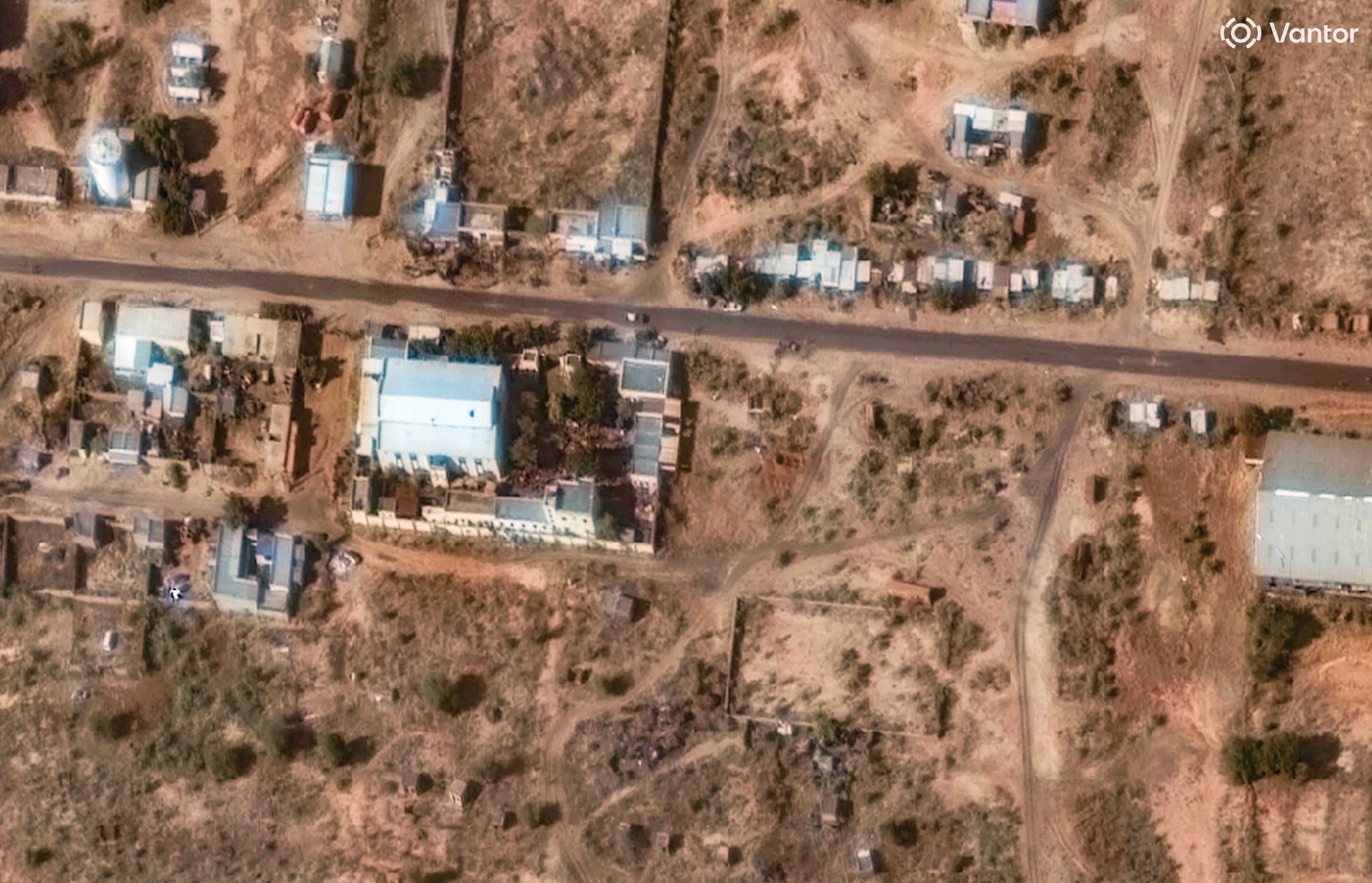
One year after the UAE-backed Rapid Support Forces (RSF) massacred tens of thousands of civilians in El Fasher, the capital of North Darfur state in war-torn Sudan, the city remains largely depopulated.
Vegetation is claiming what used to be busy markets and roads. Hospitals are bombed out and empty, and the mass graves are quiet. This is the picture painted by the satellite imagery analysis by the Yale School of Public Health Humanitarian Research Lab (HRL) in a report titled “El-Fasher, One Year Later.”
Human activity is largely limited to just five of the city’s 24,307 square kilometres in the Daraja Oula neighbourhood, where RSF troops are based. Except for the market in this neighbourhood, none of the city’s other eight markets show signs of human activity.
Six of them have been bombed, and two others subsequently fell into dilapidation. “At least five markets have vegetation overgrowth indicating an absent pattern of life,” stated the report, published on 28 October, marking the anniversary of the fall of El Fasher, the last major city in the Darfur region to hold out against the RSF.
The RSF had captured the rest of this vast region, consisting of five states, soon after starting the war in April 2023 against its former partner in the military junta, the national army, called the Sudanese Armed Forces (SAF).
SAF’s only major base in this region was in El Fasher. Following a 20-month-long siege—starving the population with famine by cutting off food supplies—the RSF, which had been repeatedly bombing its hospitals and markets, finally launched a ground invasion on 26 October.
The SAF did not send reinforcements or air support. Many of its troops surrendered or fled. The local youth, organised as the Popular Resistance, took to the trenches and held out for nearly three days until the evening of 28 October, when El Fasher’s Resistance Committee announced that “the last resisting soldier fired his last bullet” and “then fell as a martyr.”
RSF troops went on a killing spree, neighbourhood to neighbourhood, door to door, to depopulate the city. Daraja Oula, presently the only neighbourhood with signs of human activity centred around the RSF, was the last civilian refuge in El Fasher. “Yale HRL identified burning activity consistent with human remains at 19 locations [in this neighbourhood],” added the HRL report published on the first anniversary.
One of the locations is right outside the Al-Saudi Hospital. Attacking the hospital, the RSF “executed physicians, nurses, hospital staff, patients, and their families.”
The bloodshed was so enormous that satellite photos showed reddish discolouration of the ground in many areas. Many of these red patches were strewn with “objects measuring ‘approximately 1.3 to 2.0 metres, which is the expected range of a human body of average height lying horizontally,’” HRL reported on 28 October 2025.
As it continued to massacre civilians over the next days, satellite images as of 1 November 2025, showed at least 150 “clusters of objects consistent with human remains,” added a subsequent HRL update, which concluded that the “RSF has systematically killed and disposed of a number of objects consistent with human remains, likely in the tens of thousands.”
The report on 28 October 2026, the anniversary of the fall of El Fasher, reiterates this estimation, pointing out that 70,000 people are missing. They are neither visible in satellite images nor in the records of humanitarian organisations in Tawila, where survivors who managed to flee have taken refuge in IDP camps.
A UN fact-finding mission concluded in February that RSF’s mass killings had the “hallmarks of genocide.” Now in November, the RSF continues the war in its fourth year, and the UAE continues to supply it with arms and vehicles, through Chad in Sudan’s west and Ethiopia in its east.