


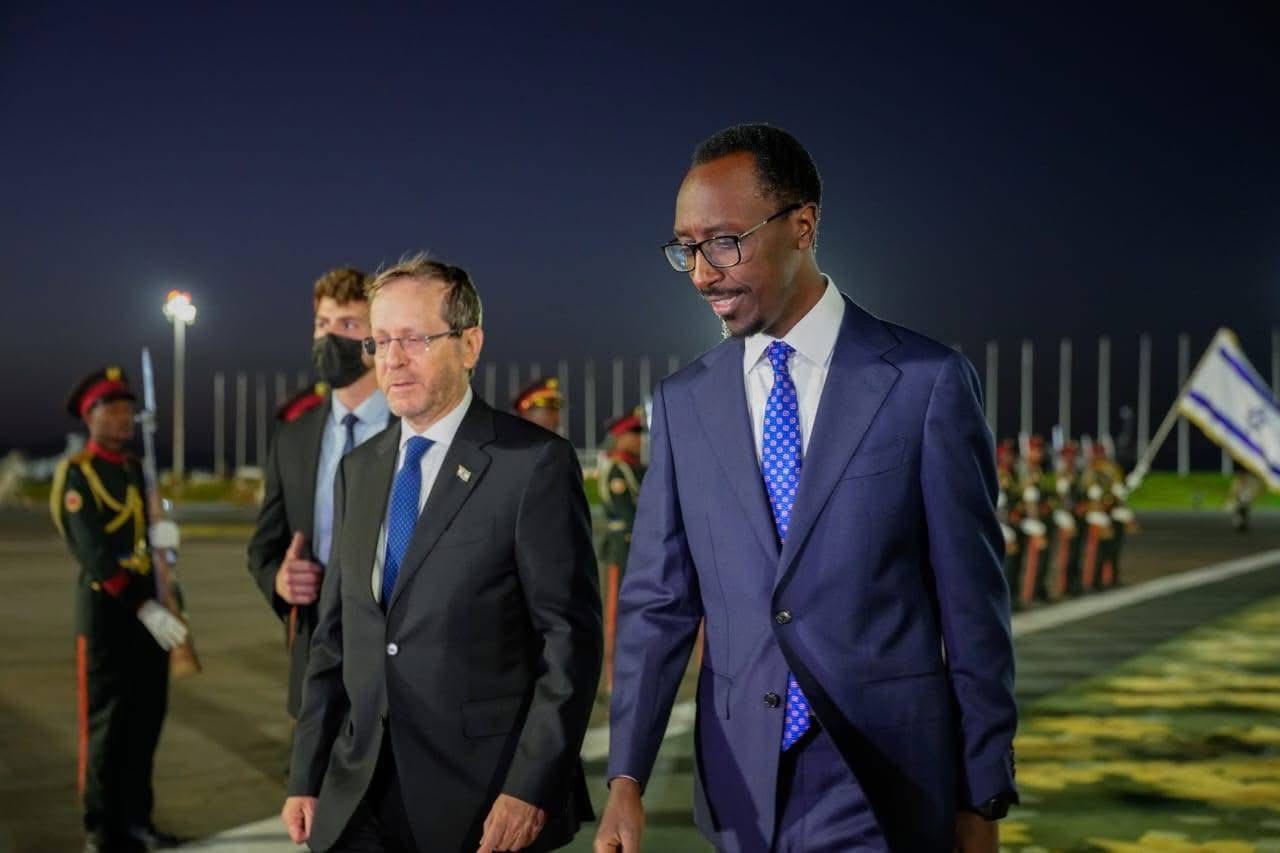
As Israeli President Isaac Herzog visits Addis Ababa on 25–26 February, the city has once again become a diplomatic stage. The visit of Israeli President Isaac Herzog is being framed as outreach—a gesture of friendship, history, and cooperation. Yet in 2025, symbolism is no longer innocent. Every handshake carries the shadow of war. Every communiqué is measured against the blood-soaked ledger of a region already exhausted by violence.
The Horn of Africa sits at a geopolitical hinge. Ethiopia, with more than 120 million citizens and the headquarters of the African Union, is not merely another bilateral partner. It is a continental anchor. It is also landlocked, strategically restless, and searching for reliable access to the Red Sea—a maritime corridor through which roughly 12 per cent of global trade flows. In January 2024, as reported by AP News, Ethiopia signed a memorandum of understanding with Somaliland to secure port access, igniting fury in Somalia and sharp rebukes from regional powers. Turkish President Recep Tayyip Erdoğan’s unusually blunt warning that external interference risked destabilisation.
Now, as Herzog meets Ethiopian officials in Addis Ababa, the stakes are magnified by the moral climate of 2025. The Middle East has endured catastrophic violence over the past year. United Nations agencies have reported tens of thousands of Palestinian deaths since the Gaza war escalated, with entire neighbourhoods levelled and critical infrastructure decimated. Humanitarian agencies describe conditions of near-famine and systemic collapse. Allegations of disproportionate force and grave breaches of international humanitarian law have reverberated from The Hague to Canberra. South Africa’s case before the International Court of Justice has further internationalised the crisis, embedding legal scrutiny into the diplomatic bloodstream.
Against that backdrop, Israeli strategic expansion into the Horn cannot be divorced from perception. The visit is part of a deliberate effort to deepen ties across Africa—blending security cooperation, agricultural technology, and diaspora diplomacy. On paper, this is pragmatic statecraft. Israel has long cultivated African partnerships, particularly in water management, cyber capability, and counter-terrorism. Yet in a year when images from Gaza dominate global consciousness, strategic manoeuvring acquires a different resonance.
The Red Sea corridor has already become a theatre of contestation. Houthi attacks on commercial shipping have disrupted trade and driven up insurance premiums. Leading global conflict-monitoring bodies and internationally respected policy research institutions have both warned that the Red Sea is emerging as one of the world’s most volatile maritime zones, where local fragilities intersect with global power rivalry. Turkey maintains its largest overseas military base in Somalia. Gulf states have invested billions into ports stretching from Berbera to Djibouti. Egypt watches Ethiopia’s every strategic move through the prism of Nile politics and the unresolved tensions surrounding the Grand Ethiopian Renaissance Dam.
While official communiqués emphasised cooperation, the visit unfolded under the shadow of Gaza and regional unease over Israel’s expanding footprint along the Red Sea corridor.
Add another layer—Israel seeking to consolidate influence along this arc—and the geometry of rivalry sharpens. Even in the absence of formal military basing, security cooperation in such a corridor carries heavy implications. Ethiopia’s pursuit of diversified partnerships is understandable for a state seeking economic resilience and sovereign leverage. But perception of alignment matters as much as substance. Somalia has already described the Ethiopia–Somaliland port deal as a violation of territorial integrity. Turkish rhetoric has framed Israeli engagement as destabilising. In a climate charged by Middle Eastern conflict, diplomatic nuance can evaporate overnight.
The warning here is not theatrical. It is structural. The Horn of Africa has endured cycles of proxy competition before. During the Cold War, ports and airfields became chess pieces for distant capitals. The result was not prosperity but prolonged instability. Ethiopia itself is emerging from a brutal civil conflict in Tigray, with some academic estimates placing the death toll in the hundreds of thousands. Domestic reconciliation remains fragile. Economic recovery is uneven. Introducing an additional axis of geopolitical rivalry risks compounding internal strains.
For global policymakers, the pattern is painfully familiar. Strategic access pursued without regional consensus tends to breed backlash. Security arrangements negotiated behind closed doors corrode trust. The Middle East offers decades of sobering evidence. From Lebanon’s protracted crises to Syria’s shattered cities, the interplay of external interventions and internal divisions has left societies hollowed out. In 2025, that lesson feels less like history and more like a warning.
Israel’s supporters will argue that engagement in Africa is neither novel nor malign. Agricultural cooperation has transformed arid landscapes. Intelligence-sharing has countered extremist threats. These are tangible contributions. Yet diplomacy does not operate in isolation from moral context. When civilian casualties dominate headlines and allegations of systemic abuses saturate international forums, expansion of strategic footprints can be interpreted as insulation rather than partnership.
Leading global policy institutions have consistently underscored the vital role of middle-power diplomacy in easing tensions and stabilising contested regions. In an interconnected world where maritime arteries bind continents together, disruptions in strategic waterways like the Red Sea are never confined to one geography. A single disturbance at a chokepoint can send shockwaves across supply chains, unsettling markets from Asia to Europe and beyond. The stability of the Horn, therefore, is not a regional concern whispered at the margins of global affairs; it is a shared global responsibility, woven deeply into the fragile fabric of international trade and collective economic security.
What is required now is not grandstanding but restraint. The African Union, headquartered in Addis Ababa, should urgently advance a maritime governance framework clarifying commercial access rights and sovereignty protections. Multilateral oversight of port agreements would help dispel fears of covert militarisation. The European Union and the United States, deeply invested in Red Sea stability, can incentivise transparency through development financing and insurance guarantees that reduce the allure of unilateral deals.
Above all, regional actors must avoid importing the unresolved traumas of the Middle East into the Horn. The humanitarian devastation witnessed in 2025 has already reshaped global opinion. Extending rivalry into another vulnerable theatre would compound rather than contain instability. Strategic depth cannot substitute for moral credibility. Security pursued without legitimacy ultimately proves brittle.
Herzog’s forthcoming visit will be watched not only in Addis Ababa but in Mogadishu, Ankara, Cairo, Riyadh, and beyond. It will be parsed in chancelleries and think tanks, in shipping insurance offices and humanitarian coordination centres. The Horn stands at a crossroads: either a corridor of cooperative development or a frontier of layered competition.
The choice confronting policymakers is stark. One path repeats the logic that has scarred the Middle East—dominance framed as defence, expansion justified as necessity, civilians left to bear the cost. The other path demands transparency, multilateralism, and a recognition that sovereignty and access are not mutually exclusive.
In 2025, humanity in the Middle East has already paid a devastating price. The Horn of Africa need not become the next ledger entry. Diplomacy, at its best, prevents tragedy before it calcifies. Addis Ababa now becomes a test of whether that higher ambition still holds sway in a fractured international order.
