


Ethiopia's battle for unity is no longer being fought only in parliament chambers, military barracks, or the diplomatic salons of Addis Ababa. Increasingly, it is being waged in concert halls, diaspora festivals, coffee ceremonies, and in the trembling silence after a song that reminds millions of what has been lost.
For a nation of more than 120 million people, carrying the weight of one of Africa's oldest civilisations and one of its most painful contemporary fractures, the question of national cohesion has become existential. Ethiopia's ethnic federal system, introduced in the 1990s, promised recognition and autonomy for historically marginalised communities. Instead, it often hardened ethnicity into the country's most valuable political currency. Local grievances over land, language, and power became national fault lines, transforming difference into permanent political competition.
The 1995 Constitution emerged from a genuine attempt to answer historical exclusion. By recognising nations, nationalities, and peoples, it promised dignity to communities long pushed to the margins and introduced one of Africa's boldest experiments in ethnic federalism. Yet the same constitutional architecture that offered recognition also institutionalised identity as the primary language of politics. What began as a remedy for injustice often became a permanent negotiation of difference, where citizenship itself risked being filtered first through ethnicity. Innovation and burden arrived together, and Ethiopia still lives inside that unresolved tension.
What was designed as inclusion gradually became a machinery of suspicion. The consequences are visible in every direction. Tigray's devastating war left hundreds of thousands dead, according to international estimates from the United Nations and humanitarian agencies. Oromia remains tense. Amhara is unsettled. Youth unemployment continues to rise. Inflation has eaten into dignity as much as into wages. The World Bank estimates that more than a quarter of Ethiopians still live below the national poverty line, while conflict-driven displacement has made Ethiopia one of Africa's largest internal displacement crises.
Yet perhaps the deepest wound is psychological: the growing feeling among citizens that belonging itself has become conditional.
A country once held together by the emotional architecture of shared history now risks becoming a federation of strangers. Scholars have warned that the shift from a civic Ethiopian identity to narrow ethnonationalism creates a dangerous logic where communities no longer see neighbours, but competitors for survival. In such an atmosphere, patriotism becomes suspicious when wearing ceremonial clothes.
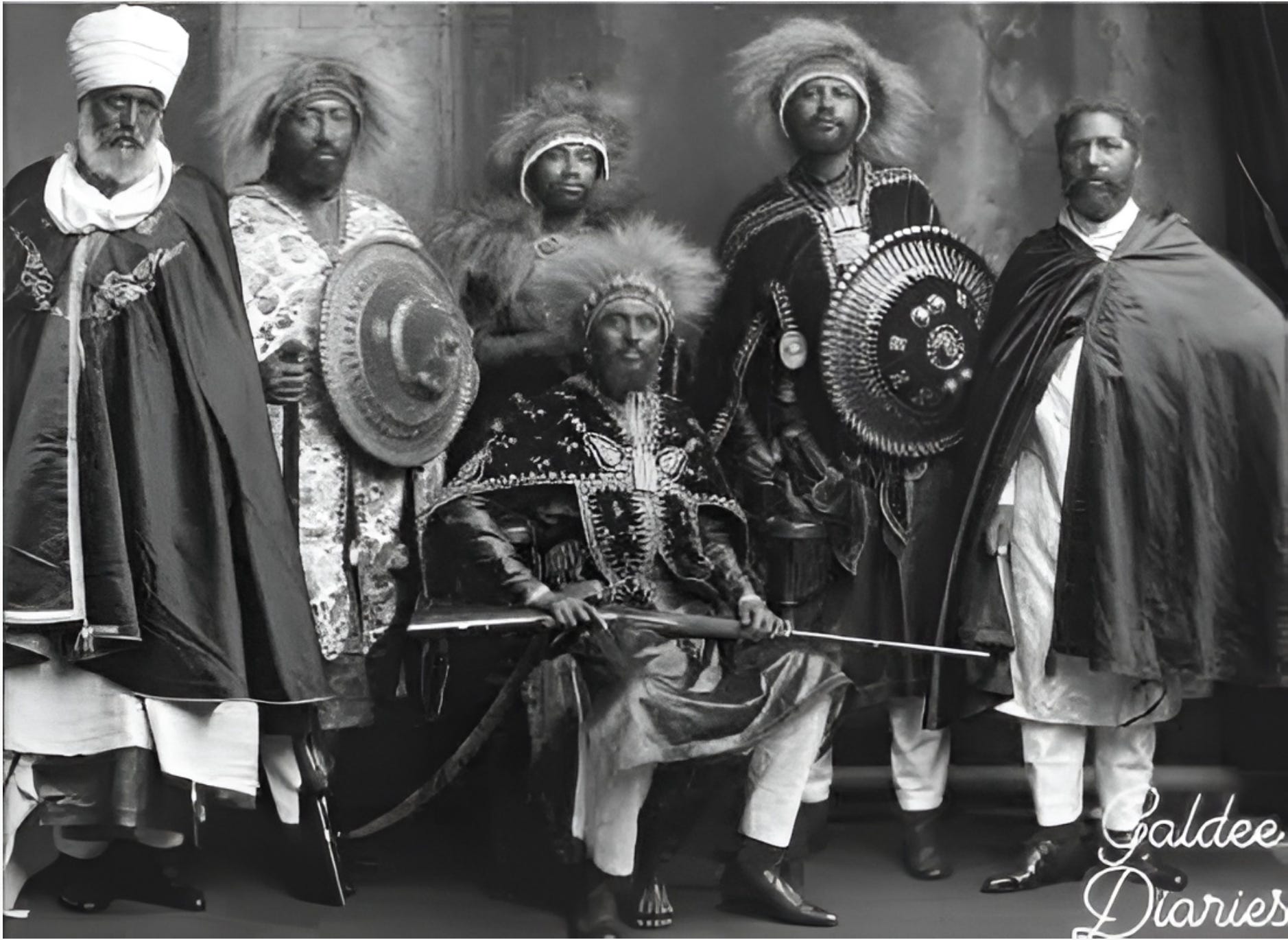
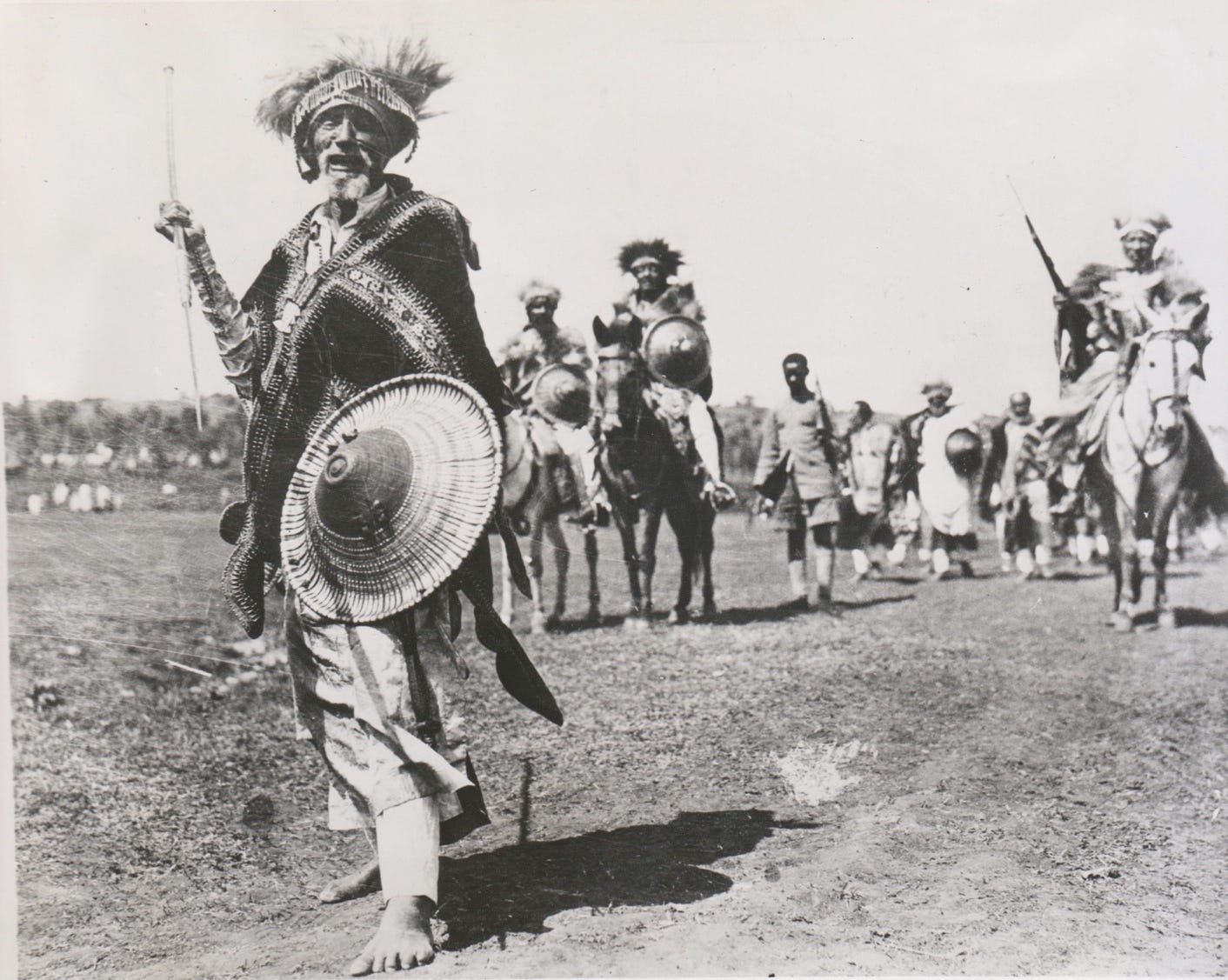
The memory of Adwa still breathes like a national heartbeat. In 1896, Ethiopians from Oromo, Amhara, Tigray, Gurage, Afar, and countless other communities marched not as separate identities, but as one people defending a shared future. Emperor Menelik II and Empress Taytu did not win Adwa alone; victory was carried by farmers, priests, women, elders, and warriors whose unity defeated colonial ambition. Adwa remains more than a military triumph—it is Ethiopia's clearest historical proof that diversity, when bound by common purpose, becomes strength rather than fracture.
Diplomacy in Ethiopia does not belong only to ministers and ambassadors. It also lives in the hands of musicians like Teddy Afro and Aster Aweke, in the voices of Orthodox priests and imams preaching restraint, in the authority of elders mediating local disputes, and in the diaspora leaders who carry national conversations abroad. These are the country's quiet negotiators—its Track II diplomats—working beyond formal state channels to preserve trust where institutions have failed. They translate pain into dialogue, and sometimes their legitimacy travels further than official policy ever can.
This is where Ethiopia's most unexpected diplomats have stepped forward: its musicians. Teddy Afro does not hold ministerial office, but few public figures command greater moral attention. His 2026 album Etorika, especially the widely discussed track “Das Tal,” landed not as entertainment but as national intervention. Within days, millions were listening across Ethiopia and throughout the diaspora, from Melbourne to Minneapolis, from London to Johannesburg. The BBC itself framed the release as a political event, noting how listeners interpreted the song as both a lament and a warning.
Its emotional force lies in its honesty. It speaks to exhaustion—to citizens tired of conflict, tired of elite games, tired of being told that division is destiny. For many, the song felt less like music and more like a national mirror.
That matters in foreign policy terms. Joseph Nye's famous concept of soft power—influence through attraction rather than coercion—often evokes Hollywood, K-pop, or Olympic ceremonies. But Ethiopia's soft power may be found in a voice cracking through an old speaker in a taxi in Addis Ababa. Music here is not decoration. It is a political infrastructure. Teddy Afro's music is “not merely music—it is memory, it is identity, it is a voice.” The diaspora understands this instinctively.
The Ethiopian diaspora is not simply an overseas population; it is an emotional republic stretching across continents. From remittances that sustain households to lobbying efforts in Washington, Brussels, and London, diaspora communities amplify Ethiopia's voice far beyond its borders. During moments of crisis, they become advocates, translators, defenders, and critics all at once. Their festivals, professional networks, academic circles, and digital campaigns function as a diplomatic force multiplier—extending Ethiopia's influence in ways embassies alone never could.
Nearly three million Ethiopians live abroad, carrying with them not only remittances but legitimacy. UNESCO has highlighted how diaspora festivals, cultural centres, and heritage programs serve as living diplomatic bridges between Ethiopia and host societies. In Washington, DC, Aster Aweke's concerts became communal reunions. In the United States, Meklit Hadero blends Ethio-jazz with Oromo, Amharic, Kambaata, and English, refusing the false choice between roots and modernity. Her work insists that multiplicity is not fragmentation; it is nationhood in its truest form.
This is not sentimental politics. It is a strategic necessity. Across Africa, governments are learning that cultural diplomacy often succeeds where official diplomacy fails. Ghana's “Year of Return” reconnected the state to the African diaspora with extraordinary economic and symbolic returns. Nigeria's Nollywood became an instrument of continental influence without ever needing a foreign ministry memo. Ethiopia, with its ancient heritage, Orthodox traditions, coffee diplomacy, and globally recognised musical identity, possesses equal—perhaps greater—potential.
Yet potential is not policy. Too often, governments seek the prestige of culture while fearing the freedom that culture demands. Artists are celebrated when they unify, but scrutinised when they criticise. That contradiction is dangerous. Suppressing musicians, journalists, and public intellectuals does not create stability; it merely pushes national grief underground, where it returns harder and louder.
Every nation carries scars, but peace depends on whether those scars become bridges or borders. Ethiopia's wars—whether remembered through Tigray, the Red Terror, imperial conquest, or local displacement—live not only in archives, but in family silence, songs, and inherited suspicion. Memory diplomacy is the difficult work of allowing grief to be spoken without letting it become permanent political inheritance. Nations do not heal by forgetting trauma; they heal by creating shared language around it, so remembrance becomes reconciliation rather than revenge.
The lesson from Ethiopia's recent history is brutally simple: censorship cannot manufacture trust. Nor can infrastructure alone. The Grand Ethiopian Renaissance Dam is a magnificent national project, but concrete cannot replace the social contract. Roads connect territory; they do not automatically connect memory. Real unity requires something more difficult: the political courage to allow citizens to imagine themselves beyond ethnicity without asking them to erase it.
That means strengthening inclusive institutions such as the National Dialogue Commission, not as ceremonial theatre but as genuine negotiation. It means educational reform that teaches Oromo, Amhara, Somali, Sidama, and Tigrayan histories as chapters of one national story rather than competing national myths. It means cultural centres abroad that present Ethiopia not as a singular identity, but as a confident mosaic.
Ethiopia's internal cohesion matters far beyond its borders because it sits at the centre of one of the world's most contested strategic corridors. The Red Sea and the Horn of Africa have become arenas of competition among Gulf powers, the United States, China, Russia, Turkey, and regional neighbours, all drawn by trade routes, military access, and security interests. Though landlocked, Ethiopia remains the demographic and political anchor of this theatre. Instability in Addis Ababa echoes in Port Sudan, Mogadishu, Djibouti, and beyond, making national unity not only a domestic necessity but a regional imperative.
It also means the international community must stop viewing Ethiopia only through the language of crisis. The Horn of Africa has become a theatre of intense geopolitical competition—American, Chinese, Russian, Gulf, and regional rivalries all pressing into fragile domestic spaces. Ethiopia is too often treated as a strategic chessboard rather than a society trying to heal itself. External pressure without social understanding risks deepening the siege mentality already poisoning internal trust.
Global policymakers should recognise that Ethiopian stability will not come from security doctrine alone. It will come from legitimacy—and legitimacy is cultural before it is constitutional. The world has seen what happens when nations lose the emotional story that binds them. Bosnia, Lebanon, Sudan—fragmentation rarely begins with guns. It begins when people stop believing they belong to each other.
Ethiopia still has time to resist that fate. Its music says so. Its diaspora says so. Its history says so.
The nation that defeated colonial conquest and carried civilisational continuity across centuries should not surrender to the smaller prison of ethnic fatalism. Unity need not mean uniformity. It can mean something far more powerful: the decision to remain together despite pain.
Ethiopia's future will not be secured by force alone, because its deepest crisis is not only political—it is emotional, historical, and profoundly human. The road from Adwa to Addis Ababa, from coffee ceremonies to concert halls, from constitutional promises to diaspora voices, reveals the same truth: unity survives where people still believe they belong to one another. History gives that memory, culture keeps it alive, and diplomacy—formal and informal—turns it into a possibility. Ethiopia does not need to invent unity; it needs to remember it, protect it, and choose it again.
In the end, perhaps diplomacy is not always negotiated across polished tables. Sometimes it arrives in a melody. Sometimes it returns in memory. Sometimes a country remembers itself because a singer dares to remind it. And sometimes, that is where peace begins.

Beautifully written and thought through for mine. (But I've never been to any African nation.) My Surgeon relative worked in Ethiopia for MSF more than a decade ago and had some amazing experiences. Our daughter fell in love with cuisine from an Ethiopian restaurant in New York and shared a wonderful meal there with us when we visited NYC. Then I returned the favour at a similar delicious event in Western Sydney. I now know some of the history of the region thanks to your cautiously optimistic essay and will search for musical proof of your Afro story.