


Africa’s relationship with China has never been a simple story of romance or rivalry. It is a story of urgency. Of speed. Of hard choices made under the pressure of poverty, population growth and a global system that rarely waits for latecomers. Ethiopia sits at the centre of this story, not as a passive stage, but as a conscious actor navigating a world where development is negotiated in steel, debt schedules and freight corridors rather than ideals.
Over the past two decades, China has become Africa’s largest trading partner and one of its most consequential financiers. Between 2000 and 2014 alone, Chinese banks and state-linked institutions lent more than US$86 billion to African countries. Ethiopia has been among the top recipients, securing an estimated US$13–14 billion in Chinese loans for railways, roads, industrial parks and power infrastructure. These figures are not abstractions. They are embedded in concrete, locomotives and factory floors that now shape everyday life across the Horn of Africa.
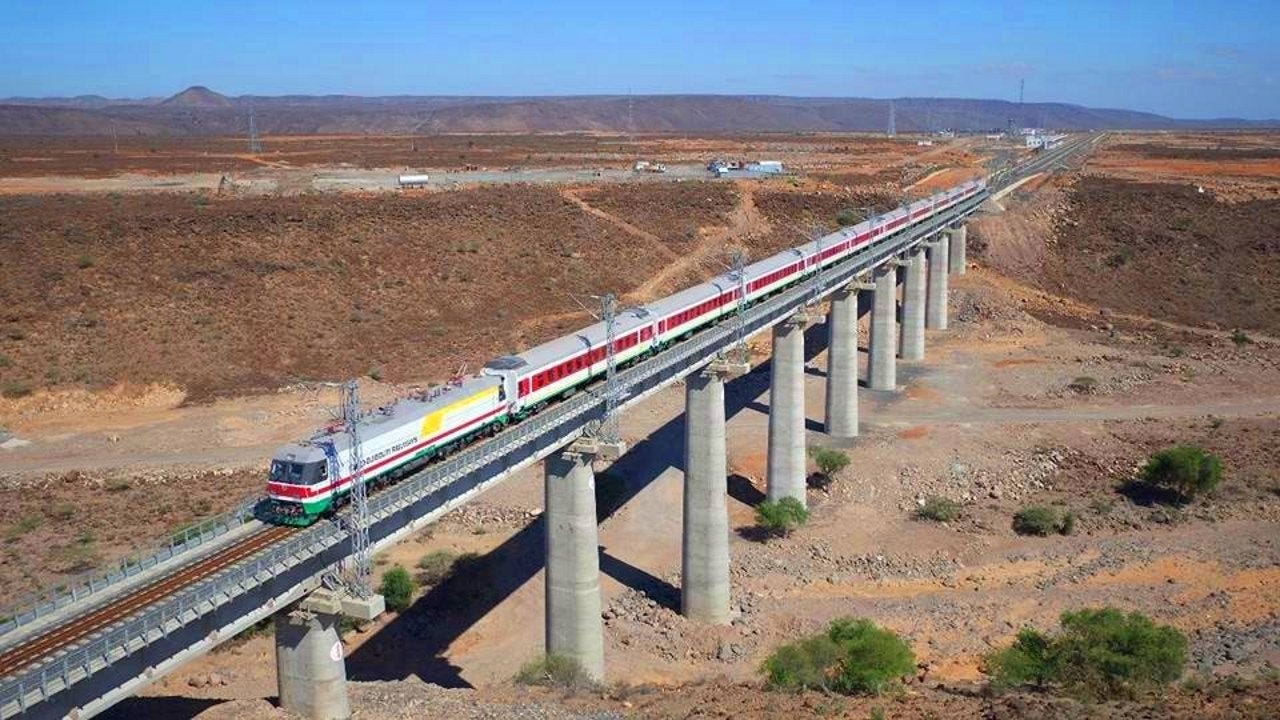
The Addis Ababa–Djibouti railway is perhaps the most emblematic symbol of this relationship. Costing roughly US$4.5–5 billion and financed largely by Chinese policy banks, the electrified line reduced the journey from Ethiopia’s capital to the sea from days to hours. For a landlocked country of more than 120 million people, this was not a luxury but an economic lifeline. When freight volumes initially fell short and debt repayments became unsustainable, China quietly extended repayment terms from 15 to 30 years. No press conference. No lectures. Just renegotiation.
This quiet pragmatism defines much of China’s engagement with Ethiopia and, increasingly, Africa as a whole. Beijing does not arrive with democracy templates or governance scorecards. It comes with engineering teams, concessional loans and a willingness to work within the political realities of partner states. For governments pursuing state-led development strategies, this approach feels less like intrusion and more like recognition of urgency.
Ethiopia’s developmental state model—focused on infrastructure, industrial parks and export-led manufacturing—has found a natural counterpart in China’s own economic history. Chinese firms now anchor industrial zones in Hawassa, Kombolcha, Dire Dawa and Bole Lemi. Chinese investment in Ethiopian industrial parks reportedly tripled in 2021 compared with the previous year. Garment factories, shoe manufacturers and light engineering plants have created tens of thousands of jobs, particularly for young women, even as they expose tensions around wages, labour rights and environmental standards.
Critics, both within Africa and abroad, often reach for the language of neo-colonialism. The concern is familiar: Africa exports raw materials, and imports manufactured goods, reproducing old asymmetries under new flags. Nigeria’s former central bank governor once warned that this pattern looked uncomfortably like colonial economics. The fear is not unfounded. Around 70 per cent of Africa’s exports to China remain concentrated in oil, gas and minerals, while machinery, electronics and manufactured consumer goods dominate Chinese exports to Africa.
Yet this critique risks flattening African agency. Ethiopia did not stumble into its partnership with China. It sought it out. Western lenders were reluctant to fund large-scale infrastructure without extensive conditionality. Private capital was expensive and impatient. China offered speed, scale and a tolerance for long payback periods. The decision to accept those terms was political, strategic and deliberate.
Today, that choice carries consequences. Ethiopia’s external debt distress, culminating in a Eurobond default and restructuring talks under the G20 Common Framework, has placed China at the centre of creditor negotiations. As Ethiopia’s largest bilateral lender, Beijing effectively holds a gatekeeping role. It has supported debt reprofiling and payment deferrals but has resisted outright write-offs, insisting on comparable treatment from private creditors. This has slowed resolution and unsettled investors, underscoring how financial dependence quietly translates into structural influence.
Still, influence should not be confused with control. China has not seized Ethiopian assets. It has not imposed policy diktats. Its leverage operates through balance sheets rather than bayonets. That distinction matters in a region scarred by overt external interference.
Across Africa, similar patterns emerge. Angola’s oil-backed loans funded highways and airports but left the country exposed when oil prices fell. Zambia’s debt crisis forced painful negotiations, yet Beijing ultimately restructured loans and wrote off portions under political pressure. Kenya’s Chinese-built railway sparked transparency battles in court, demonstrating that democratic institutions can push back.
These experiences suggest that outcomes are shaped less by China’s intent than by African governance, negotiation capacity and domestic accountability.
What is often overlooked is the social dimension of this engagement. Infrastructure changes how people live. Railways redraw labour markets. Industrial parks transform gender dynamics. Ports reshape urban geography. When land is acquired or factories pollute waterways, resentment follows. In Ethiopia, tensions around compensation, labour conditions and cultural misunderstandings in Chinese-run factories have surfaced, even if they rarely escalate into overt anti-China mobilisation. Managing these frictions will determine whether Chinese-built development retains its social licence.
The lesson is not restraint or righteousness, but humility. Africa’s engagement with China is not an ideological pivot nor a civilisational wager; it is a survival strategy shaped by time pressure, demographic reality and unfinished nation-building.
This relationship unfolds within asymmetric power, yes, but not within passivity. African states bargain, recalibrate and hedge, often simultaneously, because development cannot wait for perfect partners. The mistake of distant observers has been to read African choice as allegiance and pragmatism as surrender. In truth, what is unfolding is a series of hard, transactional decisions taken in a global system that has too often closed its doors, moved its goalposts, or priced its capital beyond reach.
For traditional donors and emerging partners alike, the deeper discomfort lies elsewhere. China did not invent Africa’s infrastructure deficit, nor did it create the impatience that now defines African policymaking. It simply responded to it. Where others offered process, China offered pace; where others offered conditions, China offered execution. This has exposed an uncomfortable truth for the global development architecture: that legitimacy in the twenty-first century is earned less through value statements than through delivery.
The question, then, is not whether China’s model should be emulated or resisted, but why so many alternative models failed to scale, to adapt, or to listen. Moral authority erodes when lectures arrive without roads, when governance advice arrives without power lines, when concern arrives only after others have already built.
The real risk ahead is not China, but singularity. Development anchored to one capital, one currency, one creditor, or one worldview narrows sovereignty rather than strengthening it. A resilient global order demands plurality: African countries with multiple partners, donors willing to share space, and institutions capable of co-financing rather than competing. This is not a call for withdrawal, but for presence of a different kind—faster, fairer, and less afraid of African agency.
The future of Africa’s partnerships will not be decided by slogans about influence or containment, but by who is willing to stand in the complexity of African choice, respect its urgency, and invest without demanding ownership of the story that follows.
A more constructive global response would expand options rather than demand allegiances. Competitive, transparent infrastructure finance. Faster, less bureaucratic development lending. Support for African debt management and contract negotiation. These are not acts of charity but investments in a more stable international system.
Ethiopia’s story with China is still being written. It contains ambition and anxiety, progress and peril. It reflects a continent determined to build, even when the terms are imperfect. The quiet logic of China in Africa has delivered roads, rails and factories. Whether it delivers durable prosperity will depend less on Beijing’s intentions than on Africa’s ability to steer, diversify and hold its own partners—all of them—to account.
In that sense, the most important question is not whether China is good or bad for Africa. It is whether the global system is finally willing to meet Africa’s urgency with seriousness, respect and real alternatives.

There is a reason usury is condemned....but it goes Way Deeper than people realize.
The dynamics of the present monetary model are such that collapse is a regular occurrence! It is built into the model and is Not Dependent On Scale. Maybe that is why the folk at the top feel so comfortable using terms like re-set!
The thing is that the 'complexity' of today's economies is driven by the same instability that the present model cannot shed. There is no real case to be made that "modern" society should subject itself to this Ancient Mathematical Illiteracy and all its ramifications! Too many hold a similar mythical vision about today's systems being categorically different from these same practices of ages ago. But "neo-isms" are pretty much the same as the original-isms just at larger scale!
Abstract:
“This document is the result of a rigorous control system theory stability analysis of the current world de facto standard currency system and identifies a root instability in the form of the growth component of Debt associated with the money creation process. It first establishes the inherent instability of Common Lending Practices (application of interest). Then the analysis further charts the logical consequences of said root instability as it affects the economy as a whole and identifies how it provokes a systematic divergence between debt and value attributed to wealth in past cycles with the minimum value required in current and future cycles as those incorporate past unpaid debt i.e. systematic compounding of debt. It also identifies how the only means available within the system design for staving off inflation is through the continued contribution of collateral wealth as guaranty for the creation of new principal debt money commensurate with past debt growth. Finally it illustrates that compounding debt inevitably leads to a point where an inability to provide new wealth to guaranty new money to keep up with debt growth becomes chronic at which point either runaway inflation or a definitive collapse of the system inevitably ensues.”
http://bibocurrency.com/images/pdfdownloads/Formal%20Stability%20Analysis%20and%20experiment%20%28final%29%20rev%203.4.pdf
The view from another angle by Marc Gauvin
"Steve Keen wrote:
"The myth: You need new money created to pay interest. False. When you borrow $1,000 at 5% interest, you pay $50 per year in interest, that's existing money circulating through the economy as income and spending, not newly issued money. "
So you are assuming willy-nilly that money used to pay interest is not from any past P?
If the rule is that all money is created as debt principal, then here is the math:
Formally:
Let pk be principal paid and cancelled in period k, with ∑(k=1,n)p_k=P
Let ik be interest paid (and recycled) in period k, with
∑(k=1,n) i_k=I
Then over the full term n:
∑(k=1,n)(p_k+i_k)=P+I>P for any I>0.
Because principal payments extinguish money, by the final period n you have at most p_n of P left in circulation, but you owe p_n+i_n, so:
p_n+i_n>p_n⇒final payment cannot be made from the remaining p_n alone.
Thus, to pay P+I in full without new P, some periods would have to have ik=0 (or negative), i.e. if interest i is positive across all periods, it is impossible to pay all P+I.
By the principle of superposition, the above holds for any number of such concurrent loan contracts."
But are we really limited in "economic activity" by way of dependence on conventional "finance"? Is there not another more rational and practical means to support human capacity?
A Systems Engineering Approach to Formal Monetary and Financial Stability Without the Vagaries of “Austerity” *
Marc GAUVIN Sergio DOMINGUEZ, PhD Eng.
Abstract:
Currency units ($, €, ¥, ₩, etc.) are not specified nor defined formally. Nonetheless, account entries and balances in terms of such units are routinely assigned the role of records/measures of the “value” of “assets”, without any formal adherence to the requirements of the most elementary logic and math of “measure”. In all domains other than finance and economics, the application of mathematical expressions in terms of units that are not both conceptually defined in valid logic and mathematically specified unequivocally with respect to the reality to which such expressions are expected to be applied, are necessarily in all cases indeterminate (i.e. inapplicable). This paper establishes how such indeterminacy is translated into systemic “financial” risk in terms of formal stability as defined in dynamical systems theory and engineering. The real economy is made up of goods and services (factories, farms, infrastructure, intellectual property i.e. non-financial assets on balance sheets) all of which are dependent on the independent physical nature and properties of real material and human resources. The “financial economy” on the other hand, is made up purely financial assets (securities, mutual funds and other financial instruments in the hands of households, corporations, governments and other direct owners). Economic risk and liability is determined predominantly according to the mathematics of finance as applied to both the financial and real economies that determine the dynamics of account balances over time in currency units. While all economic accounts are ultimately resolved in terms of real assets, outcomes are determined by both the real and financial economies. The real economy being ultimately dependent on objectively determinable physical/scientific criteria while the (predominant) financial economy on purely (arbitrary) mathematical criteria with, as mentioned above, no determinate relation to any reality other than itself (i.e. according to circular logic). This paper explores how the current state of affairs described above is logically and mathematically unresolvable and hence wholly unmanageable, precluding any rational judicial solution and thus requiring ultimately arbitrary, unknown and/or occult criteria for “resolution” as in the application of penalties and losses under the guise of “austerity”. The paper also demonstrates how at no cost or penalty to any agent public or private and by merely defining currency formally as an arbitrary unit-measure of “value” and strictly adhering to the math of measure, the financial system can be rendered “Passive” pursuant to dynamical systems theory with increased transparency and functionality. Finally, the paper illustrates how by virtue of the aforementioned principles of a Passive financial system, all risk inherent in the real economy, can be mitigated by optimally and judiciously managing the relations of the aggregate “system balance” (aggregate risk) in terms of the full array of possible transaction type permutations, without any need for “controlling" access to or “circulation” of currency that lead to the vagaries associated with the politics of “austerity”.
*Submitted December 2020 to Monetary Research Centre (MRC) University of National and World Economy (UNWE) Sofia Bulgaria
https://mrcenter.info/Doc/ConferencePapers/2020/MRC%202020%20A%20systems%20approach%20to%20money_4122020%20rev2_17.01.2021.pdf