


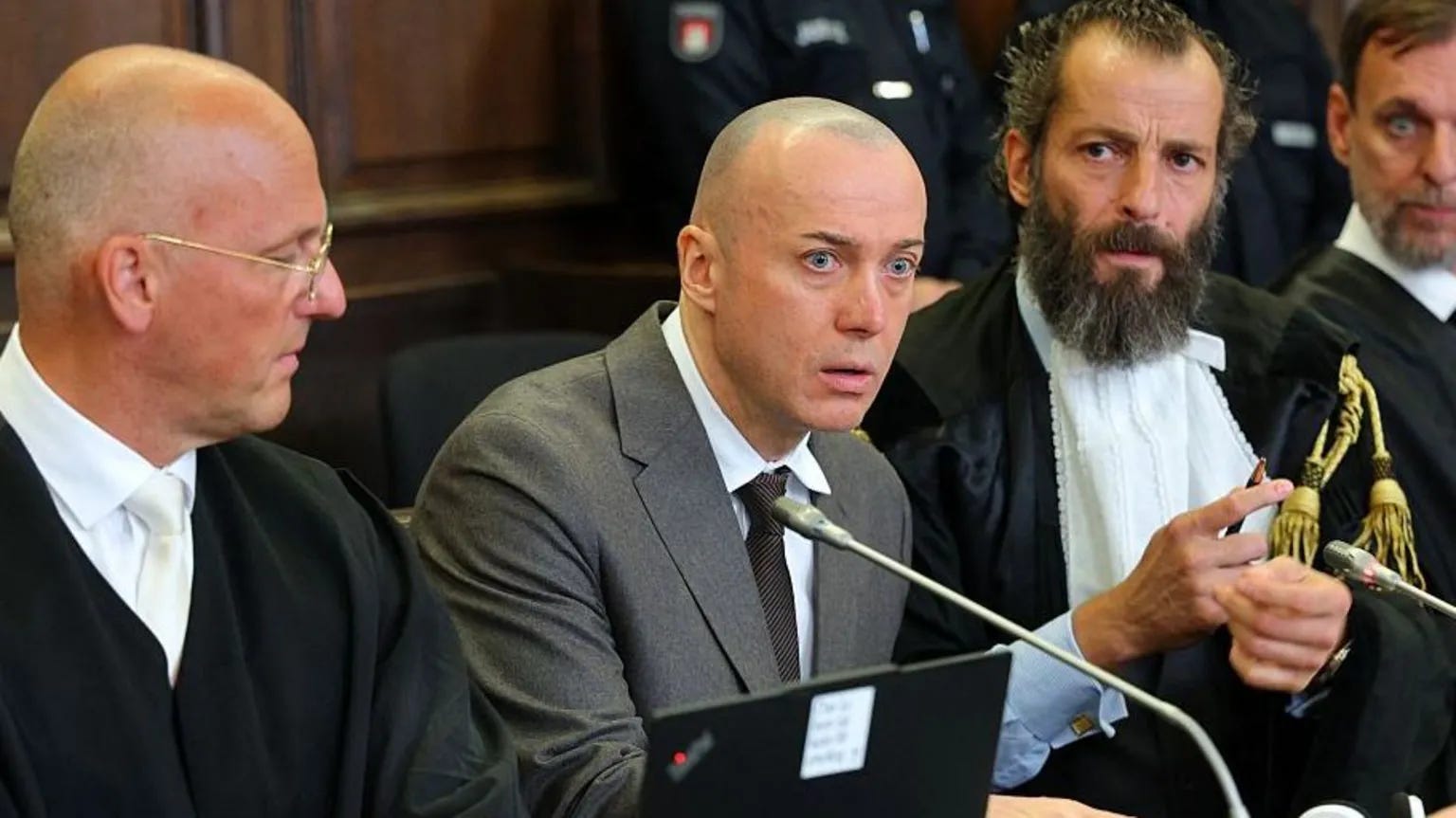
The trial that opened in Hamburg on 14 October 2026 is not a courtroom drama about a pipeline. It is a mirror held up to the post-Cold War order, and the reflection is deeply unsettling. Serhii Kuznietsov, a 50-year-old former Ukrainian military officer, sits in a German court accused of an act that severed the economic artery between Russia and Germany.
The explosions beneath the Baltic Sea in September 2022 did more than destroy steel and concrete. They shattered the foundational assumption that economic interdependence could prevent war; the doctrine of Wandel durch Handel that had guided German policy for decades.
What makes this trial a historic stress test is not the guilt or innocence of one man. It is the collision between two irreconcilable legal philosophies that have now become a live diplomatic rupture within the European Union. Poland refused to extradite a Ukrainian suspect, with the Warsaw Regional Court ruling that destroying an aggressor’s critical infrastructure during a war constitutes a military act, not a crime of sabotage.
German courts, by contrast, have asserted jurisdiction on the principle that the effects of the explosions reached German territory, treating the pipelines as protected civilian objects. The Polish Prime Minister declared the case “closed,” while Berlin pressed forward. This is not a technical dispute about double criminality. It is a philosophical chasm between Carl Schmitt’s state of exception and Kantian universalism, played out in real time across European arrest warrants.
The insurance ruling in London’s Commercial Court in July 2026 compounded the legal vertigo. Justice Moulder concluded that the €579 million claim by Nord Stream AG was void because the explosions were an “act of war,” regardless of who carried them out. This is a doctrine of causation without agency—a legal fiction that assigns responsibility to a state of affairs rather than an identifiable actor.
In an era of grey-zone warfare, where attribution is deliberately obscured, the law is being forced to develop doctrines of systemic responsibility that bypass the traditional requirement of individual culpability. The pipeline consortium, 51 per cent owned by Gazprom, was stripped of its insurance without a single perpetrator being named. The law, in other words, is adapting to the grey zone by retreating from the very determinacy it requires.
The geopolitical fallout is already reshaping the European energy landscape with brutal efficiency. Before the explosions, Nord Stream 1 supplied Germany with 55 per cent of its gas. By 2025, LNG accounted for 47 per cent of EU gas imports, up from 23 per cent in 2019, with US LNG now comprising over 59 per cent of EU LNG imports. Europe has cured one dependency only to contract another.
The NUPI and Clingendael policy brief warns that this new reliance exposes Europe to geopolitical pressure and price volatility, with US LNG imports to the European Economic Area increasing by 61 per cent in 2025 alone. The sabotage did not liberate Europe from energy coercion. It transferred the leverage from Moscow to Washington, and in doing so, it demonstrated that the weaponisation of interdependence is now a permanent feature of the international system.
For Ukraine, the political stakes could not be higher. Germany is Kyiv’s largest European provider of military and financial aid, and the trial threatens to erode the domestic consensus that sustains it. The Alternative for Germany and the Sahra Wagenknecht Alliance have seized on the proceedings to demand an immediate halt to German military support and a restoration of relations with Moscow. The UnHerd analysis notes that while the trial may not affect German support in the short run, it could make Berlin more reluctant to back Ukraine’s EU and NATO membership in the future.
The likely judicial outcome—a conviction of Kuznietsov framed as a rogue operation executed without explicit authorisation from President Zelenskyy—is a political compromise designed to preserve plausible deniability for Kyiv while upholding the integrity of German law. It is a compromise that satisfies no one entirely, but it may be the only path that keeps the Western coalition intact.
The deeper truth exposed by this trial is that international law was never designed for the grey zone. The 1884 Convention for the Protection of Submarine Cables and UNCLOS Article 113 criminalise the breaking of submarine cables, but they were written for commercial disputes, not strategic infrastructure sabotage. No international tribunal currently possesses jurisdiction over infrastructural sabotage outside formal armed conflict.
The Hamburg trial is the first attempt to fill this void through domestic criminal law, and in doing so, it exposes the fragmentation of the international legal order. The absence of ecocide charges—despite the release of approximately 500,000 tons of methane—reveals a structural anthropocentrism that privileges property and sovereignty over planetary boundaries.
The verdict, expected in early 2027, will land during a volatile phase of European political cycles. It will establish precedents, however limited. It will demonstrate that infrastructure sabotage is not beyond the reach of law. But it will not create a general rule capable of governing future grey-zone operations. The international community must confront an uncomfortable question: can the rule of law survive an era in which strategic necessity collides with legal norms, and in which the systems that underpin modern civilisation are increasingly vulnerable to covert attack?
The Nord Stream trial is not the end of this story. It is the beginning of a new chapter, and the wisdom and courage to write it in a way that serves justice rather than power has never been more urgently required.