


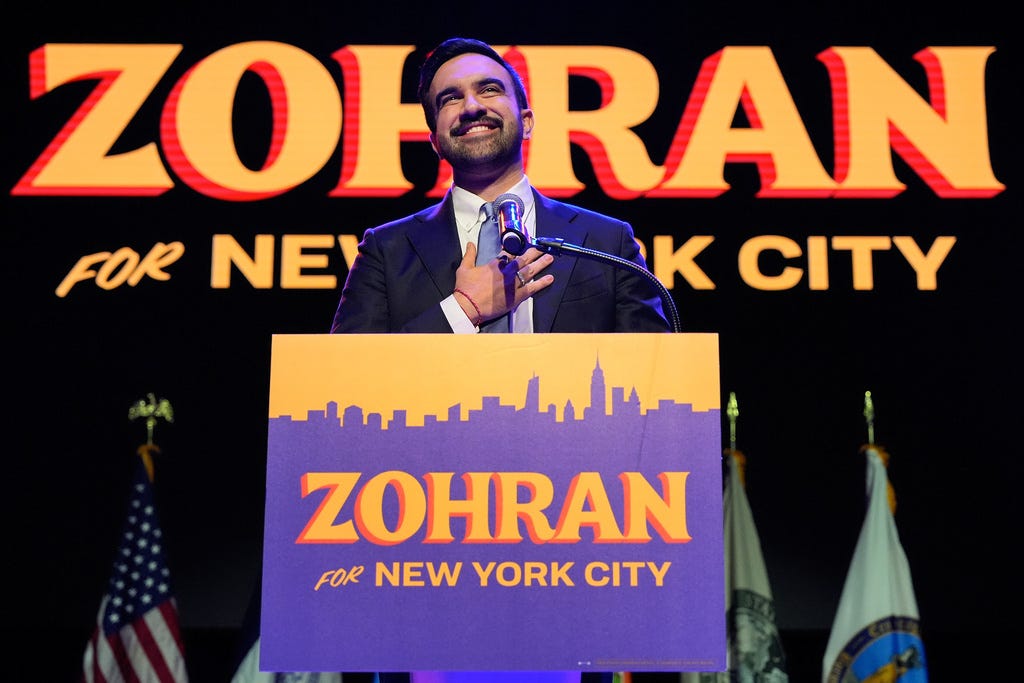
Zoran Mamdani winning the New York mayoral race looks like a big shift at first glance. He ran a campaign that felt unusually coherent for American politics, with ideas people could understand without needing a policy handbook. Buses without fares, some attempt at subsidised groceries, childcare for all, the minimum wage almost doubled. It all lands well on a population that is tired, broke, and fed up. And yes, he’ll probably make life better for some people. That’s not nothing.
But his rise also sits comfortably inside a pattern we have seen before. A young left-adjacent figure appears, polished social media in hand, “socialist” label floating somewhere nearby, and suddenly the city’s most frustrated people redirect their anger into a narrow electoral lane. Many learned to be cautious after the AOC era, because that style of politician seems to appear out of nowhere while somehow already having the fingerprints of donors, consultants, and aligned media all over their path. The socialist branding excites young workers and students, but the agenda that follows is always adjusted to be harmless enough that the ruling class feels no real threat.
Mamdani fits this logic. Even the backlash against him feels theatrical. Claims that he’s a communist agent or secretly plotting Sharia law are so absurd that they function like PR. The louder and more ridiculous the attacks, the safer he looks to the public. Meanwhile, money flows in through PACs, bundlers, and other channels that hide their origins. None of that is accidental. If he were genuinely dangerous to the city’s power structure, he wouldn’t be getting invited to talk with Bloomberg’s friends.
The surface of his agenda is familiar. He sounds left but steers clear of anything that touches ownership or the property system that defines New York. He praises the idea that billionaires shouldn’t exist but doesn’t propose any mechanism to reduce their grip on the city. It’s all well within the range of lightly progressive rhetoric that feels bold but doesn’t threaten the ground beneath anyone’s feet.
The rent freeze he promised was a good example of this mismatch between marketing and reality. Posters all over gentrified neighbourhoods shouted “Freeze the Rent” as if the entire city would be affected. But the freeze only applies to rent-stabilised units, and mayors have done that before. It’s not nothing, but it’s nowhere close to a structural shift. For most people paying two or three thousand dollars a month in unregulated rentals, the slogan meant absolutely nothing.
And the neighbourhoods where he performed best say a lot. The strongest support came from the gentrified pockets of Queens and Brooklyn. Wealthier parts filled with younger knowledge workers who respond well to the language of progressive branding. Meanwhile, he did poorly in lower-income districts filled with black and Latino residents. The so-called socialist wave is always carried by the gentrifiers first.
On his more ambitious proposals, the gaps become clearer. Universal childcare would be huge for families, though paying childcare workers at teacher levels would require raising taxes on the rich in a way New York has historically avoided. We don’t know how he expects to overcome that. The housing plan also looks bold on the surface—two hundred thousand units—but the location of those developments matters. Realistically they’ll be pushed to the outer boroughs, far from job centres, because wealthier areas will resist anything that resembles public housing. That means an even more divided city: wealthy neighbourhoods protected, poorer ones crowded, monitored, and equipped with “smart building” surveillance tech sold as modern efficiency.
The minimum wage plan sounds the most explosive. Thirty dollars an hour by 2030 is a big deal. Many workers would welcome it. But without exceptions or relief for small businesses, the predictable outcome is a wave of closures among locally owned shops. Chains will survive. They always do. And developers will swoop in to scoop up the vacant storefronts. People forget how quickly the city lost its independent bookstores, bars, markets, and diners even before the pandemic was used as an excuse to kill thousands of small businesses. The wage hike without structural safeguards will only accelerate that shift. That part of the program benefits real estate interests more than the working class.
Then there are the buses. Zero-fare buses are a nice gesture, but only in a vacuum. They do not exist in a vacuum. Mamdani also fully supports congestion pricing, which is a regressive tax on driving in the city. Wealthy people barely notice it. Working people do. Delivery drivers do. Small businesses do. Suddenly driving into Manhattan becomes a fifteen-dollar toll that hits everyone except the rich. And the free buses that are meant to balance this will only make commutes longer and more crowded. Buses in New York are already painfully slow. Free fares will increase usage without solving any of the structural issues that slow them down. It is a plan that moves workers from distant housing to wealthy centres in longer, more exhausting cycles.
And the grocery store plan, launched with a TikTok video that blamed price hikes on simple “greedflation,” feels like wishful thinking disguised as policy. Supermarkets run on tiny profit margins. A city-owned version would either be heavily subsidised or very limited. Either it becomes a barebones store with a narrow selection or it becomes a quiet step toward steering food stamp recipients into controlled, “approved” stores with electronic monitoring—especially since Mamdani has talked about fraud, replacement of EBT cards, and more oversight. It’s not hard to picture these stores becoming a new kind of company-town outlet for the poor while the wealthy continue to shop wherever they want.
All of these things taken together form a picture. Not of a socialist city but of a city managed through a softer language while moving deeper into the financialised, segregated, two-tiered structure already underway. A city where workers live farther away, commute longer, earn a bit more but own nothing. A city where property remains king and surveillance expands quietly. A city where the ruling class gets stability and the illusion of progressive reform at the same time.
That doesn’t mean Mamdani will personally bring about a dystopia. It means his policies fit into the early stages of one that is already forming. The win is meaningful, but only if people use the breathing room to organise and expand movements outside electoral channels. If not, the city will move toward what some critics call Mamdanopolis, a place shaped by polished rhetoric and deep polarisation, where small improvements mask a larger hardening of the social order.
If anything changes in the long run, it will not be because a mayor promised it. It will come from struggle, organisation, and the kind of pressure that forced the Palestine shift in public opinion. Mamdani reflects the moment. He does not define it.

The writer doesn’t understand how congestion charges work. They free up inner city rods so that buses can run more freely. Sure, wealthy people will pay to drive into Manhattan, but that will pay for more buses.