


The second anniversary of the Hamas attack on Israel on 7 October 2023, and the trauma that Israelis and Palestinians have endured over the past two years, has inevitably prompted reflections on how we arrived at the current situation, marked by so much death, pain, and human misery.
It seems necessary to revisit the issue of rape, not only because, on the second anniversary, social media is filled with discussions about the atrocities, including the allegation of rape, committed by Hamas. For many pro-Israel individuals, Hamas caused the “war” on 7 October and bears responsibility for the deaths of Palestinian civilians. Israel’s primary goal has been to defeat Hamas and ensure Israel’s safety, but “war is war,” and unfortunately women and children have been the innocent victims.
It is necessary to address the issue of Hamas rape because it has resurfaced as a dividing issue between feminists, some of whom are pro-Israel, and some who are pro-Palestine. The feminist disagreement is not a side issue, an internecine fight between competing feminist groups, but instead has actively contributed to shaping public debate in favour of Israel, particularly through the success of pro-Israel feminists in having their views platformed and promoted by mainstream media.
A feminist conference, FiLiA, which took place during the second anniversary week, exemplifies the division, as we shall see below.
Rape and Israeli Hasbara
Israel claims it was caught off guard on 7 October by Hamas in an unprovoked attack by a group of Islamic fundamentalists driven solely by their innate religious barbarism and hatred of Jews. Whether or not pro-Israel feminists are upset by this fact, history did not start on 7 October 2023, and the attack did not happen in a vacuum. It was the result of decades of Israel’s systematic dehumanisation of Palestinians—dispossession of land, siege, imprisonment without trial, and much more. Pointing this out is not an endorsement of Hamas violence; it’s not about hating all Jews; it’s about humanising Palestinians and understanding their deep humiliation and powerlessness as a stateless people without citizenship living under a regime of total control and oppression.
An important Israeli tactic to garner support for its upcoming violence was claiming that Hamas had brutally and systematically raped Jewish women. This strategy shouldn’t surprise us. History demonstrates that accusations of rape are often employed as weapons in conflict zones to justify violence against opponents. Rape propaganda follows a consistent pattern: depicting the men of the opposing side as savages who deserve nothing but to be killed and slaughtered like animals. Israel’s use of rape as a weapon was quickly put into motion after 7 October.
Throughout the first year, the alleged “fact” of rape was strongly supported by mainstream media and promoted not only by Israel’s Prime Minister, Benjamin Netanyahu, but also by leaders of all European countries, and backed by both US Presidents, Joe Biden and Donald Trump.
During a speech at the first anniversary of 7 October, hosted by Jewish leaders, President Trump made the following statement:
Hamas raped, tortured, maimed, and murdered innocent civilians in the most barbaric ways imaginable.
It has mainly been up to alternative media to lead the way in examining the evidence for these claims. On the second anniversary of the Hamas attack, The Electronic Intifada marked the occasion by publishing all its articles from the past two years discussing how Israel’s rape claim is a hoax.
The rape accusation remains very effective. Those convinced that Hamas rapes happened are now, on the second anniversary, extremely active on social media. When anyone questions the rape story, many responses from Zionist women seem more influenced by male pornographic fantasies than by real facts. The sensational pornographic claims, like all belief systems, are accepted by many who support Israel without question; they don’t even consider other information, let alone read it.
Rape: The Tale of Two Feminisms
A question was repeatedly asked for months after 7 October by politicians, journalists, mainstream media figures, and other supporters of Israel, to anyone who even slightly challenged the Israeli narrative about Hamas Do you condemn Hamas? The only politically acceptable response was complete silence about the Occupation and concession that Hamas was the initial and sole cause of Israel’s devastating assault on Gaza and that Hamas, not Israel, must bear total responsibility for the consequent suffering of Palestinians.
As a feminist, the corollary of this question that was asked of me was: Do you condemn Hamas for raping Jewish women?
There are two broad feminist approaches to the violence perpetrated on women’s bodies since 7 October. I belong to the first approach and have written a series of articles in the past two years. You can find them here.
The first approach addresses the violence inflicted on Palestinian women, including rape, and shows that women’s and children’s bodies have been the physical and psychological battlegrounds where multiple acts of violence have taken place.
UN Rapporteur for violence against women and girls, Reem Alsalem, recently claimed that Israel is committing a femi-genocide—the “deliberate destruction of Palestinian females, the intentional destruction of their lives and bodies, for being Palestinian and for being women.” She describes multiple forms of violence, from sexual and reproductive violence to bereavement, starvation, and death. The extent and severity of the violence are so extreme that current legal and criminal systems no longer fully address or explain them; other feminist approaches focus on specific forms of violence for detailed analysis. Human rights lawyer and scholar Noura Erakat recently addressed the UN Security Council, summarising data from multiple sources about Israel’s systematic attack on the reproductive capacity of women in Gaza. Alsalem and Erakat both argue that the international community has left Palestinian women vulnerable to an Israel that treats their bodies and those of children as battlegrounds on which genocide can be achieved.
The second feminist approach is pro-Israel, defending Israel as an example of a Western liberal democracy and civilisation, and emphasising the violence against Jewish and Israeli women on 7 October, as well as the presumed sexual violence against female hostages taken by Hamas.
A fringe event described earlier is called “Solidarity Means All Women: Confronting the Silence Around October 7,” featuring journalists Julie Bindel and Nicole Lampert as speakers. The event highlights “the disturbing silence around the sexual violence committed by Hamas, and the broader erasure of Jewish women from feminist and progressive discourse.” Since “anti-Semitism is rising globally,” “many Jewish women report feeling excluded from feminist spaces that once claimed to stand for all women.” They argue that the silence about Jewish women’s suffering is due to “the growing influence of the Islamoleft—a convergence of far-left activism with Islamist ideologies—[which] has contributed to a climate where acknowledging Jewish suffering is seen as politically inconvenient, or even taboo.”
The Aftermath of 7 October: Rape, Feminist Solidarity and Silence
I notice a shift in tone among pro-Israel feminists. After two years of mostly staying silent about Palestinian suffering, a new language appears in the promotional material for the event described above.
We recognise that the Arab Israeli conflict is deeply painful and politically charged, and that many feminists feel passionately about the suffering in Gaza. This gathering is not intended to minimise that suffering …
However, to my knowledge, they have not accused Israel of being responsible for it, but are part of the overall pro-Israel discourse that Hamas has the primary responsibility for Israel’s actions.
In preparation for the conference, pro-Israel feminists shared posts on social media expressing hope that “the conference will make space for Jewish women to talk of their distress at being scolded or cast out by other feminists for referencing the 7 October massacre, tortures, rapes, and kidnappings, and of shock at the callous silence, indifference, and denial of too many women’s organisations.”
Bindel and Lampert’s stated purpose at the fringe event is to address a purported urgent feminist omission, which, since 7 October, is “the erasure of Jewish women’s suffering and the exclusion of antisemitism from feminist analysis.” The request is for solidarity with our Jewish sisters in the UK for the pain they share with Israeli Jewish women because of “the sexual violence committed by Hamas” and “the disturbing silence surrounding it.”
They, along with other pro-Israel journalists, promoted Israeli hasbara about rape in mainstream media immediately after 7 October—such as The Sun, The Daily Mail, The Times, The Telegraph—and in The Jewish Chronicle. They supported a Jewish women’s campaign called “MeToo Unless You’re a Jew,” which smeared UN organisations, human rights groups, and individuals who did not quickly adopt the rape narrative. They claimed that since the MeToo movement, all women speaking out about sexual violence have been believed, but an exception has been made for Jewish women. I can think of no other political group that presents its members as victims of silencing and hatred but, in reality, gained immediate widespread international attention and support— including from the President of the United States—for unverified claims. Feminists who warned that the evidence needed careful examination were slandered as the lowest of the low “so-called” feminists, driven solely by outright anti-Semitism aimed explicitly at Jewish women.
Again, I note a change in tone after two years, less accusatory of pro-Palestinian feminists. The panel members hope that feminists will engage in dialogue with “openness” and “compassion.”
Let’s take the event’s intended ethics seriously, including the desire for kindness, and the specific expectation that women should accept responsibility and be accountable for lacunae in their politics. I draw the following observations.
The demand from pro-Israel feminists and some Jewish women for unconditional support based on the absence of victims asks critical thinkers to abandon honesty, intellectual rigour, and truth. I do not diminish the trauma many Jews, both women and men, have experienced related to 7 October and its aftermath. However, it is not, as some literature claims, “taboo” in feminist circles to discuss sexual violence against Israeli Jewish women; what is taboo is to suggest that it did not happen. I cannot offer solidarity related to rape, as it would be dishonest and unethical for me to do so.
I have debunked Israel’s rape allegations; my detailed essay on this is available here. The claims that Hamas committed systematic sexual violence and rape are unsubstantiated—there’s no forensic evidence that any of the murdered women were raped, nor have any women taken hostage come forward with such claims. Women did not make the rape allegations, as the MeToo movement claimed, but by male religious fundamentalist first responders, followed immediately by Western heads of state. I investigated the allegations not because I hate Jewish women, which I do not, but because I seek the truth. My conclusions are not biased by any pressure from the far-left, since I have received none, and I have no more connection to fundamentalist Islam than pro-Israel feminists have to the fundamentalist Judaism of Israel’s far-right government. If I had any bias from personal connections, it would be with Jews, since I married a Jew.
The main idea of the event is that feminist solidarity should include all women and address the silence surrounding 7 October. Yet all pro-Israel feminist journalists have remained silent about evidence of the rape of Palestinian women by Israeli soldiers. They have thus participated with mainstream media in the silencing of voices that tell the truth. You can find my article here.
The trauma of Palestinian women has been actively excluded from feminist solidarity by the very feminists who are making the exclusionary accusations. Having vociferously accused Hamas of rape, they have completely ignored concrete evidence from multiple respected and reliable human rights organisations, even though such cases were reported in Israeli media—Haaretz, Ynet, The Times of Israel, and The Jerusalem Post. Indeed, their own mantra, espoused by Bindel, is that rape is rape, regardless of who commits it. The truly inclusive feminism they call for should be willing in reality, not just virtue signalling rhetoric, to uphold the ethical principle that rape is rape, even if it is committed by men with whom one shares an ideology—in this case, Zionism.
Weaponizing anti-Semitism as a slur against other feminists has now reached a point, thankfully, where the term is increasingly losing its power to silence and shame as more and more feminists are daring to speak out. At the FiLiA conference, writer and activist Rahila Gupta, who has campaigned against religious fundamentalism her whole life, gave a talk in which she reminded feminist delegates of the unspeakable suffering of Palestinian women and their children, who make up 70% of the dead. She insisted she would take no lectures about “the evil of Hamas,” nor would she “allow that evil to eclipse the evil of the fascist government that is running Palestine.” Where Netanyahu declares there will only be Israeli sovereignty from the river to the sea, she declares there should also be Palestinian sovereignty from the river to the sea. To rapturous applause, she stated: “Free, free Palestine!”
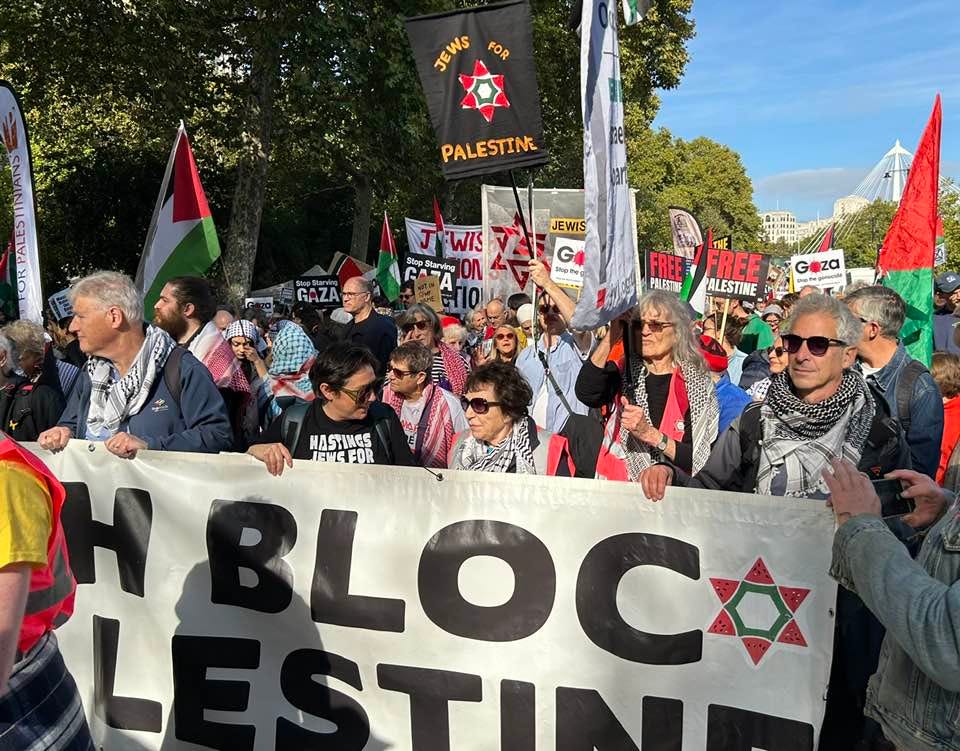
Nevertheless, it still takes courage to speak out publicly for Palestinian women, especially if you are a Jewish woman or man. On one hand, protesting is politically risky for all of us—Jewish and non-Jewish, young and old, from various political and religious backgrounds or none. The UK government offers military support to Israel. It is complicit in genocide, carrying all the political consequences of silencing and restricting dissent that come with the UK’s ideological commitment to Zionism. To be vocal in today’s political climate may land you in solitary confinement, as I was, for nine hours.
On the other hand, Jews face the extra burden of speaking truth to power because it can distance them from their fellow Jews and family. A recent open letter from dozens of British Jews urged the British government not to weaponise anti-Semitism to silence opposition to its policies. Contrary to the views of pro-Israel Jewish feminists and their supporters, they argue that the increase in anti-Semitism in Britain is not fuelled by sympathy with Islamism but is directly linked to the government’s involvement in the genocide. After the horrors of the attempted Jewish genocide by Nazi Germany, many Jewish women and men are motivated to speak out courageously out of a commitment to “never again.”
In conclusion, pro-Israel Jewish feminists and their allies, supported by the political establishment, have remained silent about Palestinian women’s suffering and the sexual and other atrocities committed by Israel. By doing so, they have been complicit in the genocide, never speaking out on behalf of Palestinian women, and that their bodies, and those of their children, have been the battlegrounds upon which the genocide has been expedited. The lack of solidarity with their Palestinian sisters and silence regarding the catastrophe that has befallen them both before and after 7 October demonstrates, at best, the failure of their feminist imagination. What continues to unfold in Gaza is not only a war against its people—it is a war against the very essence of human dignity.
Jewish women will never be truly safe until Palestinian women are free from apartheid and gain self-determination and full citizenship rights. No matter how upsetting some Jewish feminists might feel, it is not an act of hate speech or a call to erase all Jews to say, “From the River Jordan to the Mediterranean Sea, Palestinian women and men should be free!” It is a call for moral rectitude, for all our sakes.

Blah blah blah blah blah blah blah