


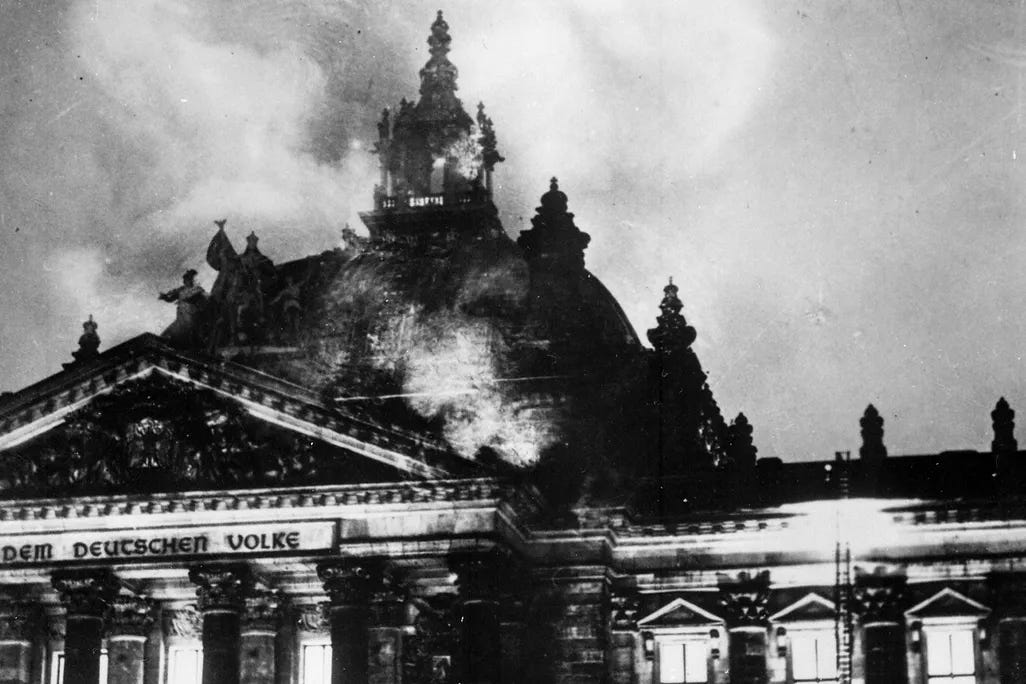
While many nations occasionally resort to a “state of exception” to deal with temporary crises, Israel exists in a permanent state of exception. This Israeli exceptionalism is the very essence of the instability that plagues the Middle East.
The concept of the state of exception dates back to the Roman justitium, a legal mechanism for suspending law during times of civil unrest. However, the modern understanding was shaped by the German jurist Carl Schmitt, who famously wrote that the “sovereign is he who decides on the exception.” While Schmitt’s own history as a jurist for the Third Reich serves as a chilling reminder of where such theories can lead, his work provides an undeniably accurate anatomy of raw power: it reveals how a ruler who institutes laws also holds the power to dismiss them, under the pretext that no constitution can foresee every possible crisis.
It is often argued that Israel, a self-described democracy, still lacks a formal constitution because such a document would force it to define its borders—a problematic prospect for a settler-colonial regime with an insatiable appetite for expansion. But there is another explanation: by operating on “Basic Laws” rather than a constitution, Israel avoids a comprehensive legal system that would align it with the globally accepted foundations of international law. Without a constitution, Israel exists in a legal vacuum where the “exception” is the rule. In this space, racial laws, territorial expansion, and even genocide are permitted so long as they fit the state’s immediate agenda.
Isolating specific examples to illustrate this point is a daunting task, primarily because nearly every relevant pronouncement from Israeli officials—particularly during the genocide in Gaza—is a textbook study in Israeli exceptionalism. Consider Israel’s relentless assault on UNRWA, the UN-mandated body responsible for the survival of millions of Palestinian refugees. For decades, Israel has sought the dismantling of UNRWA for one reason: it is the only global institution that prevents the total erasure of Palestinian refugee rights. These rights are not mere grievances; they are firmly anchored in international law, most notably via UN Resolution 194.
While UNRWA is not a political organization in a functional sense, its very existence is profoundly political. First, it stands as the institutional legacy of a specific political history; second, and more crucially, its presence ensures the Palestinian refugee remains a recognized political entity. By existing, UNRWA preserves the status of the refugee as a subject with the legal right to demand a return to historic Palestine—a demand that the “state of exception” seeks to permanently silence.
In October 2024, Israel unilaterally legislated the closure of UNRWA, once more asserting its “exception” over the entire framework of the United Nations. “It is time the international community (...) realizes that UNRWA’s mission must end,” Prime Minister Benjamin Netanyahu had already declared on 31 January 2024, signaling the coming erasure. This rhetoric reached its physical conclusion on 20 January, when the UNRWA headquarters in occupied Jerusalem were demolished by the Israeli military in the presence of National Security Minister Itamar Ben-Gvir.
“A historic day!” Ben-Gvir announced on that same date. “Today these supporters of terror are being driven out.” This horrific act was met with bashful responses, mute concerns, or total silence by the very powers tasked with preventing states from positioning themselves above the law.
By allowing this Israeli “exception” to stand unchallenged, the international community has effectively sanctioned the demolition of its own legal foundations.
In the past, Israeli leaders masked their true intentions with the language of a “light unto the nations,” projecting a beacon of morality while practicing violence, ethnic cleansing, and military occupation on the ground. The genocide in Gaza, however, has stripped away these pretenses. For the first time, Israeli rhetoric fully reflects a state of exception where the law is not just ignored, but structurally suspended.
“No one in the world will let us starve two million citizens, even though it may be justified and moral until they return the hostages to us,” Finance Minister Bezalel Smotrich admitted on 5 August 2024. This “justified and moral” stance reveals a localized morality that permits the extermination of a population as an ethically defensible act. Yet Smotrich also lied; the world has done nothing practical to dissuade Israel from its savage pulverization of Gaza.
The global community remained idle even when Smotrich declared on 6 May 2025, that Gaza would be “entirely destroyed” and the population “concentrated in a narrow strip.” Today, that vision is a reality: a genocide-fatigued population is confined to roughly 45% of the territory, while the remainder stays empty under Israeli military control.
Netanyahu himself, who has stretched the state of exception beyond any predecessor, defined this new reality during a cabinet meeting on 26 October 2025: “Israel is a sovereign state... Our security policy is in our own hands. Israel does not seek anyone’s approval for that.” Here, Netanyahu defines sovereignty as the raw power to act—genocide included—without regard for international law or human rights.
If all states adopted this, the world would fall into a lawless frenzy. In his seminal State of Exception, Giorgio Agamben diagnosed this “void”—a space where law is suspended but “force of law” remains as pure violence. While his recent stances have divided the academic community, his critique of the exception as a permanent tool of governance remains an indispensable lens for understanding the erasure of Palestinian life.
Israel has already created that void. In the hands of a genocidal settler-colonial society, the state of exception is a relentless nightmare that will not stop at the borders of Palestine. If this “exception” is allowed to become the permanent regional rule, no nation in the Middle East will be spared. Time is of the essence.

How does one expect to stop rogue nations from their imperial colonial activities while remaining loyal to the imperial notion that ‘the state creates the currency’?? Most all are going along with this nonsense that also dates back at least as far as the Roman Empire, if not before.
And when Israel gets support from the imperial USA with its own history of exceptionalism and the usual declaration to have the power to create the currency, one must question whether any challenge of Zionists in Israel is enough.
No one is really challenging 'the system' if they do not challenge the assumptions upon which it is based. If the system is wrong then challenging behavior within the system does nothing to challenge the system. Anyone saying 'follow the money' is already, by default, going along with ages old and impossible assumptions about money that remain in place today. So, they have no ability to fully challenge those they claim to challenge if they are only moralizing about the 'behavior of the bad guys' but never say one word about the impossible system that ‘those guys’ are operating in or the universal participation by the entire populace in a system that cannot be made to produce different results.
I would like to connect the dots to the ages old mistake in reasoning that leaves most all thinking that the monetary unit, used to measure the value in other things and record the value transactions amongst a populace, is at the same time also thought to BE an item of value that can magically be "created" by government and/or banks straight out of the ether and still held to be property and an item to be sought after. The lunacy of all of this and the ages long acceptance of this illogic and all its nefarious effects is yet to be challenged at its logical and conceptual base and, instead, misses the systemic base entirely and only bemoans those effects as though there is some moral way people are to operate inside a system whose imperatives tell them to do just the opposite.
The assumptions most all are operating under will not allow them to find the way out of the very systemic effects they bemoan. In fact, those effects are products of the system and cannot be remediated from within the system while remaining loyal and responsive to the system's imperatives.
https://bibocurrency.com/index.php/downloads-2/19-english-root/learn/299-stop-wwiii