


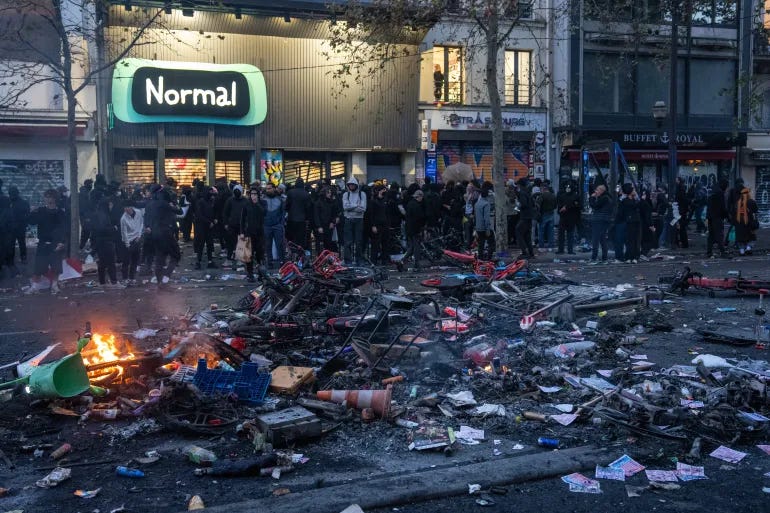
Hundreds of thousands are set to take to the streets in cities across France on Saturday, 24 October, once again protesting austerity and the cost of living crisis. Demonstrations are set to go ahead despite an extremely repressive response from the government and local authorities, including curfews and bans.
Over the past couple of days, a growing number of cities and regions have announced protest bans, drawing criticism from trade unions and progressive groups. “The government has banned demonstrations on Saturday in Lyon, Marseille, Rouen, Grenoble, Le Havre, Bourg-en-Bresse, Le Mans, Toulon, Chambéry, and Perpignan,” wrote Clémence Guetté of La France Insoumise on 22 October. “New bans are coming down every hour. Is this what democracy looks like?”
Many of the bans are being contested in court, with the final outcome yet to be determined.
French President Emmanuel Macron failed to revise his stance on the protests in the same period, announcing that only trade union mobilisations will be allowed on Saturday. “Where they are not organised by trade unions, we will ban them wherever we can,” Macron stated.
The government announced the intention of deploying troops to “guard” the demonstrations. The idea was announced after nationwide protests on 17 October—attended by roughly 800,000 people—turned into riots against the erosion of education services and overall living standards.
A securitisation strategy tested in Kanaky
This institutional response has been heavily criticised by progressive forces that joined students on the streets. As Prime Minister Sébastien Lecornu’s administration insisted on framing the mobilisation exclusively as a security issue, including in meetings with political parties, left forces denounced the strategy for failing to address concrete issues.
Paul Vannier of La France Insoumise said the government was engaging in “a strategy of letting the situation rot,” insisting that it should instead shape a solution to students’ demands. This would include freezing prices, increasing wages, making higher education more accessible, and allocating €10 billion for the education system.
The French left has also sounded the alarm about the long-term consequences of the violent repression of the protests: thousands of youth were arrested during the mobilisation, and dozens were injured—some of them very seriously.
While alarming, this course of events is not surprising, La France Insoumise pointed out. The party compared the repression observed in French cities to the one witnessed during protests in Kanaky in 2024: “a state of emergency, extended curfews, a general ban on demonstrations, the blocking of TikTok, nearly 3,000 security personnel deployed with army support, armoured vehicles, and the massive use of LBD launchers and grenades.”
“What the state tested in 2024 in Kanaky is now applying in 2026 to its own youth, with the same men in charge,” the media outlet L’Insoumission wrote.
Trade unions’ support continues.
It is in this context that progressive forces in France have reiterated calls for the public to respond to the students’ call and protect their right to protest on Saturday. “On 24 October, we once again call on all activists to put on their red [trade union] vests so that young people and workers can exercise their right to demonstrate and to make their demands heard,” the General Confederation of Labour (CGT) wrote.
“We are witnessing an authoritarian shift that goes hand in hand with the government’s stubborn refusal to own up to its record and to call into question its unjust policy in favour of the wealthiest,” dozens of trade unionists, advocates, and cultural workers wrote in an appeal, calling for support for the protests.
“This choice is irresponsible and dangerous for democracy and for the physical integrity of those who defend it without the framework of these mobilisations,” they stated. “It paves the way for the far right to come to power.”