


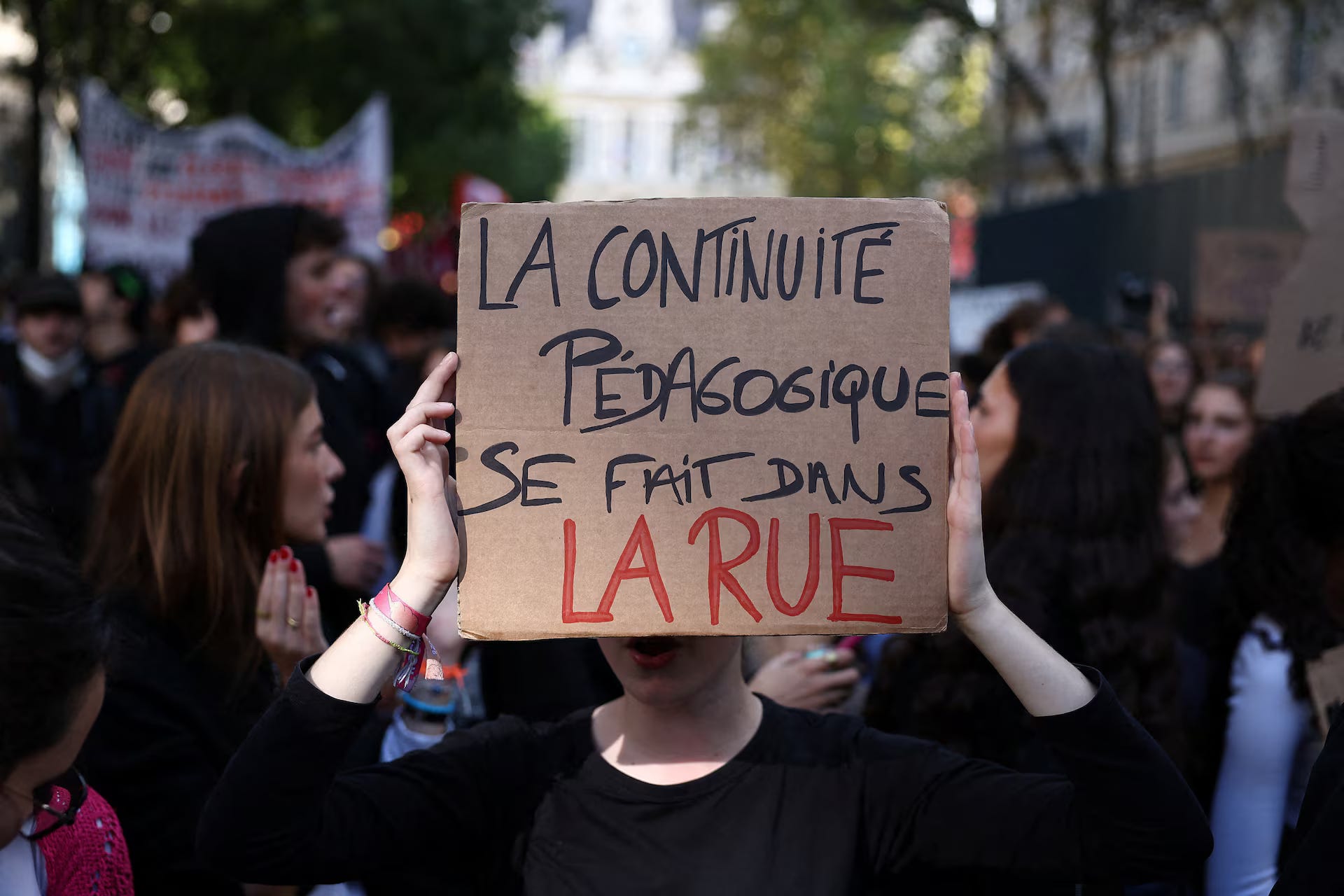
High school and university students in France continued their protests on Tuesday, 13 October, demanding government investment in public education. Approximately 480,000 protesters took to the streets in the latest iteration of the mobilisation, with families, teachers, and trade unions backing students’ demands.
The mobilisation remains marked by widespread police violence. Police used tear gas and dispersal grenades on crowds, including at Tuesday’s central march in Paris. Hundreds of students were injured and thousands arrested in these incidents, prompting reactions from human rights organisations.
In response, the public joined students as they blocked high schools and organised marches to physically shield them from potential harm. Trade union members, notably from the education sector, were highly represented in these support lines.
“The CGT reaffirms the urgent need to address the demands of those who are the country’s future,” the General Confederation of Labour (CGT) asserted. “The CGT salutes their fighting spirit. It welcomes the strong anti-fascist tone of the demonstrations, which shows that there is no inevitability to the continued flourishing of fascist ideas or to the far right’s rise to power.”
Students demand access to higher education.
Since the beginning of the month, French students have organised three massive demonstrations to warn against the state of education under austerity. “For several weeks, high school and university students have been mobilising to denounce the deterioration of their study conditions, the Parcoursup system, staff and resource shortages, policies that are dismantling public services, and—more broadly—the future this society holds in store for them,” the trade union federation Solidaires recognised in their statements.
Equal access to higher education has been high on the protesters’ demand list since the beginning. This refers in good part to how students are currently recruited into university courses—the Parcoursup admission platform. Introduced in 2018 under Macronist ministers to replace a previous system that randomised selection for oversubscribed courses, Parcoursup was supposed to “rationalise” admissions.
In practice, however, critics and applicants emphasise the platform allows institutions to apply unclear selection criteria and even discriminate against students from working-class areas.
In September 2026, the left party La France Insoumise warned that 126,652 students were not able to access a course as a result of the system—up from 77,000 in 2023. “This selection process is the product of austerity-driven political choices deliberately implemented by successive Macron-era governments,” the party warned.
“Parcoursup is a social sorting machine,” Solidaires echoed. “The platform organises competition among young people for places that the State deliberately refuses to create. It transforms the right to study into a privilege, scarcity into selection, and austerity into supposed individual failure.”
Commodification of education
Jean-Luc Mélenchon, the left’s presidential candidate, pointed out that these choices are part of a broader political agenda: “the commodification of education and knowledge.”
Trade union briefs on the subject back this interpretation. At the beginning of this school year, Solidaires warned that thousands of those left without higher education placings are being sacrificed in the name of austerity.
“But not everyone experiences this violence in the same way,” they wrote. “The wealthiest families can afford private schooling, fund housing on the other side of the country, or sustain a year without studying. Young people from working-class backgrounds, however, have no way out. A lack of options means either being forced into the job market or military service—abandoning their plans for good—or facing precariousness, isolation, and debt at a private institution.”
“We have shifted from an egalitarian system to a discriminatory one: pay for your own future,” Mélenchon concluded in a recent interview.
The left leader anticipated that student demands will be an important topic during the upcoming election campaign, where the left is contrasting a program of rupture with neoliberal policies to the far right’s intention to build a debt brake not unlike Germany’s. In practice, this would translate into years of sustained attacks on social security and public services.
Trade unions and progressive organizations announced their support for the youth mobilizations will continue as they build campaigns to resist the government’s intention to impose billions in cuts to pensions and social security while spending record amounts on rearmament.
For their part, student unions invited their members to remain active and join a general mobilisation against the cost of living crisis this Saturday, 17 October.