


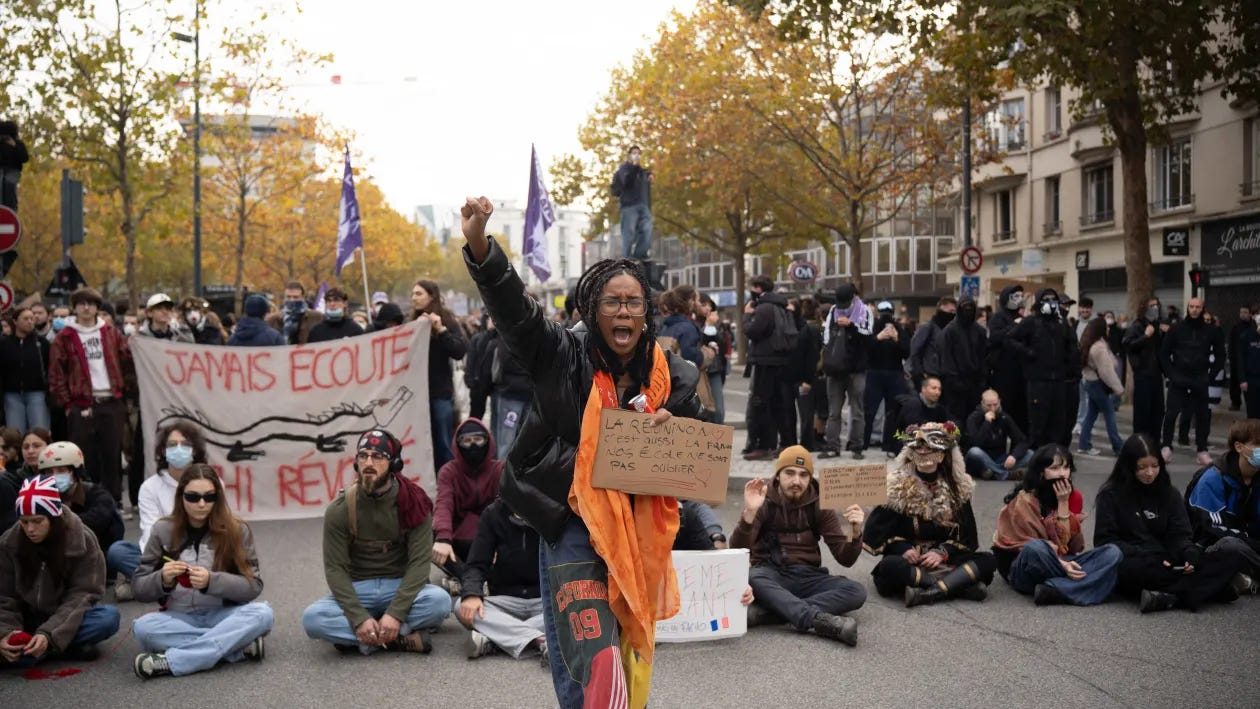
Nationwide mobilisations against austerity have continued in France following the massive strike on 5 November, with additional protests announced for 10 November, 14, 17, and 19.
Hundreds of thousands persist in resisting the cuts-based policies envisioned by President Emmanuel Macron and the government of Prime Minister Sébastien Lecornu. They are demanding that authorities finally table concrete proposals to address the concerns that ignited the protests in October.
Until now, the Lecornu administration has only offered measures amounting to “crumbs,” according to student organisations and trade unions involved. The latest in this series was a pledge to increase the minimum wage by 1.6%, announced at a meeting with unions and employers on Monday, 9 November.
“This small increase is not the government’s generosity,” the student union Union Étudiante wrote. “It’s a first step forward made possible by the mobilisation of workers, students, trade unions, and everyone who has taken to the streets.”
A minimum wage increase worth three metro tickets
While government officials claim the increase would help alleviate the cost-of-living crisis plaguing the working class, most trade unions and progressive groups in France have voiced strong disagreement.
After factoring in the inflation adjustment already set to kick in from January, the net amount of the government’s promised increase could amount to as little as €7 to €8 net monthly. Trade unions had demanded at least a €100 increase.
The government’s offer represents “nothing in the face of precarity,” Union Étudiante emphasised, considering it is just enough to purchase three public transport tickets in Paris or a sandwich in a bakery. “It’s an insult to everyone forced to choose between eating, seeking care, paying rent, and financing their studies,” the student group stated.
“Given the level of the measures announced, the social conference held today at Matignon [the prime minister’s residence] obviously does not put an end to the mobilisation,” wrote the General Confederation of Labour (CGT). “On the contrary, it opens a new stage in the balance of power needed to win real progress.”
The trade union organisation Solidaires similarly criticised the government for failing to offer concrete solutions to the mounting anger, including on student demands for more investment in public education. “The number of additional teachers is insufficient, the funding needed to ensure decent study conditions is nowhere to be seen, and promises on the Parcoursup system remain vague,” they wrote.
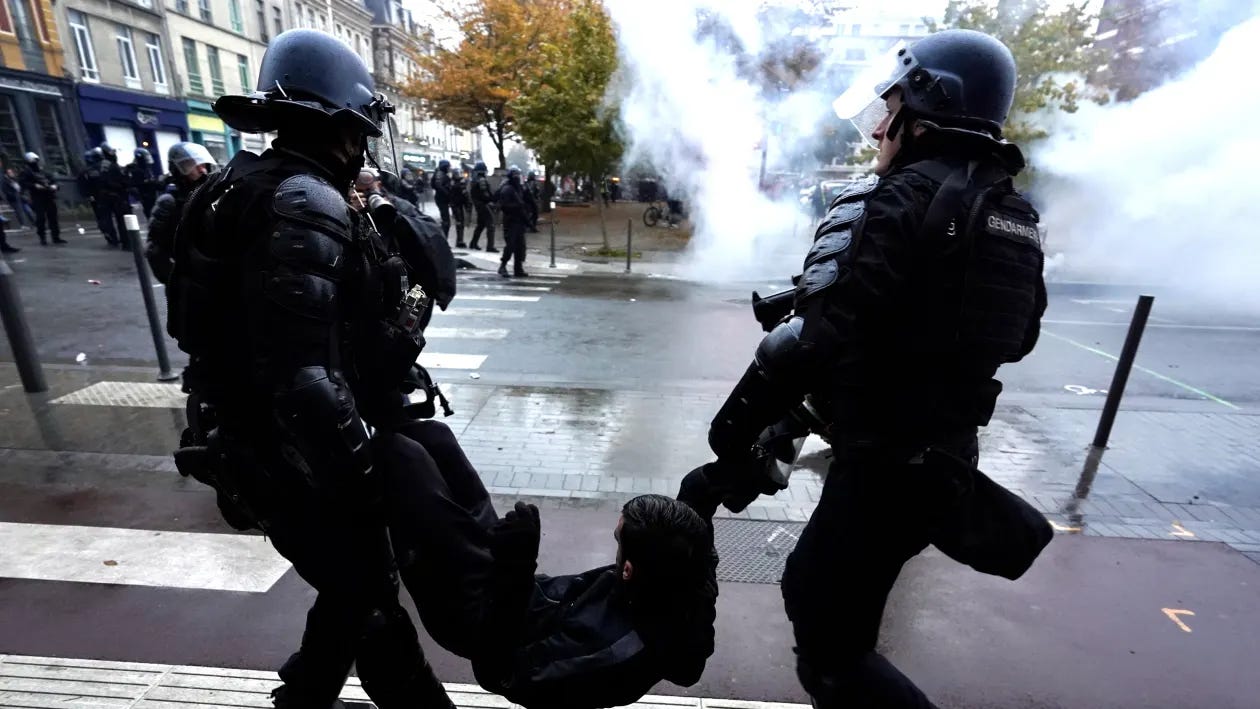
The left pledges an “emergency social decree” to address the cost-of-living crisis.
Student unions that met prime minister Lecornu on Monday shared similar impressions. In addition to noting no significant breakthroughs, students walked out of a discussion on reforming the higher education recruitment platform Parcoursup over the participation of the far right—which has repeatedly dismissed the protesters’ grievances.
Most recently, Rassemblement National leader Marine Le Pen opposed imposing a minimum wage increase, arguing it would lead to job losses and echo workplace measures from the USSR. She had previously admitted she would not break with the neoliberalism championed by Macron if elected president in 2027.
In contrast, the programme of left presidential candidate Jean-Luc Mélenchon—who is increasingly shaping up to be the only true electoral alternative to Le Pen—pledges to increase the net minimum wage by approximately €200 to €1,700 immediately upon being elected.
The move would benefit over 2 million workers in France—approximately 60% of whom are women—who were pushed into ultra-precarious working conditions by Macronist policies, wrote media outlet L’Insoumission.
“How can we not raise the minimum wage to €1,700 when the wealth of the country’s 500 richest families has doubled since 2017? Billionaires have never made such enormous profits. Macron has turned France into a tax haven for billionaires.”
The minimum wage increase promised by the left is among a host of other measures included under the umbrella of an “emergency social decree” intended to address the cost-of-living crisis. Other measures include freezing prices and profit margins, as well as other moves to ensure salaries keep pace with prices.
Students and education trade unions are once again taking action on Tuesday, 10 November. On Saturday, 14 November, a new round of general mobilisations was announced, while trade unions are circulating a new call to “generalise strike actions” on 17 November. Two days later, more protests are expected, boosted by the participation of retirees’ organisations.