


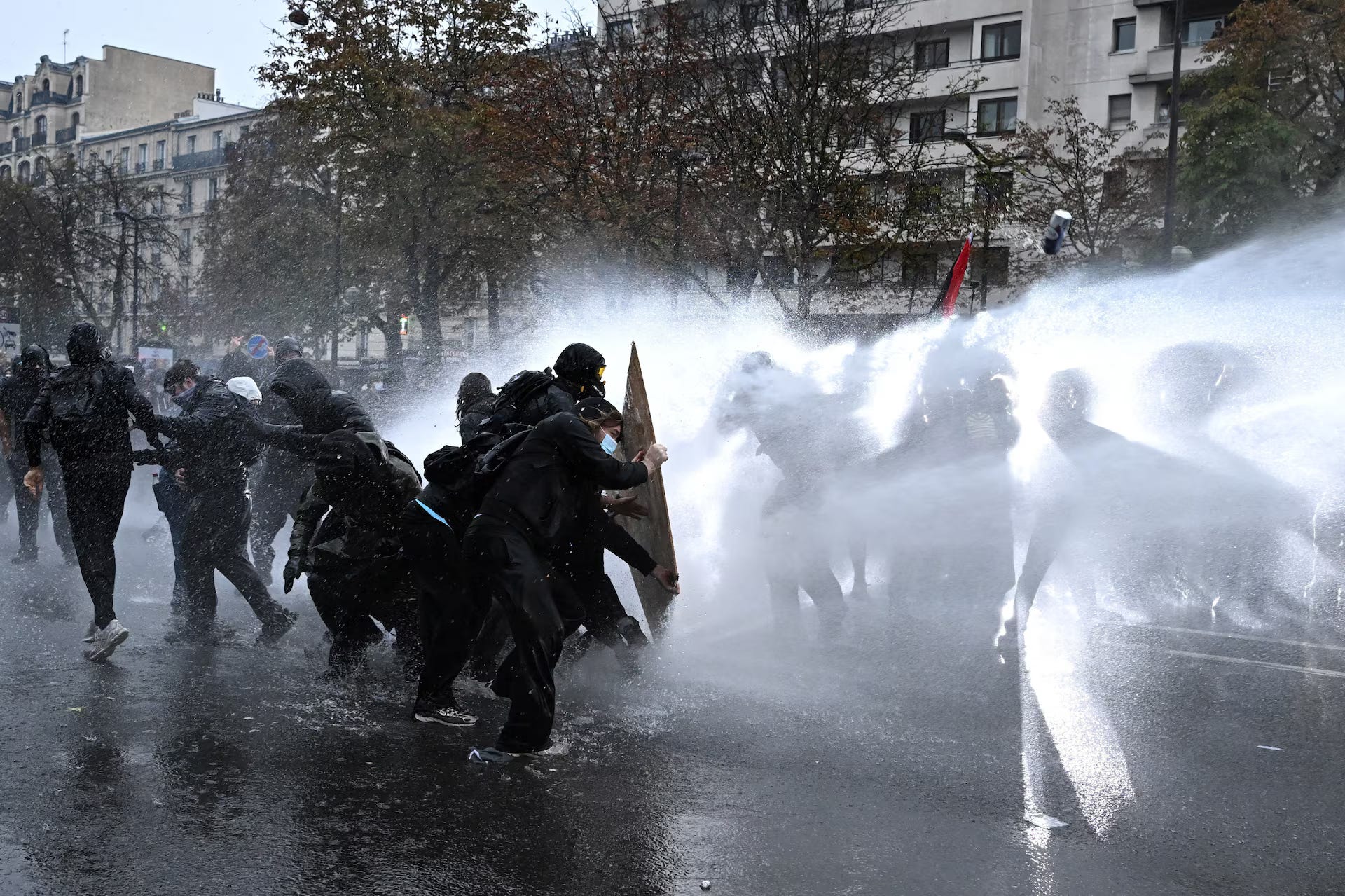
France is gearing up for another round of anti-austerity mobilisations on Saturday, 31 October. As the weekend approaches, President Emmanuel Macron and Prime Minister Sébastien Lecornu have still not substantially addressed the protest demands tabled by the student movement.
For the past weeks, students and their organisations have taken to the streets in the hundreds of thousands, denouncing the state of the education sector, including overcrowded classrooms, overworked teachers, and dilapidated buildings. Authorities have responded with a full-blown crackdown—police violence, curfews, and protest bans—while avoiding meaningful conversation about the protests’ causes.
“The authorities” top priority is to strip the movement of the political meaning it carries: the condemnation of the neoliberal policy that has ruined the French education system,” presidential candidate Jean-Luc Mélenchon pointed out in a recent interview. “Young people are pulling at the thread of a larger unravelling.”
The government tried to break student unity.
Lecornu and his ministers called a meeting with high school and university student groups on Monday, announcing the government was ready to open dialogue on their demands. Yet even before the meetings kicked off, a list of government-proposed measures published by the media only fuelled frustration.
These measures included a transparency-orientated reform of the higher education recruitment platform Parcoursup, the creation of 15,000 additional higher education placements, low-interest loans to regional authorities for renovating school infrastructure, and the indexation of grants to inflation.
Students criticised the officials for attempting to set a negotiation agenda before even speaking to them. They also called them out for trying to break their unity by organising separate meetings with different groups instead of a joint discussion. In this process, they emphasised crucial voices were left out.
Among others, the Fédération Lycéenne des Quartiers (FLQ), representing high school students from working-class neighbourhoods—the demographic group from which the protest wave originated—was not invited to meet Lecornu. Students interpreted this as yet another sign of the government’s failure to grasp what is at stake. “They see us first and foremost as ‘young people from the banlieues,’ rather than young people who, like everyone else, want to make their voices heard,” FLQ’s Soumaya Sarré told Mediapart.
“Crumbs” instead of solutions
The way meetings were set up was not the only problem. Following the publication of the government’s proposals, the university students’ association Union Étudiante described them as “crumbs” and detailed how they fail to address the movement’s concerns.
“There are not 15,000 places missing but at least 250,000,” the organisation warned. “Where are those 250,000 places needed for young people who have been denied their right to education because of classist and racist selection?”
Union Étudiante similarly criticised the lack of clarity surrounding proposed financing for infrastructure investment, employment plans, and the promise to “reform” rather than abolish Parcoursup.
This last demand has become emblematic for the student movement over the past weeks of protest. Young people on the streets have repeatedly explained how the tool allows university selection to maintain racist and classist tones—all while pushing tens of thousands of students without placements toward the private sector.
“We are not asking for a reform that offers more transparency or clarity; we already know how the selection process works, and it will remain unjust even if the selection criteria are made public,” Union Étudiante wrote. “The problem is selection itself. Why should young people be denied the right to pursue higher education? We must abolish all forms of selection while keeping a centralised platform for enrolling in academic programmes.”
Mobilisations against racism and the far right
Trade unions and progressive organisations continue to support the students ahead of Saturday’s demonstrations, while building toward a general strike on 5 November. The networks remain connected over shared austerity-related problems, linking budget cuts in public services, attacks on pensions, and precarious working conditions.
In between regular nationwide mobilisations, the past few days have also seen significant protests against racism and the far right. After a racist attack in the Trappes working-class suburb of Paris last Friday—where one person was killed and five, including a 12-year-old, were seriously injured—calls are circulating for solidarity assemblies.
“This crime did not come out of nowhere,” wrote Saint-Denis mayor Bally Bagayoko. “For years, the perpetrator blamed ‘Black people and Arabs’ for all his misfortunes.”
“He claimed he wanted to avenge a looting that never actually happened—a piece of false information broadcast on television,” he added.
“This hatred has its architects: those who, hour after hour on the airwaves, designate our neighbourhoods as the problem and ‘the other’ as a threat.”
The far-right National Rally—whose programme ahead of the 2027 presidential election endorses exactly this vision of “the other”—held its congress in Orléans over the 24–25 October weekend. Approximately 26,000 people joined a local march against the policies endorsed by the party, signalling continuous resistance in the lead-up to the April 2027 presidential election.