



Although many genocides have occurred throughout history, the genocide of the Palestinians is unique. First, it is not carried out solely by Israel but in complete cooperation with the US and European governments. Second, the victims themselves record their genocide in real time, despite the knowledge that Israel may murder them for doing so. Third, the genocide is accompanied by vericide—the deliberate erosion of truth. Like the genocide itself, vericide heralds a new world order where mass murder is normalised, totalitarian censorship is permissible, and those who try to expose reality are killed.
Many political actors participate in vericide and ignore, bury, or lie about the reality that we can all see live-streamed daily. Amongst these actors are gender-critical feminists. Although the gender-critical feminist movement is diverse and spans the political spectrum, a notable subset aligns with pro-Israel views, sometimes overlapping with conservative or right-wing coalitions. This alignment with the right is not universal, as some gender-critical feminists see Gaza as a core feminist issue related to anti-colonialism, anti-violence, and intersectional justice. However, gender-critical feminists, in particular prominent figures who help shape public opinion, are more likely to support Israel than broader feminist groups. They emphasise the importance of free speech and opposing what they regard as leftist authoritarianism.
To remain faithful to Israel and the Zionist ideology that underpins it, gender critical feminists are obliged, of necessity, to hide, obfuscate, or deny the truth of the genocide. In doing so, they betray many of their own values and principles: naming male violence, speaking truth to power, and standing in solidarity with women regardless of nationality, ethnicity or religion.
Hasbara and the manipulation of truth
The first intimation of gender-critical feminism’s ideological allegiance with Israel was signing the October Declaration, an open letter issued by British Friends of Israel on 23 October 2023, in response to the Hamas attack on 7 October. Many prominent feminists signed it, including those in organisations such as Transgender Trend and Sex Matters, and journalists and social commentators such as Jo Bartosch, Julie Bindel, Hadley Freeman, Nicole Lampert, and Janice Turner.
The Declaration states: “We...stand in solidarity with British Jews and condemn all forms of antisemitism, whether in Britain or elsewhere.” Who, with any sense of humanity and moral reasoning, could disagree with these sentiments? Despite its seemingly benign and friendly intent, the Declaration is more than just a gesture of friendship extended to British Jews who are immediately traumatised by the severe human losses inflicted by Hamas. It also makes a specific set of politically and racially charged assertions that help shape a narrative—Israel is an innocent party, a liberal democracy like any other, threatened out of the blue by barbaric fundamentalist Islam whose only aim is an existential fight for Muslim supremacy.
First, the letter claims that Hamas carried out “the murder, torture, rape, and kidnapping of over 1,500 people.” Regarding the figures, although Hamas was undoubtedly responsible for many deaths, the army was also responsible, as pictures of hundreds of burnt cars and shelled homes by aerial bombardment demonstrate. The army had invoked the Hannibal directive which means that the exact number killed by Hamas, rather than Israel, remains unclear. I will return to the rape claim shortly.
Second, the letter describes the attack as unprovoked, creating the illusion that the conflict with the Palestinians began on 7 October. This claim masks the historical context and political realities. Israel is not a liberal democracy as we typically understand it, as we are constantly told. The state of Israel was established in 1948 as an ethno-nationalist state and has been maintained through violence and acts of terrorism against Palestinians—land theft and forced displacement, apartheid policies, sieges, and the mass incarceration of Palestinians, including children, without trial. Erasing the historical context of the 75-year violation of Palestinian human rights also obscures how the Palestinians, abandoned by the international community, have attempted unsuccessfully to break free from oppression and state-sanctioned violence, to pursue self-determination and statehood.
Third, the letter labels the attack as an anti-Semitic attempt to cause another holocaust, portraying Israel as the victim rather than the oppressor in a fight for its survival, this time against Islam. The Gaza war is not a religious conflict—Judaism versus Islam—it is a political struggle.
Finally, the letter shifts all moral responsibility for the upcoming actions “taken by Israel to defend itself,” namely, the murder of thousands of women and children, to Hamas, which “knew there would be consequences.”
Having defined the violence as Islamic fundamentalism, the right-wing Israeli government framed its retaliation in terms of religious fundamentalist Judaism and the idea of collective identity, a point that feminists have conveniently overlooked. The punishment began immediately after 7 October—an “us or them,” “Jews or Muslims,” or “Western civilisation or barbarism.” Yoav Gallant, then-Israeli Defense Minister, infamously stated on 9 October: “We are imposing a complete siege on Gaza: no electricity, no food, no water, no fuel. Everything is closed. We are fighting human animals, and we are acting accordingly.” Israeli President Isaac Herzog made remarks on 12 October suggesting that there are no innocent civilians in Gaza. Specifically, he said, “It is an entire nation out there that is responsible. It is not true, this rhetoric about civilians not being aware, not involved. It’s absolutely not true.”
On 28 October, Israeli Prime Minister Benjamin Netanyahu articulated in apocalyptic and biblical language an existential struggle for the survival of Jews that dates back 3,000 years. He called for “a holy war of annihilation” against the Palestinian people in Gaza, invoking “Amalek,” a nation in the Hebrew Bible that God ordered the Israelites to destroy as an act of revenge. “You must remember what Amalek has done to you.”
Over the last two years, Netanyahu has faithfully kept his promise.
Feminists align with Israel as a progressive, civilised state for women and, in supporting it, they invoke its Western values, including freedom for women, as opposed to the perceived patriarchal threat of Muslim societies, with Palestine seen as its surrogate representative. They maintain Israel’s narrative that its war on Gaza is justified and pro-civilisation by ignoring the religious fundamentalism used by Israel to wage war, the brutal tactics employed, and Israel’s intentional targeting of women and children.
The Feminist Weaponisation of Silence
I have written extensively about the unproven claims made by Israel that Hamas systematically raped Israeli women. The journalists Julie Bindel, Hadley Freeman, Nicole Lampert, and Janice Turner abandoned journalistic due diligence. They actively endorsed the rape narrative as fact, repeating the war propaganda designed to incite unconditional support from Western nations. These journalists blindly endorsed the claims of #MeToo_Unless_Ur_A_Jew, a Jewish women’s grassroots movement that criticised women’s organisations such as UN Women. They also took issue with Reem Alsalem, the UN Special Rapporteur on violence against women and girls, who is herself gender-critical, for not immediately condemning Hamas because she waited for concrete evidence before making formal statements. Any women who questioned whether the testimony to rape was genuinely from women themselves were accused by feminists of holding such a deep hatred against Jews that they made an exceptional case for Jewish women.
Bindel referred to UN Women as “so-called feminists” who stay silent, “simply because Israeli Jewish women are the wrong type of victim.” “Rape is rape, whether or not you like the victim, and a rapist is a rapist, even if you support his cause.” Yet she, and all other gender-critical pro-Israel journalists, remained silent about the incontrovertible evidence that Israeli soldiers rape Palestinian women and men held hostage in detention camps, a fact well-documented over decades by Israeli’s own human rights organisation B’Tselem. By spreading the myth that Hamas systematically raped Jewish women on 7 October and hiding the truth about the IOF (Israel Occupying Force), feminists reinforce the narrative that Israeli men are innocent and that violence is inherent in Palestinian men, desensitising Western audiences to the humanity of Palestinians.
Any feminist monitoring the situation for women and children in Gaza has been kept fully informed by two outstanding UN Special Rapporteurs—Alsalem and Francesca Albanese, the UN Special Rapporteur on the human rights situation in the Palestinian territories. By early 2024, they were highlighting the egregious human rights violations faced by Palestinian women and girls. These abuses include: the deliberate targeting and killing of Palestinian women and children in places where they seek refuge or while fleeing, the arbitrary detention of hundreds of Palestinian women and girls subjected to inhumane and degrading treatment, the denial menstrual hygiene, the denial of food and medicine, being severely beaten, and being subjected to multiple forms of sexual assault.
In the summer of 2025, Alsalem wrote a report for the Human Rights Council, Sex-based violence against women and girls: new frontiers and emerging issues. In it she opposes the concerted international push in law and social policy to disassociate the definition of men and women from their biological sex and erase the legal category of “women”. When states ignore the importance of biological sex and sex-related data, this undermines their ability to identify, assess, and eradicate male violence against women and girls. She puts sex-realism to use for analysing the scale and intention of Israel’s military assault on women. She has created the neologism “femi-genocide” to capture it. Femicide is a distinct form of male violence involving the murder of women and girls solely due to their female sex. Genocide is the violation of the right of a people as a whole to exist. Femi-genocide is the putting of femicide to the service of genocide, deliberately targeting and destroying women’s lives and reproductive capacities as a genocidal tool. Femi-genocide by Israel is the large-scale, deliberate, and systematic killing of Palestinian women because they are both Palestinian and female. It is the “deliberate destruction of Palestinian females, the intentional destruction of their lives and bodies, for being Palestinian and for being women.” Alsalem calls for Western intervention to prevent the femi-genocide, not only because “the continuity of Palestinian life depends on it,” but because “our collective humanity and future depend on it.”
Alsalem’s data about Israel deliberately targeting women and girls has proved the death knell for the recognition of her important work by gender-critical pro-Israel feminists. Cultural critic Jo Bartosch is an exception to this, yet she nevertheless exemplifies the common failure among pro-Israel feminists who, in principle, support all women regardless of class, nationality, ethnicity, or religion from sex-based violence. They abandon their values of solidarity with women when it comes to Palestinian women, since it would necessitate exposing the truth that the violence done to them is by Israel. On one hand, Bartosch strongly defended Alsalem when 200 NGOs signed a letter demanding her removal as UN Rapporteur because of her sex-realist beliefs. Bartosch argued that, unlike postmodern faux feminists focused on “gender identity” politics, Alsalem is a “true feminist” because she concentrates on “the actual atrocities committed against women and girls worldwide.” On the other hand, neither Bartosch nor, to my knowledge, any other gender-critical feminist who would usually stress the importance of collecting sex-related data has addressed Alsalem’s identification of Israel as an active participant in the global violence against women. Indeed, Alsalem claims that the extent and severity of the violence are so extreme that existing legal and criminal frameworks can no longer fully address or explain them.
The UN’s conclusion that Israel is committing genocide through bombing and starvation garnered much news coverage over the summer. What was most striking was that whereas the Western media has effectively placed itself at the service of Israel’s genocidal enterprise, even mainstream media started criticising Israel for weaponising starvation. While most media outlets published photos of starving children, feminist journalists stayed focused on transgender issues: Suzanne Moore wrote about how Marks & Spencer’s policy on male employees who identify as women helping teenage girls with bra fittings highlights precisely the erosion of women’s rights when organisations are captured by gender-identity ideology. Julie Bindel discussed the Polari Prize, which honours LGBTQ+ literature, and the backlash from trans activists over the longlisting of an author with gender-critical views. Suzanne Moore posted on X that the silence from fellow writers and journalists about the successful campaign to silence an author threatens all our freedoms. They assume their own free speech rights are safe while ignoring global threats to free expression. She said, “Look around the world, you complete fools.”
Moore participates in the very phenomenon she decries. Israel has banned all Western journalists in Gaza, leaving Palestinians with no choice but to broadcast the erasure of their own culture and people in real time, in hopes that the world will recognise their humanity and take action to defend them. They leave recorded videos in the event of their death. Moore has not condemned Israel’s murderous attempts at suppression of the truth but has chosen silence, and thus complicity.
On the very same day that Moore castigated her own profession for its alleged cowardice in failing to speak truth to power, Israel carried out a targeted killing of journalist Anas al-Sharif, along with five colleagues in a makeshift newsroom tent. Sharif was a 28-year-old with a large social media following of hundreds of thousands and was one of the most important witnesses to Israel’s nearly two-year assault on the bodies of children, women, and men. While Israel claims it killed a Hamas commander, and the BBC wrongly claimed that he worked for a “Hamas media team,” Israel had actually murdered a Pulitzer Prize-winning journalist. Within weeks of Sharif’s murder, Israel conducted another attack on Nasser Hospital, followed by a second strike minutes later, deliberately targeting emergency responders, medical personnel, and journalists rushing to the scene. One of the victims was the feminist Palestinian photojournalist Maryam Abu Daqqa. After witnessing the massacre live on television of journalists and medics, no one has been held accountable.
Nicole Lampert did comment but denied that Israel is deliberately targeting journalists. She posted on X that “the killing of journalists is a tragedy of war, all wars.” In her view, the “coordinated push from some newspapers around the world” that claims Israel has gone out of its way to murder journalists is nothing less than an example of anti-Semitism. Having insisted that feminists unconditionally accept the pornographic imaginaries of the male first responders on the scene of 7 October, otherwise they were anti-Semitic, she now demands that the international community not believe the testimonies of journalists and medics, otherwise we are anti-Semitic. Despite being a journalist, Lampert ignored the facts. According to the Costs of War Project, the killing of Palestinian journalists in this genocide in Gaza by Israel, along with other acts of violence against journalists, marks the deadliest conflict for journalists in all known conflicts in the history of the world. To speak the truth that Israel is targeting journalists is, through Lampert’s reductionist lens, a “new libel to add to the genocide libel, the starvation libel, the deliberately targeting of babies libel, the Israelis killed themselves libel, the libel that Israel knew Oct 7 was going to happen.”
The author JK Rowling is often asked on social media why she hasn’t spoken out about the dispossession, rape, and murder of Palestinian women. She never responds. Her supporters usually defend her silence by turning the question back on the questioner: “Have you also advocated for women in sports, prisons, rape crisis centres, refuges, changing rooms, and other single-sex facilities, and for women’s free speech in the professions? Or do you, like most people, lack the time or the arrogance to assume expertise in everything?” First, one doesn’t have to be a public advocate for women’s sex-based rights to notice that someone who is, in particular someone with such a high profile as Rowling, omits to comment on the violation of the sex-based rights of Palestinian women. The fact is, when prominent gender-critical feminists like Rowling openly oppose violence against women and girls but remain silent when Israeli soldiers commit it, that silence is inherently political. Second, Rowling assumes geo-political expertise, particularly regarding Afghanistan. In doing so, she
enters the feminist discourse that women’s rights are secured by standing with Israel against Islam.
Rowling calls for Western intervention into the Taliban’s systematic and widespread erasure of women’s fundamental human rights. She states: “Afghan women are as deserving of respect, autonomy, and dignity as every other woman in the world. The lack of meaningful reprisals for the flagrant human rights abuses visited upon Afghan women by the Taliban shames the international community.” What kind of meaningful action does Rowling think the West can make beyond moralising rhetoric? In 2001, the US, supported by NATO allies and partner nations, led an invasion aimed at removing the Taliban regime. After twenty years, they withdrew, failing to achieve their goals and inadvertently strengthening the Taliban’s control over women.
When Rowling speaks out on behalf of Afghan women, but not Palestinian women, this does not indicate neutrality about Israel. If she spoke on behalf of Palestinian women, she would need to acknowledge that Israeli men carry out the most significant violation of their human rights. Since we have the power to intervene on their behalf by not arming Israel, I apply Rowling’s words about Afghan women to Palestinian women: “Palestinian women are as deserving of respect, autonomy, and dignity as every other woman in the world. The lack of meaningful reprisals for the flagrant human rights abuses visited upon Palestinian women by the Israeli army shames the international community.”
Rowling’s loyalty to Israel is made clear through her silences. She discusses the killing of Charlie Kirk, an American conservative political activist dedicated to free speech as a way to encourage good-faith dialogue, even with trans activists and their allies with whom he disagreed. She outlines four qualities of the political backdrop that she believes are connected to the still-unknown motives of the assassin.
First, she claims, “If someone believes they have a right to free speech, but their opponents do not, this is a form of illiberalism.” Many gender-critical feminists have experienced such illiberalism when asserting their right to speak on sex and gender. We have been subjected to online vilification, threats, including death threats, and smear campaigns. However, the gender-critical community, in turn, extends the same illiberalism to those with whom it disagrees on Israel. After a decade of insisting that words are not violence, that political disagreement does not kill people who identify as trans, and condemning “hate speech” laws that accuse feminists of “transphobia,” feminists now categorise speech criticising Israel as “hate” and slur critics of Zionism as “anti-Semites.” Bindel, for example, says that when people march to demonstrate against Israeli violence toward women and children and chant “Free, free, Palestine,” what it really means is “Kill the Jews.”
Second, Rowling states, “If no conflicting evidence could alter your beliefs, you’re a fundamentalist.” This is clearly true and applies to gender-critical feminism. Many feminist supporters of Israel, including those with whom I once stood shoulder to shoulder in our fight against gender identity ideology and the misogyny inherent to transactivism, remain faithful to Israel despite that after almost two years of horror that women and children have suffered, an estimate of the death toll is now realistically set by scholars and scientists at 680,000, 75 per cent of which are women and children, and not the current number set at 65, 000. The numbers are hard to prove or disprove since investigators are banned from entering Gaza, a fact that alone should worry feminists.
Third, Rowling says, “If you believe the state should punish those with opposing views, you’re a totalitarian.” She expresses horror at the powers of the state when it polices views she shares. Like me, she was disturbed by the recent arrest of comedy writer Graham Linehan at Heathrow Airport, where five armed police officers detained him for tweets that transactivists considered hateful. She says, “What the fuck has the UK become? This is totalitarianism. Utterly deplorable.” Yet she has remained completely silent about the police’s mass arrests of middle-aged and older women, including the daughter of a Holocaust survivor, under the terrorism law for peacefully holding signs opposing genocide, and supporting those who take direct action to prevent it. Women and men have been subject to more extreme acts of totalitarianism than Glinner. They were frisked, handcuffed, DNA tested, fingerprinted, detained overnight in a police cell, and now face criminal charges and a potential six months in prison.
Fourth, Rowling states, “If you believe political opponents should be punished with violence or death, you’re a terrorist.” The current war in Gaza is an extension, in extreme form, of the long-standing settler-colonial dynamics whose primary goal is the ethnic cleansing of the Palestinian population, marked not only by illegality but by terrorism, systematically using violence and death to achieve its Zionist political goals. Moreover, as Alsalem points out, with the dismantling of the law-based order that the war on Gaza represents, normalisation of violence against women is rapidly metastasising beyond Gaza.
I suggest we begin to connect the terrorism exercised by Israel on Gazans to the rise of fascism in Western Europe. Fascism is always characterised by the mobilisation of hyper-masculinity and male machismo, of which historical Nazi Germany serves as a prime example. At a recent protest march in Berlin, several Nazi-style officers were filmed punching a young Irish woman in the face, bloodying her nose, before dragging her away. To my knowledge, no pro-Israel feminist has condemned this incident, or the context in which it occurred—the extreme, violent clampdown in Germany of protests against Israel.
The Feminist Weaponisation of Racism
The fantasy that Palestinian men are sexual brutes has also contributed to the context for far-right racist claims that Muslim asylum seekers are more likely to be rapists than British men.
Kellie-Jay Keen is a gender-critical activist infamous for popularising the dictionary definition of a woman as a counter to gender identity ideology. Though she did not sign the October Declaration, she repeats its hasbara almost to the letter. Her understanding of the conflict’s history is simplistic and binary, framing it as a dichotomy between Western civilization and Islam. In responding to accusations of genocide, she remarks on X, with breathtaking confidence and astonishing historical inaccuracy, that “Muslims have wanted a Jewish genocide since the inception of Islam.” She stated, “War is ugly, Israel is not committing genocide.” In response to an accusation on X about her silence on the deaths of thousands of Palestinian women, she responded by defending Israel’s military actions: “Hamas is bad. Destroy Hamas.” She describes pro-Palestine marches as “Hamas parades.”
Keen’s anti-Muslim activism focuses on accusing asylum seekers of sexually preying on British women and spreading an anti-migrant fervour on her social media platforms. The narrative that asylum seekers are disproportionately involved in sexual violence, especially rape, has been promoted by statistics suggesting Afghan nationals are disproportionately likely to be convicted of sexual offenses than British nationals. This claim originated from a report by the Centre for Migration Control, a think tank linked to Reform, but has since been widely disputed and debunked. The narrative was amplified by certain right-wing media outlets and political figures, including GB News, The Daily Mail, Reform UK politicians, Nigel Farage, and the far-right activist Tommy Robinson.
Julie Bindel recently, along with other gender-critical feminists, signed a letter expressing concern about the dramatic increase in far-right violence that has been fuelled on social media by several influential figures belonging to the gender-critical community. In particular, they pinpoint one influential figure, whom I presume to be Keen, though unnamed, “has actively fanned the flames of racist violence with increasingly inflammatory video messages.” Bindel and other signatories insist they are “ethically compelled to have no truck with any form of racism.” They are not willing to work with or share a platform with supporters of the far right, including Tommy Robinson, who justify or incite the violent scapegoating of immigrants and minority communities. They point out that individuals promoting this narrative are not motivated to protect women and girls; instead, they are exploiting violence against women to fuel hate and division.
Despite Bindel’s proclamations about her own alleged anti-racism and her desire to distance herself from the far-right, her support for Israel and its racist, apartheid regime belies this claim. Sadly, Bindel and Tommy Robinson are not as far apart as she claims since Robinson is also deeply aligned with Israel.
Academic Maryam Aldossari reflects on pro-Israel gender-critical feminists, using Bindel as a prime example of performative feminism and anti-racism. Bindel asserted in 2023 that Israel’s war on Gaza is “taking a stand for civilization,” endorsing a Telegraph article that dismissed Palestinian suffering and condemned those who march in defence of Palestinian humanity. Bindel, Aldossari argues, embodies a familiar type of British pundit who has resurfaced—loud, self-asserting, and whose outrage is as selective as it is performative, always aligning morally with Western state power. They stay silent about the genocide but are quick to support Israel and its allies. Whilst women and children in Gaza are incinerated in their tents, they direct their anger at protesters (many of whom are Jews) who they smear as extremists, and twist acts of dissent into endorsing “jihad,” and wield accusations of anti-Semitism as a weapon.
Many Palestinian feminists in Gaza, like Hala Hanina, contend that Western, feminists have remained silent about numerous human rights abuses against women, such as sexual abuse, rape, and displacement. They ask why Palestinian women’s suffering, which is similar to their own as women, still goes unnoticed. They feel deeply betrayed by Rowling in particular, who, as an influential children’s author, was very influential on them in their childhood, and in whom they had placed hope that, as a woman who understands violence at the hands of men, she might relate to their pain. Some “self-claimed feminists” sometimes call for a ceasefire, “but what’s next?” The answer is “they do nothing!” And “that is why we feel betrayed.”
Nadine Quomsieh, a feminist Palestinian journalist from the West Bank, observes the Western feminist movement that cannot speak about Gaza, and expresses similar deep disappointment. She asks:
What happens when it cannot find the language to speak about women giving birth on floors, grieving over mass graves, boiling weeds to feed their children, simply because they are Palestinian?
She points out that this feminist movement has forgotten its roots—resistance, solidarity, justice: “If our feminism cannot hold space for that reality, then what are we building, and who is it really for? Can our global movement stretch wide enough to embrace the grief, strength, and truth of Palestinian women? Can it kneel beside us, listen to us, stand with us—not because we are flawless, but because we are human?”
A personal example illustrates the way that gender-critical feminists who are pro-Israel shut down references to Palestinian women’s pain. A year into the war, I was chatting in the autumn on WhatsApp in a gender-critical group that had existed harmoniously for eight years. For the first time in the group’s history, ideological fractures had opened up after 7 October. A member chattily asked us all how we were doing that day. Here is my reply: “I’m enjoying the autumn, the dark nights, candles, and fires. I defrosted the lemon drizzle cake. It was absolutely delicious. It has gone well with cups of hot tea at ‘teatime’ in the afternoon and the gathering dusk. Such pleasures in life (appreciated by me more, not less, as I watch, horrified by what the Israeli government is doing to the Palestinians) xxx.” A reply from the one member who had signed the Declaration was: “I don’t want to hear any more anti-Israel propaganda in this group. I hear enough of that everywhere else I look. You know that, Heather. I think it’s time for me to leave.”
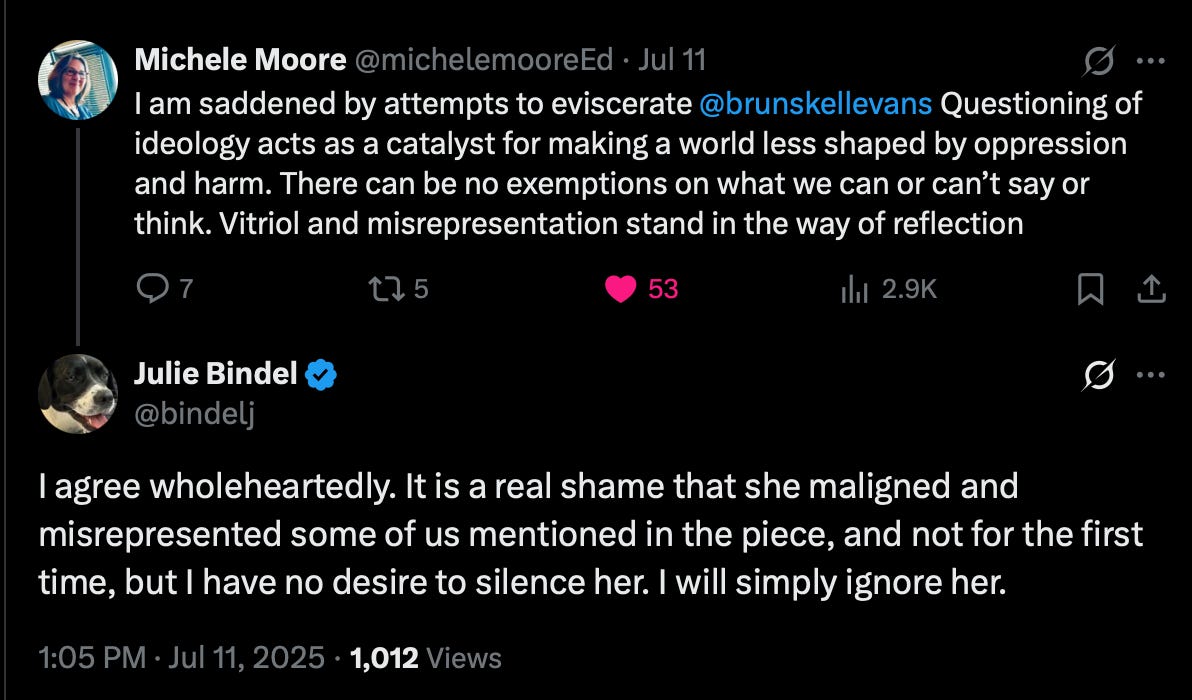
This is in neither the first nor the last time feminists attempted to suppress criticism of their support for this genocide. Worse, many feminists openly advocate ignoring oppositional voices while consciously avoiding dialogue and laying false claims to being “maligned.”
The women and men in church congregations and village halls across Middle England show more despair about Israel, and grief and sorrow for the trauma experienced by women and children in Gaza, than gender-critical feminists.
Gender-critical feminism now follows the pattern of many resistance movements—it has become complicit with the power it once opposed. Experts at deconstructing gender-identity ideology, feminists are now supplicants at the altar of Zionist ideology: Hamas are rapists, Israel is a liberal democracy, Hamas attacked without cause, driven solely by the genocidal goals of Islamist fundamentalists to wipe out all Jews; Israel has an existential right, rooted in history, to do whatever it sees fit to the Palestinian population, including violating every international and humanitarian law meant to protect women and children.
Feminists stay silent about Israel’s lies, or they deny them, and mock, demean, or demonise those who oppose the war. They help fuel anti-migrant fervour against Muslim asylum seekers. They contribute to the flashpoint between Jews and Muslims on the global stage, where identities are hardened, so that the political compromises that women and children so desperately need, like sharing land, creating states, or power-sharing, become nearly impossible.
The journalist Anas al-Sharif, who paid the highest price for telling the truth, wrote a eulogy for himself the night before he was killed. I quote him because his last words are a poignant rebuke by a Palestinian man—an alleged brute!—to feminists for their moral cowardice in not defending women and children in the face of violence by Israel:
I never once hesitated to convey the truth as it is, without distortion or falsification—so that Allah may bear witness against those who stayed silent, those who accepted our killing, those who choked our breath, and whose hearts were unmoved by the scattered remains of our children and women, doing nothing to stop the massacre.
I fully distance myself morally and intellectually from pro-Israel, gender-critical feminists. Since there is no official organisation from which I can resign, this essay will serve as my statement. Feminists have embraced an ideology that openly supports genocide while advancing some of the most hideous tropes of racism. Who can take seriously their claims of violence against women when they are the most virile advocates for it?
I predict a future moral reckoning. Women and men will look back and see today as a shameful chapter in feminist history, marked as a moment in time when feminists stood in solidarity—not with women—but with the killing machine, as “sisters in arms.” Shame on them!

Huzzah for this piece. We really really need to talk about mind control programming. The MK Ultra program never went away, it simply upgraded its technology. And it seems odd that the Technocracy is being ushered in by these very same “feminists”. I prefer the term “womanist”, since the CIA highjacked feminism when they planted Gloria Steinem in the lead role.
Heather’s piece on Gaza, genocide + vericide is masterful. It rightly calls out public feminists' with large platforms silence, hypocrisy, or outright apologia. There is a reason why she is our Terfs Against Genocide (TAG) Queen!
But I want to flag how the blame still falls on certain feminists. I wonder if this is to avoid the trauma of confronting what all this tells us about feminism as such? To that end:
From the 1990s on, professional feminism shifted focus: from freeing the housewife (to be exploited by capital rather than “work for free”) and promoting the single life, to making “men’s violence against women” its defining issue. This reorientation entrenched selective solidarities that obscure class and imperialism (core–periphery relations). That’s why feminists can condemn Russia, the Taliban, or Hamas, yet remain silent to complicit on Israel, NATO, or Ukraine. What if this isn't a bug; but a feature of feminism? Feminism has always had its Mosleyites or femalists willing to march with Tommy Robinson.
Feminism is not anti-establishment — perhaps it never really was?? It is part and parcel of NGOs, academia, media, and the state (including its coercive arms). Those ties certainly encourage silence on Palestine.
The Patriarchy functions as a floating or empty signifier. Its an ideological fantasy always in need of a stable of concrete villains. Enter the cynical “Matrix of Patriarchy”: the IDF waves Pride flags, Hamas doesn’t, therefore Israel is “less patriarchal” or its machismo is “for good.”
TLDR:What does feminists intersecting so easily with fascism, imperialism, Zionism, racism, colonialism, and Orientalism tell us about feminism?