


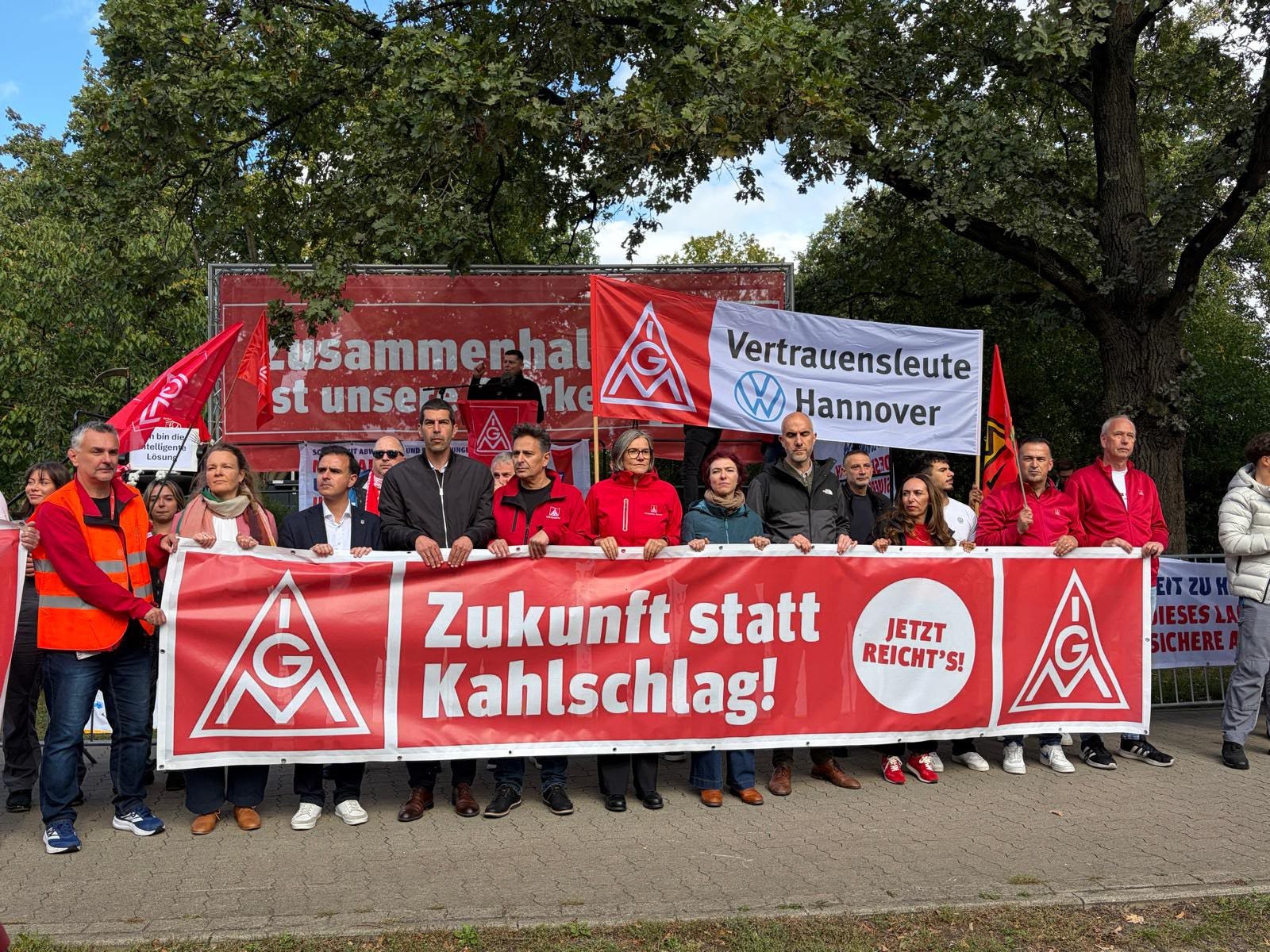
With Germany’s export capitalism in deep crisis, German capital has gone on the attack, seeking to destroy the eight-hour workday, lower wages, and push workers ever deeper into job insecurity. German trade unions like IG Metall have vowed to resist this.
Most expect a big showdown between labour and capital this coming fall and winter. This might well indicate a move from nationwide efforts to defend jobs, wages and working conditions in the automotive industry to an expansion of workers’ protests beyond it.
To prepare for this, IG Metall called a nationwide day of action in early September. Some 175,000 people protested at over 200 locations. IG Metall organised it in response to the attack on the employment of German car workers.
Things look grim. Tens of thousands of workers at car suppliers, engineering service providers and manufacturers have already lost their jobs. Yet corporate management is pushing for more, shifting the blame onto the victims of its own mismanagement: lagging behind in electric vehicle manufacturing and in other areas.
Blaming someone else is one of the golden rules of management—the rules of those with the gold. Meanwhile, tens of thousands of workers fear losing their jobs as entire regions of Germany are thrown into decline.
The plans of corporate management threaten Germany’s entire automotive industry. IG Metall forecasts that virtually all workers in all layers of Germany’s car industry, whether at manufacturers or suppliers, are exposed.
Unfortunately, “all workers in all areas” does not mean that IG Metall is calling for a political strike. As a leftover from Nazi Germany—some traditions do not die—German trade unions shy away from the political strike. In other words, Nazism did not suddenly end in 1945. Parts of its labour relations system were carried over into the new, democratic Germany.
Even if reporting in Germany’s corporate press sometimes suggests otherwise, the German car industry continues to rake in billions in profits. Manufacturers like Volkswagen, BMW and Mercedes-Benz still rank, in international comparison, alongside Toyota, Hyundai and Xiaomi in profits. Not only that, German carmakers also still hold a front seat on Germany’s stock exchange.
So why has there been so much whining in German boardrooms for months? In the wake of the shift from petrol to electric drivetrains, which affects central elements of Germany’s traditional car markets, and of a mismanaged technology, the competitive advantage of German manufacturers is waning.
Under the decades-old management motto of “better instead of cheaper,” Germany’s car managers justified many years of higher wages, technological advances and innovation.
However, highly subsidised Chinese competitors now produce the same cars more cheaply. This led to a significant drop in sales in China’s “volume market.” Now Chinese manufacturers such as BYD and MG are pushing into the European car market—to the detriment of the Germans.
As so often in a stagnating capitalism where the pie no longer expands, the game is zero-sum: when one side wins market share, the other loses it. This is the system everybody wants. Yet in capitalism there are not only winners; there are losers as well.
Electric car sales are expected to increase further, given Germany’s current petrol price of €2.32 ($2.65) per litre (22 September 2026) and the fact that in August alone Germany registered 68,930 battery-electric cars, up a whopping 75.1% and a record 32.4% share of all new cars. This will continue, particularly since the orange monster—in the not-demolished sections of the White House—keeps threatening Iran with total annihilation. German carmakers were ill-prepared for three recent developments:
That electric car sales would increase sharply.
That China would enter the European market with such ferocity.
That a madman would enter a “ never-ending war” with Iran.
As these factors continue to bite, the whining in Germany’s corporate boardrooms grows ever louder. To make matters worse, the geopolitical situation of Trump versus Europe and his tariffs has affected car sales. From 2019 to 2025 alone, car exports decreased, with the Volkswagen Group selling 19% less.
At present, many are starting to realise that three decades of “competitive export corporatism” are reaching their limits. Management’s hard-nosed, so-called “ industrial peace” formula—employment security in exchange for wage restraint or even concessions—backed significant productivity increases. This resulted not only in super-profits for German carmakers but also in the annihilation of almost all of Europe’s car industry in favour of German corporations.
Past years, if not decades, of secure employment came without a significant reduction in working time; the 35-hour week, introduced in 1984, is a distant memory. Stratospheric and, above all, continuously increasing productivity came at the expense of demand for human labour power. In other words, while in 1984 30,000 workers made a certain number of cars, today the same number of cars is made by between 5,500 and 7,500 workers. Automation has eliminated these workers over the past decades.
In short, rapid automation spiced up by super- productivity underpinned many years of a growing share of the world car market for German corporations. This also led to a “displacement” of competitors. The resulting excess capacities are now being adjusted—mostly downward and mostly on the backs of workers.
What is already commonplace at many car suppliers—investment in factories at the price of a downward adjustment of collective bargaining agreements—now also seems to be taking hold at Germany’s premium carmakers. “Downward adjustment” means that working conditions and wages are not changing for the better and that industry-wide collective agreements are undercut in order to secure the existence of production sites and corporate profits.
It was none other than Karl Marx who offered a raft of wonderfully illustrated examples of the point at which it makes more sense to invest elsewhere than to keep jobs and factories alive. This is capitalism pure—a system that, we are told daily, is the best way of distributing goods and services. Well, and a handsome profit for some, unemployment for others.
It appears that corporate management is prepared—during the current transformation of products and factories toward electric cars—to accept lower profits. Perhaps more money can be made elsewhere, as Marx pointed out over 150 years ago.
Much of this is justified with a well-rehearsed and frequently wheeled-out management ideology: restructuring. Meanwhile, the lower managerial class—the henchmen and apparatchiks down Fayol’s chain of command—are only too happy to work as the willing executioners of top management, with all the nastiness they can, well, “manage.”
Sennett and Cobb called the outcome “The Hidden Injuries of Class” (1972), Benson and Kirsch called it the “Capitalism of Resignation,” and Case and Deaton saw it as “Deaths of Despair and the Future of Capitalism.”
The commonly reissued management demand is that the Personaldecke, or the number of workers needed, become thinner and thinner. In other words, the costs of the transformation to electric vehicles and of regaining competitiveness will be offloaded—as usual—onto workers.
The single most relevant move in all this might well have been VW management’s recent unilateral termination of several collective agreements. It happened at exactly the company that prided itself on being “the” model of German industrial relations.
Unilaterally, management cancelled the December 2024 agreement that included protection against dismissals for “operational reasons” (one of management’s favourite excuses) until the end of 2030. It is now 2026: four more years to go. But when has management ever stuck to its word or a signed agreement? Perhaps not since Adam Smith wrote about a British pin factory in 1776.
Worse for VW’s management, the agreement secured production at “all locations” and extended the 35-hour week to workers employed prior to 2005.
Looking at the German car industry as a whole, we see a dramatic destruction of relatively well-paid and secure industrial jobs. This is what is taking place in Germany in 2026. In the first half of 2026 alone, an additional 42,300 jobs (6%) in Germany’s automotive industry were cut.
Today, just 700,000 workers are still employed in Germany’s once-mighty car industry—fewer than in 2005. Those who believe this is it and that it has bottomed out will unfortunately be bitterly disappointed. Germany’s corporate bosses are not done. In fact, capitalism is not done.
Almost daily, new information leaks from Volkswagen—randomly, of course. It concerns the next austerity package, the next site closures, and the looming job cuts. This public relations offensive—never forget “ Poison Ivy,” the Nazi-loving godfather of corporate PR—is deliberately fabricated by VW’s corporate management to overlay an internally circulating operational memo on the expected 9% profit increase to be gained from cuts to wages and working conditions.
To top this off, Mercedes boss Brudermüller is calling, only a few months before the start of collective bargaining, for Germany’s metal industry to return to the 40-hour week. He is a man who, as a graduate of Universität Karlsruhe and Berkeley, has most likely never worked a single month on a German assembly line.
Immediately, the state premier of Germany’s most reactionary state—Saxony’s Kretschmer—reiterated this demand on 27 August 2026. That conservative politicians, corporate bosses and Germany’s right-wing business press work hand in hand is not new.
Kretschmer’s cunning idea was to invite the trade unions to reconciliation talks to rescue the people of Zwickau, the site of the VW factory. Simultaneously, Germany’s south-western employers’ association, Arbeitgeberverband Südwestmetall, called on the government (21 August 2026) to abolish the eight-hour day.
One does not need to be a follower of conspiracy theories or fantasies to recognise that German workers are dealing with a never-before-seen, full-frontal attack on the achievements of Germany’s organised workers. Capital, conservative and reactionary politicians, and the business press are running some kind of “big ideas lottery” on who can outdo whom in social dumping.
This attack extends well beyond workers in German car factories. It now covers all areas of life in Germany: social assistance, job seekers, temporary and short-term workers in precarious employment, care workers and many more.
Given all this, the recent mass political actions at the beginning of September could be an important trigger for further protests against Germany’s federal government, corporate greed, and perhaps even capitalism.
This presupposes that the mass rallies that took place on 21 September are understood as more than an overall well-choreographed social protest. It means that further “special events” must follow within the framework of these rallies.
If many works councils in Germany’s car industry have the courage to step outside the standards of past protests and carry workers’ actions over into the realm of politics, this could be an important inspiration for protests beyond the September rallies.
Yet one should never forget what Vladimir Ilyich Ulyanov “ might” have once said
“If the Germans want to storm a train station, they buy a platform ticket first.” (Wenn die Deutschen einen Bahnhof stürmen wollen, kaufen sie sich zuerst eine Bahnsteigkarte).
