


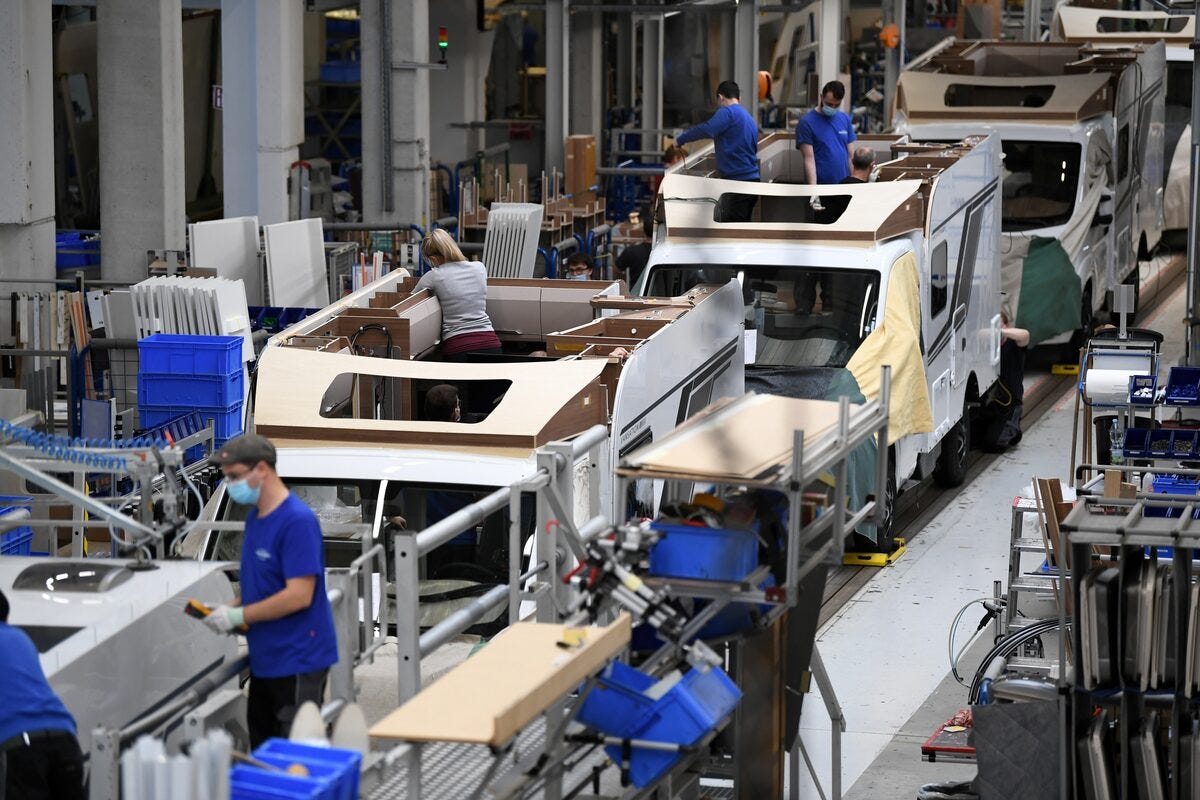
This October is a turning point for German unions in the car industry. The years of boom for cars seem to be over, and a new boom has been called, this time for Germany’s arms industry. It promises to enrich arms companies and, so the hope goes, to rescue Germany’s labour market too.
German corporations are converting backwards, from civilian production to the military. Yet arms have done Germany and the world so much “good”—twice: in 1914 and again in 1939.
Large German arms companies such as Rheinmetall, Krauss-Maffei Wegmann, Hensoldt, Diehl and Heckler & Koch will benefit, as will European manufacturers such as Airbus and the guided-weapons maker MBDA. They profit from Germany’s new super defence budget, which has washed big cash into the coffers of Germany’s growing “military-industrial complex” (MIC). Germany’s conservative government hopes to crank up industry in Europe’s largest economy.
Billions of—German—euros will also go to US military companies like Lockheed Martin and Boeing. However, industry experts point out that state money will not bring a sudden improvement in the equipment of Germany’s army, the Bundeswehr.
The construction of a new battle tank by Krauss-Maffei Wegmann (KMW, now part of KNDS), for example, will take two or three years. Heavy tanks of this kind have played little role in Ukraine’s defence against Russia. Undeterred, and spurred on by “tough-guy macho images” of German politicians posing in battle tanks, KMW and Rheinmetall can hope that another 230 “Puma” infantry fighting vehicles will be ordered.
Car maker Audi, meanwhile, is lending employees to the Bavarian arms companies Diehl, Airbus, MBDA and KNDS. The scheme is voluntary and rests on an April 2026 collective agreement with IG Metall. Staff in indirect areas at Ingolstadt—engineers, quality assurance engineers, project managers and employees in technical development workshops—can work at one of the four firms for up to 24 months. They remain employees of Audi AG throughout and have a right to return. In the face of a—frequently rehearsed—“growing international threat” (meaning: Russia), the German arms industry is booming, also in Bavaria.
Audi now wants to support Germany’s armament with personnel and to expand prospects for its own employees. Years of management literally “asleep at the wheel” ensure that the German auto industry is in crisis. Many arms companies, by contrast, can hardly cope with the flood of orders and the expected profits.
There was, as Audi said, great interest, and the scheme has already met with a strong response among the workforce—most likely pushed by the daily barrage of apocalyptic news about the impending loss of tens of thousands of jobs in Germany’s car industry. Audi has announced that it is “reducing” up to 7,500 jobs in Germany by 2029, mainly in administration and development, while its guarantee against compulsory layoffs now runs to the end of 2033.
At the same time, arms maker Rheinmetall has reached an agreement in principle with Alstom on taking over its locomotive plant in the regional city of Kassel, which employs some 750 to 900 people. Rheinmetall already operates a plant in the immediate vicinity, in the industrial “park” of Kassel’s Mittelfeld district (no real park there), and is looking for space and skilled personnel to expand its armoured-vehicle production. Contracts and conditions are still being negotiated with the works council and IG Metall.
The works council does not want to give up locomotive construction in Kassel without a fight, as its chair recently emphasised. The works council and IG Metall have announced protests against the takeover, and hundreds of Alstom employees have already demonstrated. Meanwhile, the works council and workers learnt from the newspapers that the management-to-management talks had progressed. Workers were surprised that the interested party was once again the MIC’s Rheinmetall. All the while, the works council had been (mis)led to believe that the talks with Rheinmetall had ended without result and that Alstom was now negotiating with a new interested party. Deliberately misinforming works councils is perhaps not an entirely new strategy of management.
Workers and the union agree that the car of the future is not a tank. Yet management’s restructuring includes layoffs and plant closures. “Restructuring” is yet another piece of jargon in the playbook of the language of managerialism.
Pushed by corporate management and Germany’s conservative Merz government, the European automotive industry is faltering and switching its production to armaments. Perhaps more profit can be made from making things that kill.
Workers are exposed to a daily barrage of corporate media news that can be summed up as “the European automotive industry is in a deep crisis.” There is almost never a clarification of what kind of crisis it is.
This is not primarily a resource crisis. Shareholders of all these corporations are literally swimming in money. Yet more profit can be made elsewhere. Corporate CEOs and their entourage of apparatchiks have been generously compensated in recent years. After COVID-19, most European car manufacturers recorded a significant increase in profits: in 2022, the six largest European carmakers posted record net profits of €67.8 billion.
The European automotive industry—and especially the German one—has been based on three pillars for decades:
many years of experience with internal combustion engines,
a focus on the premium segment, with large SUVs and models with high profit margins, and
the exceptional profitability of the Chinese market.
Today these patterns are reversing. German cars used to be synonymous with technology and quality; today they are criticised and sometimes even mocked. In test reports and the trade press, Germany’s car makers are ridiculed for a technological lag, especially in electric mobility, battery technology, on-board software and autonomous driving. Perhaps they have taken to heart the principle laid out by Alfred P. Sloan, the long-time boss of General Motors, in My Years with General Motors: “The primary object of the General Motors Corporation, therefore, is to make money, not just to make motor cars.”
For a long time, the Chinese market allowed Germany’s auto bosses to sell far beyond the needs of the domestic market and to make considerable profits in the process. This is now turning into its opposite. China is no longer the engine of profitability but the place where the technological lag created by German auto bosses is revealed—the proverbial emperor has no clothes. In the face of this self-made crisis, a growing part of the European (mostly German) automotive industry is entering two new dead ends:
It is slowing the transition to electric vehicles in order to extend the life of the internal combustion engine as long as possible.
It is militarising its production apparatus. Several manufacturers are looking for new “growth” (read: higher profit) areas in arms. The MIC is where corporate profits can be made.
Yet this is not merely a technological crisis, and it did not fall from the sky. It is the result of a capitalist logic in the age of mega-monopolies: a handful of car bosses choose to keep an outdated technology in order to secure their monopoly-created profits for as long as possible.
As always, managers operate with two strategies, the two Golden Rules of management (those who have the gold make the rules!). When things go right and others have done the work, take the credit. When things go badly—in particular when you are responsible for your own mismanagement—blame someone else: workers and trade unions, for example.
Now corporate bosses are making workers pay for the consequences of their managerial decisions. Against corporate mismanagement, a different logic should be enforced.
First, dividends and share buybacks from profitable years must be taken into account. If a company has distributed billions to shareholders, it cannot present the bill to workers afterwards. A special tax should be levied on the dividends and share buybacks that the major automotive companies have paid out in recent years. These funds must be channelled back into:
research and development,
the transition to electric and autonomous vehicles, and
employee training and job security.
It also means that not a single euro of state “subsidies”—the much-welcomed state cash, despite or perhaps because of free-market ideology—may flow to corporations that lay off workers, close plants or pay dividends to shareholders.
Second, a genuinely Europe-wide industrial plan for the electrification of transport is needed, drawn up jointly by the EU, trade unions and management. This means not just cars but, above all, electric public transport: buses, trams, metros and trains. It would also bring pollution-free inner cities.
Third, an affordable electric car should not cost what electric cars cost today: on average about €50,700 in Germany and €61,000 ($70,500) in the UK. The goal is electric vehicles that are smaller, simpler, repairable, material-saving and affordable, along with electric buses, e-bikes and electric motorcycles. Massive investment is also needed in what electrification requires: low-CO₂ power generation, power grids, charging stations, batteries, recycling, public transport and democratic mobility planning.
Without abundant, clean and affordable energy, electrification will remain unstable and unevenly distributed. Trump’s attack on Iran is one example: a war that has sent oil prices soaring. There is a very real risk that the transition away from fossil fuels will be reserved for those who can afford it. Workers would be excluded from the new car market or doomed to keep driving their ageing vehicles.
Finally, the crisis in the automotive industry must not be used to push Germany’s industry toward a war economy. The skills of automotive workers are of great value. They extend to metallurgy, electronics, software, batteries, assembly, logistics and maintenance.
These skills should serve to produce goods that benefit the European population, not to drive Europe into a logic of militarisation, the military-industrial complex, constant armament and military conflict. German arms have already done the world enough harm. Corporate Germany should know this much.
Apart from the former autoworkers who are thinking of themselves, the German people should recognize that retooling the automobile industry to become a weapons industry is a recipe for a war economy, which any honest American can attest is an excuse to transfer public wealth to private profit.
Unions have been neutered in the West, and they can’t be regarded as politically honest. The youth of Germany deserve a future with options, and a war economy will preempt all public needs. This is push by the German elites is as predictable as it is pathetic.