


At its annual party conference, on 4 October 2026, the Green Party of England and Wales passed a motion that equated Zionism with racism. By so doing, the Green Party became the first major political party in the West to be avowedly anti-Zionist. This is the motion:
Zionism is a political ideology which called for the creation—and, now it exists, the continuity—of an ethnonationalist Jewish State in historic Palestine to the exclusion and/or domination of the non-Jewish population. The real, material manifestation of Zionism has been the historic and ongoing dehumanisation, displacement, dispossession, disenfranchisement and destruction of Palestinians. This is based upon European settler-colonial systems of domination and oppression, which has also created racial hierarchies between Jews of different ethnicities in Palestine. The practice of Zionist ideology, promoting ethnonationalism, privileges one ethnic group on the basis of the subjugation of others. Zionism is Israel’s foundational ideology. Zionism has created and seeks to maintain—and where possible—expand, an apartheid regime between the Jordan River and the Mediterranean Sea, designed to cement the supremacy of one group, Jews, over another, Palestinians. As such, Zionism is racist.
This motion is aimed at the political ideology and practice of Zionism, as defined, and not at the religious or ethnic background of those who may identify as Zionists. Not all Jews are Zionists and not all Zionists are Jews. Rejecting Zionism and supporting the liberation of the Palestinian people is not discriminatory against Jewish people. Nor is it discriminatory to support the establishment of a single democratic Palestinian State between the Jordan river and the Mediterranean Sea with equal rights for all. Zionism is fundamentally incompatible with anti-racist principles, equality and justice (Green Party, motion A105, 2026).
The motion passed by 1022 votes in favour, with 813 against. This was an astonishing result given intense media hostility to it and despite 4 of its 5 MPs (Carla Denyer, Ellie Chowns, Sian Berry and Adrian Ramsay) and ex-leader and MP (Caroline Lucas) speaking against the motion (the fifth MP, Hannah Spencer, and the present leader, Zack Polanski, were not at the debate and have not clearly given support to the motion). The most critical was former leader Adrian Ramsay, who said the motion was an “unhelpful distraction” and “wrong in principle,” as “the Green Party has always supported the right to self-determination, and that has to apply to all peoples” (BBC News, 7 October).
In fact, prior to the conference, the Green MPs were warning that this was a “divisive” motion and that it would alienate a section of the Jewish population. These were bogus reasons: many motions at party conferences are divisive in that people have different views—but this is democracy. And Jewish Zionists becoming alienated by the motion clearly stating that Zionism is fundamentally a racist, supremacist ideology should not be an influencing factor.
But during the debate, the majority of members cast aside the concerns of most of their leaders and decisively voted for the motion. This was democracy at its best.
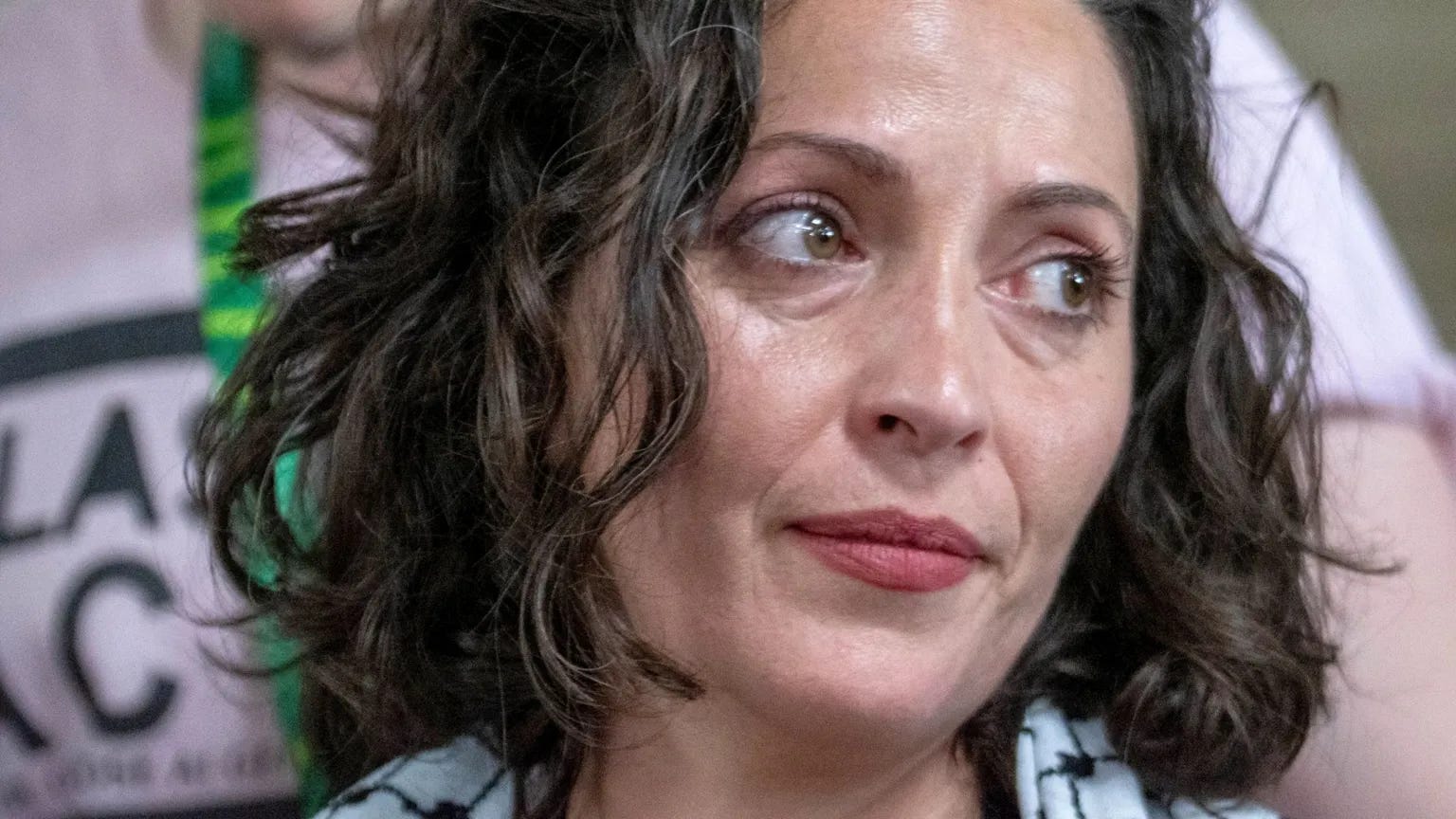
As expected, the passing of the motion has led to an onslaught by the mainstream media and political parties, with the main sponsor of the motion, British-Palestinian Lubna Speitan, being hounded (BBC News, 2026) and not receiving support from the Green Party leadership. This includes the European Green Party, which put a statement that the motion “goes against our agreed positions of the EGP and its Member Parties; therefore, as EGP, we unequivocally distance ourselves from it” (EGP, 2026). However, support did come from Douglas Ross, co-leader of the Scottish Greens, which is a separate party. Though he did not agree with all parts of the motion, he considered the creation of Israel to have been “an act of racism” and, ipso facto, considers Zionism as racism (BBC News, 6 October 2026).
Interviews have primarily been with Green MPs and with Jewish Zionists and their unfounded belief that this will make Jews unsafe in the Green Party, and if they attend a Zionist synagogue, subject to expulsion. This fear mongering is typical of Zionists and ignores the fact that many Jews support the motion, including Stephen Kapos, a Holocaust survivor, who spoke in favour of the motion.
On 3 October, the day before the motion was to be debated, The Guardian’s resident Zionist and leading columnist, Jonathan Freedland, in his weekly column, gave a supposedly “liberal” opposition to the motion. In true Freedland fashion, it was highly tendentious and completely ignored the contents of the motion. Its heading gave the game away: “Once again, Jews are being told how we should think,” and it began thus: “Tomorrow I will be in synagogue to say Kaddish, the traditional mourner’s prayer, in memory of my father, who died eight years ago this week. If I were a member of the Green Party, I would have reason to believe that that simple act could soon see me expelled as a racist” (Freedland, 2026). No, this simple act would not lead to expulsion, and the motion did not tell Jews how they should think, but many Jews did think carefully, such as Stephen Kapos, and backed the motion.
Also throwing her weight against the motion is the leader of Brighton & Hove City Council (BHCC), Labour’s Bella Sankey, who was “deeply concerned at the prospect of the Green Party returning to Brighton for future conferences.” She claimed the motion was “divisive, discriminatory and wrong” and was not compatible with Brighton & Hove’s commitments to be a welcoming and inclusive city (BBC News, 7 October 2026). This is a disgraceful threat, in violation of democracy and freedom of speech. The Green Party should sue her, and the Council should, should they follow through with this threat.
What this unequivocally shows is that Green Party MPs closely follow the western consensus on Israel and Zionism. They are doubtless well aware of the power of the Israel/Zionist lobby in the UK that has largely been responsible for this consensus and so do not want to come in its crosshairs. While comprehensible, it’s a thoroughly unprincipled, even cowardly position which helps explain their opposition to such a historic motion that simply and cogently points out a truth.
Be that as it may, nonetheless, the genie is now out of the bottle—critical discussions and debates on Zionism will no longer be silenced, and, hopefully, this will give courage to other political parties in western countries to adopt a similar motion.
The silence of Palestinian leaders, including Mahmoud Abbas and other Fatah leaders, has been the most disappointing, though not surprising at all. There were no interviews with British media outlets that vigorously defended the motion and refuted the numerous objections raised by Zionists and their allies. Unfortunately, this is one of the reasons the West minimises Palestinian rights. The other main Palestinian organisation, Hamas, is subject to the Israeli genocide in Gaza and is prohibited from airing its opinions in the UK. It is crucial to emphasise that the motion calls for “the establishment of a single democratic Palestinian State,” which stands in stark contrast to Fatah’s decades-old demands for a two-state solution.
There has also been silence from the Embassy of the State of Palestine to the United Kingdom – no mention of the motion on its website, let alone robustly defending it in the mainstream media. I will refrain from commenting on how an embassy exists for a non-existent state.
UN General Assembly motion 3379, 10 November 1975
The Green Party motion does have an important precedent: on 10th November 1975, the UN General Assembly passed motion 3379 (XXX) sponsored by the Arab League and some Muslim-majority countries: Elimination of all forms of racial discrimination: Zionism as racism (75 votes in favour, 35 votes against, 32 abstained). This is the final section of the motion:
Taking note also of the Political Declaration and Strategy to Strengthen International Peace and Security and to Intensify Solidarity and Mutual Assistance among Non-Aligned Countries, adopted at the Conference of Ministers for Foreign Affairs of Non-Aligned Countries held at Lima from 25 to 30 August 1975, which most severely condemned Zionism as a threat to world peace and security and called upon all countries to oppose this racist and imperialist ideology,
Determines that Zionism is a form of racism and racial discrimination (emphasis in original).
Under intense US (in reality, Israeli) pressure, this motion was revoked in December 1991. However, given that there is much evidence to indicate that Israel operates on an apartheid basis and has committed genocide against the Palestinians, a similar resolution could have been put forward to the UN General Assembly, which would surely have passed with a resounding majority. The failure to do so is primarily a reflection of the dire failings of Palestinian leaders, especially the leader of Fatah, Mahmoud Abbas. They should have pushed the Arab League to sponsor an updated version of motion 3379, and the fact that they have not and indeed avoid referring to Israeli apartheid is a manifestation of their collaborationist politics.
If such a motion had been passed by the UN General Assembly, then organisations, including political parties, would be able to refer to it, which, in turn, would greatly reduce the kind of invective and threats the Green Party is now receiving.