


Tucker Carlson, like any genius in the media world, has an uncanny knack for zeroing in on men and mice who have something “original” to contribute. His interview in late February with the US ambassador to Israel, Mike Huckabee, an ex-Baptist minister and Donald Trump loyalist in the Republican Party, was one such fascinating encounter.
Amongst other things, Ambassador Huckabee, who is often perceived as “Israel’s envoy to the US,” admitted candidly, nonchalantly, that thousands of Palestinian kids were indeed killed by the Israeli forces in the Gaza war—“So, what?”—and that it is a “fair” thing if Jews went about to carve out a Greater Israel by redrawing the boundaries of the Arabian Peninsula on the lines that the Old Testament apparently prophesied. Carlson’s interview raised a political storm.
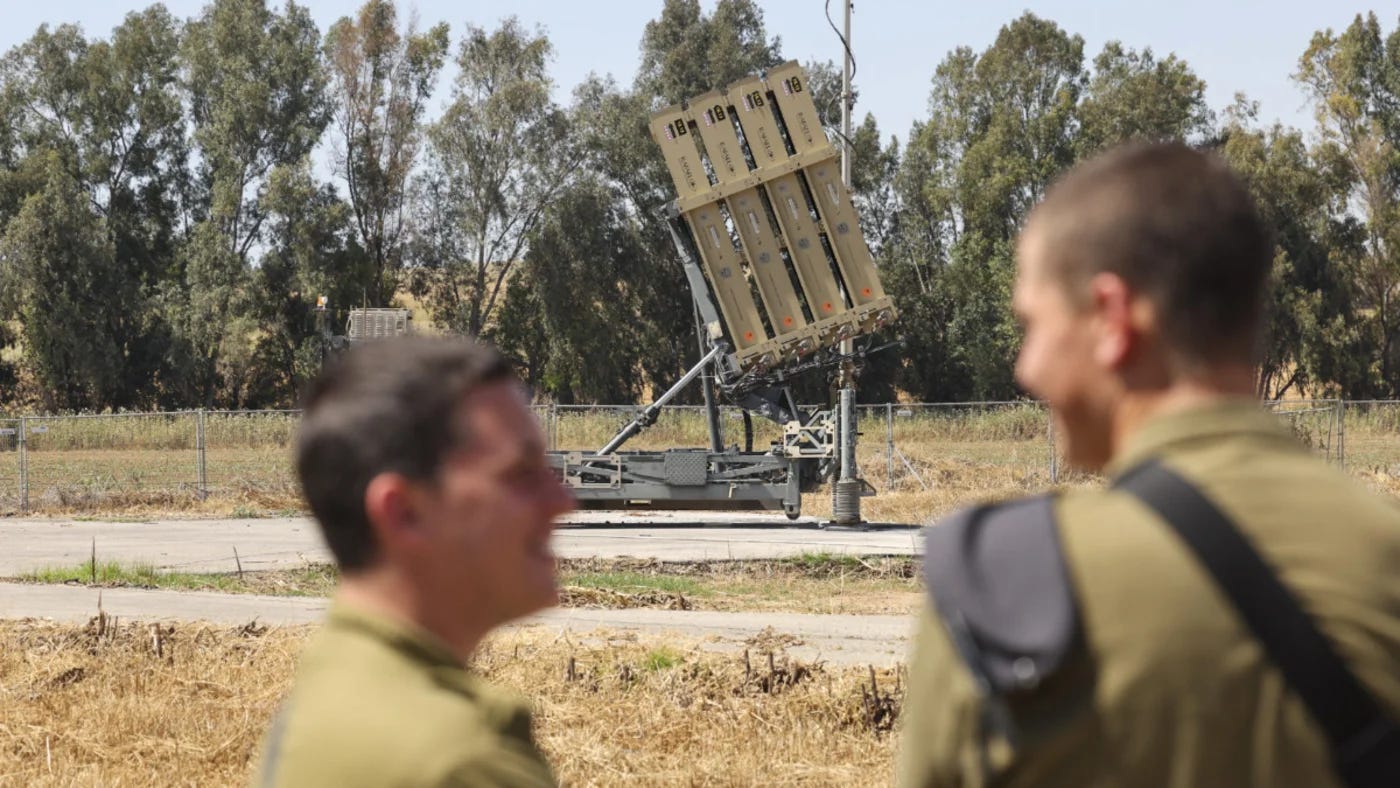
Therefore, when Huckabee disclosed on Monday that Israel secretly deployed Iron Dome missile-defence batteries and highly trained special forces to operate them in the United Arab Emirates in order to shield the Persian Gulf monarchy during the war against Iran, one could tell with fair certainty that it was what media people call a “developing story.” Indeed, it was.
On Wednesday, Prime Minister Benjamin Netanyahu’s office confirmed in a statement what the irrepressible Huckabee blurted out, adding that coinciding with the Israeli deployment, Netanyahu also made a secret visit to the UAE and met with President Sheikh Mohammed bin Zayed.
The Israeli statement claimed that Netanyahu’s trip “led to a historic breakthrough in relations between Israel and the United Arab Emirates.”
But Abu Dhabi is unused to such large dollops of “glasnost” and promptly ducked; the foreign ministry was simply sidetracked by claiming that the UAE’s relations with Israel are “not based on secrecy or covert arrangements.”
Meanwhile, the Wall Street Journal added more grist to the mill by reporting that the UAE secretly carried out multiple attacks on Iranian infrastructure and military sites throughout the war, including strikes on a refinery on Iran’s Lavan Island in early April, around the time that Trump was announcing a ceasefire and negotiations with Iran. The UAE attack was reportedly coordinated with Israel and came after a flurry of secret visits by Mossad Director David Barnea to the UAE.
To be sure, the UAE has not yet owned its attacks on Iran, let alone the secret visits by Barnea and Netanyahu. Abu Dhabi sticks to the line that it wouldn’t allow the US or Israel to use its airspace to attack Iran.
Iran insists, however, that the American jets that bombed an elementary school in Minab on the opening day of the war, killing more than 160 schoolchildren, took off from Al Dhafra Air Base in Abu Dhabi. Iran retaliated by striking Al Dhafra as well as the US infrastructure at Jebel Ali Port in Dubai.
The above string of developments brings the Persian Gulf War literally to the Arabian Sea, which washes the shores of the South Asian region.
A troika joined at the hips.
Suffice it to say, the vortex of the Persian Gulf War will henceforth be flanked by four “littoral states” with nuclear bombs: the US, Israel, India and Pakistan. The nuclear club gets bigger with the UK strengthening its military presence in the Gulf by deploying Typhoon fighter jets, autonomous mine-hunting drones, and the Type 45 air defence destroyer HMS Dragon, ostensibly designed to “secure” the Strait of Hormuz.
From Delhi’s perspective, what lends enchantment to the view is its partnership in the troika involving Israel and the UAE, which somewhat mitigates its regional isolation following the sudden death under the Trump presidency of “I2U2” (India, Israel, UAE, and the US), commonly referred to as the “West Asian Quad” or “Indo-Abrahamic alliance.”
Bereft of US participation, the I2U2 is in deep slumber, and the Israel-UAE-India troika are scrambling like headless chickens, but the latter have some staying power alright, joined at the hips with shared interests in fighting political Islam (”counterterrorism”), both internally and regionally, as a top priority in their respective national strategies. If the Palestine problem is the spectre that haunts Israel, it is the Muslim Brotherhood for the UAE and Hindu-Muslim animosity forSouth Asia.
Unlike Israel and the UAE, however, India has been a silent partner. But will it remain so if a regional conflagration gathers momentum? Fault lines are appearing for sure now that Israel and the UAE openly join hands in a common agenda to fuel the war and undermine any peace efforts to advance their dream project, namely, the destruction of Iran and its removal from the geopolitical chessboard.
“Gulf of Tears”
That said, this is an inflection point as the Israeli special forces arrive at the Strait of Hormuz. And there is also the regional backdrop of the Emirati / Israeli rift, with Riyadh deepening following the latter’s stubborn refusal to join the Abraham Accords.
Being the Custodian of the Holy Places, the Kingdom has existential concerns regarding the trajectory that Jewish supremacists are taking to ram down the throat of the Muslim Middle East their Zionist project at a juncture when Riyadh has disengaged from proxy wars and is sensitive to the anti-Israeli sentiments in the Arab street.
Riyadh senses that the UAE’s exit from OPEC aside, the recent attack on Port Sudan on 4 May by drones launched from an Emirati-Israeli base on the Red Sea with the aid of Emirati ships is a provocative move to force Saudi hands. Sudan has formally accused the UAE of providing arms and advanced weaponry and supplying drones to the Rapid Support Forces fighting the Sudanese army with Emirati-Israeli backing.
The Emirati attack came following the meeting at Jeddah on 20 April between Saudi Crown Prince Mohammed bin Salman and Sudan’s army chief, Abdel Fattah al-Burhan, where they “emphasised the importance of ensuring Sudan’s security and stability” as well as “preserving its sovereignty, unity and territorial integrity”—per Saudi readout —and also discussed the latest developments in Sudan.
What is at stake here is the strategic control of the Bab-el-Mandeb Strait (“Gate of Tears”) that connects the Red Sea on one side to the Gulf of Aden (and Arabian Sea) and on the other side would give Israeli submarines “freedom of navigation” to the Indian Ocean through waters straddling the Saudi coastline (approx. 1,760—2,600 km stretching from the Jordanian border to Yemen.)
Enter Pakistan. First of all, Indian strategists ought to put in proper perspective the first Pakistani military deployments in Saudi Arabia recently within the framework of the Saudi-Pakistani defence pact. Prudence demands that Delhi tread wearily, as variables are at work and we have no real reason to annoy the Kingdom, which hosts the single biggest concentration of NRIs in entire West Asia. Only fools rush in where angels fear to tread.
Overall, our era recalls Matthew Arnold’s famous poem “Dover Beach,” written in 1867 in an earlier era reflecting 19-century existential despair and the decline of religious faith:
Come to the window, sweet is the night-air!
Only, from the long line of spray
Where the sea meets the moon-blanched land,
Listen! you hear the grating roar
Of pebbles which the waves draw back, and fling,
At their return, up the high strand,
Begin, and cease, and then again begin,
With tremulous cadence slow, and bring
The eternal note of sadness in.
Frankly, was it really necessary in the middle of a fratricidal war for external affairs minister S. Jaishankar to travel to Abu Dhabi for a one-on-one with the sheikh on 12 April? Or for National Security Advisor Ajit Doval to follow up on 26 April? Or for PM Narendra Modi to follow through tomorrow? There are no easy answers.
